[English] 日本語
Yorodumi
- EMDB-65652: cryo-EM structure of PSII D1-S264V from Thermosynechococcus vesti... -

+
Open data


ID or keywords:

Loading...

-
Basic information

Entry
Database: EMDB / ID: EMD-65652
Titlecryo-EM structure of PSII D1-S264V from Thermosynechococcus vestitus BP-1
Map data
Sample
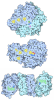
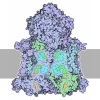
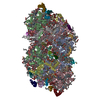
  • Complex: cryo-EM structure of PSII PsbA3-S264V from Thermosynechococcus vestitus BP-1
    • Protein or peptide: x 19 types
  • Ligand: x 19 types
KeywordsPSII mutation / PHOTOSYNTHESIS
Function / homology
Function and homology information


oxidoreductase activity, acting on diphenols and related substances as donors, oxygen as acceptor / photosystem II oxygen evolving complex / photosystem II assembly / response to herbicide / oxygen evolving activity / photosystem II stabilization / photosystem II reaction center / photosystem II / photosynthetic electron transport chain / photosystem II ...oxidoreductase activity, acting on diphenols and related substances as donors, oxygen as acceptor / photosystem II oxygen evolving complex / photosystem II assembly / response to herbicide / oxygen evolving activity / photosystem II stabilization / photosystem II reaction center / photosystem II / photosynthetic electron transport chain / photosystem II / extrinsic component of membrane / photosynthetic electron transport in photosystem II / chlorophyll binding / plasma membrane-derived thylakoid membrane / photosynthesis, light reaction / phosphate ion binding / photosynthesis / respiratory electron transport chain / electron transfer activity / protein stabilization / iron ion binding / heme binding
Similarity search - Function
Photosystem II PsbU, oxygen evolving complex / Photosystem II 12 kDa extrinsic protein (PsbU) / Photosystem II PsbV, cytochrome c-550 precursor / Photosystem II cytochrome c-550 precursor / Cytochrome c-550 domain / Cytochrome c-550 domain / Photosystem II PsbX, type 1 subfamily / Photosystem II PsbJ / Photosystem II PsbJ superfamily / PsbJ ...Photosystem II PsbU, oxygen evolving complex / Photosystem II 12 kDa extrinsic protein (PsbU) / Photosystem II PsbV, cytochrome c-550 precursor / Photosystem II cytochrome c-550 precursor / Cytochrome c-550 domain / Cytochrome c-550 domain / Photosystem II PsbX, type 1 subfamily / Photosystem II PsbJ / Photosystem II PsbJ superfamily / PsbJ / Photosystem II PsbO, manganese-stabilising / Manganese-stabilising protein / photosystem II polypeptide / Photosystem II reaction centre protein Ycf12 / Photosystem II complex subunit Ycf12 / Photosystem II reaction centre M protein (PsbM) / Photosystem II PsbM superfamily / Photosystem II PsbM / Photosystem II PsbZ, reaction centre / Photosystem II PsbZ superfamily / YCF9 / Photosystem II PsbX / Photosystem II reaction centre X protein (PsbX) / Photosystem II PsbT / Photosystem II PsbL / Photosystem II CP43 reaction centre protein / Photosystem II PsbL superfamily / Photosystem II PsbT superfamily / Photosystem II CP43 reaction centre protein superfamily / Photosystem II reaction centre T protein / PsbL protein / Photosystem II PsbK / Photosystem II PsbK superfamily / Photosystem II 4 kDa reaction centre component / Photosystem II PsbI / Photosystem II CP47 reaction centre protein / Photosystem II PsbI superfamily / Photosystem II reaction centre I protein (PSII 4.8 kDa protein) / Photosystem II reaction centre protein H / Photosystem II protein D1 / Photosystem II reaction centre protein H superfamily / Photosystem II 10 kDa phosphoprotein / Photosystem II D2 protein / Photosystem II cytochrome b559, conserved site / Photosystem II cytochrome b559, alpha subunit / Photosystem II cytochrome b559, beta subunit / Photosystem II cytochrome b559, N-terminal / Photosystem II cytochrome b559, alpha subunit, lumenal region / Photosystem II cytochrome b559, alpha subunit superfamily / Cytochrome b559, alpha (gene psbE) and beta (gene psbF)subunits / Lumenal portion of Cytochrome b559, alpha (gene psbE) subunit / Cytochrome b559 subunits heme-binding site signature. / : / Photosystem antenna protein-like / Photosystem antenna protein-like superfamily / Photosystem II protein / Outer membrane protein/outer membrane enzyme PagP, beta-barrel / : / Photosynthetic reaction centre, L/M / Photosystem II protein D1/D2 superfamily / Photosynthetic reaction centre protein / Photosynthetic reaction center proteins signature. / Cytochrome c family profile. / Cytochrome c-like domain / Cytochrome c-like domain superfamily
Similarity search - Domain/homology
Photosystem II extrinsic protein V / Photosystem II extrinsic protein O / Photosystem II reaction center protein J / Photosystem II D2 protein / Photosystem II reaction center protein M / Photosystem II reaction center protein Z / Photosystem II CP43 reaction center protein / Photosystem II reaction center protein L / Cytochrome b559 subunit beta / Cytochrome b559 subunit alpha ...Photosystem II extrinsic protein V / Photosystem II extrinsic protein O / Photosystem II reaction center protein J / Photosystem II D2 protein / Photosystem II reaction center protein M / Photosystem II reaction center protein Z / Photosystem II CP43 reaction center protein / Photosystem II reaction center protein L / Cytochrome b559 subunit beta / Cytochrome b559 subunit alpha / Photosystem II reaction center protein T / Photosystem II CP47 reaction center protein / Photosystem II protein D1 3 / Photosystem II reaction center protein H / Photosystem II reaction center protein Psb30 / Photosystem II reaction center protein I / Photosystem II reaction center protein K / Photosystem II extrinsic protein U / Photosystem II reaction center protein X
Similarity search - Component
Biological speciesThermosynechococcus vestitus BP-1 (bacteria)
Methodsingle particle reconstruction / cryo EM / Resolution: 1.96 Å
AuthorsFan SB / Jiang HW / Kato K / Tsai P-C / Jia AQ / Nakajima Y / Sugiura M / Shen J-R
Funding support1 items
OrganizationGrant numberCountry
Not funded
CitationJournal: Biochim Biophys Acta Bioenerg / Year: 2026
Title: Structural and functional analysis of a photosystem II mutant PsbA3-S264V.
Authors: Songbo Fan / Yoshiki Nakajima / Koji Kato / Haowei Jiang / Pi-Cheng Tsai / Anqi Jia / Miwa Sugiura / Jian-Ren Shen /
Abstract: Photosystem II (PSII) catalyzes water oxidation and oxygen evolution by a light-induced electron transfer chain, leading to the generation of electrons, protons and dioxygen. D1-S264 is a residue ...Photosystem II (PSII) catalyzes water oxidation and oxygen evolution by a light-induced electron transfer chain, leading to the generation of electrons, protons and dioxygen. D1-S264 is a residue located close to the Q-binding site, and mutation of this residue has been shown to bring significant effects on the electron transfer and oxygen-evolving activities. Here we analyzed the structure of a Thermosynechococcus elongatus mutant PsbA3-S264V by cryo-electron microscopy at 1.96 Å resolution, which showed significant changes in the structure surrounding the bicarbonate and Q-binding region. Due to change of Ser to Val, the hydrogen-bond between the Q carbonyl oxygen and S264 is altered, which changed the protonation pathway of Q from the original route of D1-H252 through D1-S264 to Q, to a new, longer and less efficient route of D1-H252 through D1-F265 to Q. Two residues, D1-E244 and D2-E242, changed their side chain orientations significantly. Among them, D2-E242 adopted two conformations, and both are largely deviated from the original structure. All these changes led to alterations in hydrogen-bonding networks of two channels, channel A and channel B, that connect the stromal surface to Q and may function to transport protons to protonate Q. Furthermore, isothermal titration calorimetry experiments showed a diminished 3-(3,4-dichlorophenyl)-1, 1-dimethylurea (DCMU) binding affinity of the mutated PSII, which may be explained by a structural rotation of D1-F255 in the mutant based on structural analysis of DCMU-bound PSII. These findings offer valuable insights into the functions of D1-S264 in Q protonation and function, as well as in the DCMU-binding.
History
DepositionAug 1, 2025-
Header (metadata) releaseSep 23, 2026-
Map releaseSep 23, 2026-
UpdateSep 23, 2026-
Current statusSep 23, 2026Processing site: PDBj / Status: Released

-
Structure visualization

Supplemental images

Downloads & links

-
Map

FileDownload / File: emd_65652.map.gz / Format: CCP4 / Size: 512 MB / Type: IMAGE STORED AS FLOATING POINT NUMBER (4 BYTES)
Projections & slices

Image control

Size
Brightness
Contrast
Others
AxesZ (Sec.)Y (Row.)X (Col.)
0.57 Å/pix.
x 512 pix.
= 290.56 Å
0.57 Å/pix.
x 512 pix.
= 290.56 Å
0.57 Å/pix.
x 512 pix.
= 290.56 Å

Surface

Projections

Slices (1/3)

Slices (1/2)

Slices (2/3)

Images are generated by Spider.

Voxel sizeX=Y=Z: 0.5675 Å
Density
Contour LevelBy AUTHOR: 0.003
Minimum - Maximum-0.004854154 - 0.017946314
Average (Standard dev.)0.000032341643 (±0.0006158732)
SymmetrySpace group: 1
Details

EMDB XML:

Map geometry
Axis orderXYZ
Origin000
Dimensions512512512
Spacing512512512
CellA=B=C: 290.56 Å
α=β=γ: 90.0 °

-
Supplemental data

-
Half map: #2

Fileemd_65652_half_map_1.map
Projections & Slices
AxesZYX

Projections

Slices (1/2)
Density Histograms

-
Half map: #1

Fileemd_65652_half_map_2.map
Projections & Slices
AxesZYX

Projections

Slices (1/2)
Density Histograms

-
Sample components

+
Entire : cryo-EM structure of PSII PsbA3-S264V from Thermosynechococcus ve...

EntireName: cryo-EM structure of PSII PsbA3-S264V from Thermosynechococcus vestitus BP-1
Components
  • Complex: cryo-EM structure of PSII PsbA3-S264V from Thermosynechococcus vestitus BP-1
    • Protein or peptide: Photosystem II protein D1 3
    • Protein or peptide: Photosystem II CP47 reaction center protein
    • Protein or peptide: Photosystem II CP43 reaction center protein
    • Protein or peptide: Photosystem II D2 protein
    • Protein or peptide: Cytochrome b559 subunit alpha
    • Protein or peptide: Cytochrome b559 subunit beta
    • Protein or peptide: Photosystem II reaction center protein H
    • Protein or peptide: Photosystem II reaction center protein I
    • Protein or peptide: Photosystem II reaction center protein J
    • Protein or peptide: Photosystem II reaction center protein K
    • Protein or peptide: Photosystem II reaction center protein L
    • Protein or peptide: Photosystem II reaction center protein M
    • Protein or peptide: Photosystem II extrinsic protein O
    • Protein or peptide: Photosystem II reaction center protein T
    • Protein or peptide: Photosystem II extrinsic protein U
    • Protein or peptide: Photosystem II extrinsic protein V
    • Protein or peptide: Photosystem II reaction center protein X
    • Protein or peptide: Photosystem II reaction center protein Psb30
    • Protein or peptide: Photosystem II reaction center protein Z
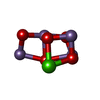
  • Ligand: CA-MN4-O5 CLUSTER
  • Ligand: FE (II) ION
  • Ligand: CHLORIDE ION
  • Ligand: CHLOROPHYLL A
  • Ligand: BETA-CAROTENE
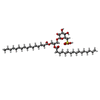
  • Ligand: 1,2-DI-O-ACYL-3-O-[6-DEOXY-6-SULFO-ALPHA-D-GLUCOPYRANOSYL]-SN-GLYCEROL
  • Ligand: 2,3-DIMETHYL-5-(3,7,11,15,19,23,27,31,35-NONAMETHYL-2,6,10,14,18,22,26,30,34-HEXATRIACONTANONAENYL-2,5-CYCLOHEXADIENE-1,4-DIONE-2,3-DIMETHYL-5-SOLANESYL-1,4-BENZOQUINONE
  • Ligand: UNKNOWN LIGAND
  • Ligand: BICARBONATE ION
  • Ligand: 1,2-DIPALMITOYL-PHOSPHATIDYL-GLYCEROLE
  • Ligand: 1,2-DISTEAROYL-MONOGALACTOSYL-DIGLYCERIDE
  • Ligand: DODECYL-BETA-D-MALTOSIDE
  • Ligand: DIGALACTOSYL DIACYL GLYCEROL (DGDG)
  • Ligand: PHEOPHYTIN A
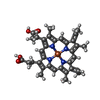
  • Ligand: PROTOPORPHYRIN IX CONTAINING FE
  • Ligand: CALCIUM ION
  • Ligand: HEME C
  • Ligand: (3R)-beta,beta-caroten-3-ol
  • Ligand: water

+
Supramolecule #1: cryo-EM structure of PSII PsbA3-S264V from Thermosynechococcus ve...

SupramoleculeName: cryo-EM structure of PSII PsbA3-S264V from Thermosynechococcus vestitus BP-1
type: complex / ID: 1 / Parent: 0 / Macromolecule list: #1-#19
Source (natural)Organism: Thermosynechococcus vestitus BP-1 (bacteria)

+
Macromolecule #1: Photosystem II protein D1 3

MacromoleculeName: Photosystem II protein D1 3 / type: protein_or_peptide / ID: 1 / Number of copies: 2 / Enantiomer: LEVO / EC number: photosystem II
Source (natural)Organism: Thermosynechococcus vestitus BP-1 (bacteria)
Molecular weightTheoretical: 39.792391 KDa
SequenceString: MTTVLQRREQ LNLWEQFCSW VTSTNNRLYV GWFGVLMIPT LLAATICFVI AFIAAPPVDI DGIREPVSGS LLYGNNIITG AVVPSSNAI GLHFYPIWEA ASLDEWLYNG GPYQLIIFHF LIGVFCYMGR EWELSYRLGM RPWICVAYSA PVAAATAVFL I YPIGQGSF ...String:
MTTVLQRREQ LNLWEQFCSW VTSTNNRLYV GWFGVLMIPT LLAATICFVI AFIAAPPVDI DGIREPVSGS LLYGNNIITG AVVPSSNAI GLHFYPIWEA ASLDEWLYNG GPYQLIIFHF LIGVFCYMGR EWELSYRLGM RPWICVAYSA PVAAATAVFL I YPIGQGSF SDGMPLGISG TFNFMLVFQA EHNILMHPFH QLGVAGVFGG ALFSAMHGSL VTSSLIRETT ETESANYGYK FG QEEETYN IVAAHGYFGR LIFQYAVFNN SRALHFFLAA WPVIGIWFTA LGISTMAFNL NGFNFNHSVV DAQGNVINTW ADI INRANL GMEVMHERNA HNFPLDLASA ESAPVAMIAP SING

UniProtKB: Photosystem II protein D1 3

+
Macromolecule #2: Photosystem II CP47 reaction center protein

MacromoleculeName: Photosystem II CP47 reaction center protein / type: protein_or_peptide / ID: 2 / Number of copies: 2 / Enantiomer: LEVO
Source (natural)Organism: Thermosynechococcus vestitus BP-1 (bacteria)
Molecular weightTheoretical: 56.656457 KDa
SequenceString: MGLPWYRVHT VLINDPGRLI AAHLMHTALV AGWAGSMALY ELATFDPSDP VLNPMWRQGM FVLPFMARLG VTGSWSGWSI TGETGIDPG FWSFEGVALA HIVLSGLLFL AACWHWVYWD LELFRDPRTG EPALDLPKMF GIHLFLAGLL CFGFGAFHLT G LFGPGMWV ...String:
MGLPWYRVHT VLINDPGRLI AAHLMHTALV AGWAGSMALY ELATFDPSDP VLNPMWRQGM FVLPFMARLG VTGSWSGWSI TGETGIDPG FWSFEGVALA HIVLSGLLFL AACWHWVYWD LELFRDPRTG EPALDLPKMF GIHLFLAGLL CFGFGAFHLT G LFGPGMWV SDPYGLTGSV QPVAPEWGPD GFNPYNPGGV VAHHIAAGIV GIIAGLFHIL VRPPQRLYKA LRMGNIETVL SS SIAAVFF AAFVVAGTMW YGSATTPIEL FGPTRYQWDS SYFQQEINRR VQASLASGAT LEEAWSAIPE KLAFYDYIGN NPA KGGLFR TGPMNKGDGI AQAWKGHAVF RNKEGEELFV RRMPAFFESF PVILTDKNGV VKADIPFRRA ESKYSFEQQG VTVS FYGGE LNGQTFTDPP TVKSYARKAI FGEIFEFDTE TLNSDGIFRT SPRGWFTFAH AVFALLFFFG HIWHGARTLF RDVFS GIDP ELSPEQVEWG FYQKVGDVTT RRKEAV

UniProtKB: Photosystem II CP47 reaction center protein

+
Macromolecule #3: Photosystem II CP43 reaction center protein

MacromoleculeName: Photosystem II CP43 reaction center protein / type: protein_or_peptide / ID: 3 / Number of copies: 2 / Enantiomer: LEVO
Source (natural)Organism: Thermosynechococcus vestitus BP-1 (bacteria)
Molecular weightTheoretical: 50.2875 KDa
SequenceString: MVTLSSNSIF ATNRDQESSG FAWWAGNARL INLSGKLLGA HVAHAGLIVF WAGAMTLFEL AHFIPEKPMY EQGLILIPHI ATLGWGVGP GGEVVDTFPF FVVGVVHLIS SAVLGFGGVY HAIRGPETLE EYSSFFGYDW KDKNKMTTIL GFHLIVLGIG A LLLVAKAM ...String:
MVTLSSNSIF ATNRDQESSG FAWWAGNARL INLSGKLLGA HVAHAGLIVF WAGAMTLFEL AHFIPEKPMY EQGLILIPHI ATLGWGVGP GGEVVDTFPF FVVGVVHLIS SAVLGFGGVY HAIRGPETLE EYSSFFGYDW KDKNKMTTIL GFHLIVLGIG A LLLVAKAM FFGGLYDTWA PGGGDVRVIT NPTLDPRVIF GYLLKSPFGG EGWIVSVNNL EDVVGGHIWI GLICIAGGIW HI LTTPFGW ARRAFIWSGE AYLSYSLGAL SMMGFIATCF VWFNNTVYPS EFYGPTGPEA SQAQAMTFLI RDQKLGANVG SAQ GPTGLG KYLMRSPTGE IIFGGETMRF WDFRGPWLEP LRGPNGLDLN KIKNDIQPWQ ERRAAEYMTH APLGSLNSVG GVAT EINSV NFVSPRSWLA TSHFVLAFFF LVGHLWHAGR ARAAAAGFEK GIDRESEPVL SMPSLD

UniProtKB: Photosystem II CP43 reaction center protein

+
Macromolecule #4: Photosystem II D2 protein

MacromoleculeName: Photosystem II D2 protein / type: protein_or_peptide / ID: 4 / Number of copies: 2 / Enantiomer: LEVO / EC number: photosystem II
Source (natural)Organism: Thermosynechococcus vestitus BP-1 (bacteria)
Molecular weightTheoretical: 39.388156 KDa
SequenceString: MTIAIGRAPA ERGWFDILDD WLKRDRFVFV GWSGILLFPC AYLALGGWLT GTTFVTSWYT HGLASSYLEG CNFLTVAVST PANSMGHSL LLLWGPEAQG DFTRWCQLGG LWTFIALHGA FGLIGFMLRQ FEIARLVGVR PYNAIAFSAP IAVFVSVFLI Y PLGQSSWF ...String:
MTIAIGRAPA ERGWFDILDD WLKRDRFVFV GWSGILLFPC AYLALGGWLT GTTFVTSWYT HGLASSYLEG CNFLTVAVST PANSMGHSL LLLWGPEAQG DFTRWCQLGG LWTFIALHGA FGLIGFMLRQ FEIARLVGVR PYNAIAFSAP IAVFVSVFLI Y PLGQSSWF FAPSFGVAAI FRFLLFFQGF HNWTLNPFHM MGVAGVLGGA LLCAIHGATV ENTLFQDGEG ASTFRAFNPT QA EETYSMV TANRFWSQIF GIAFSNKRWL HFFMLFVPVT GLWMSAIGVV GLALNLRSYD FISQEIRAAE DPEFETFYTK NLL LNEGIR AWMAPQDQPH ENFVFPEEVL PRGNAL

UniProtKB: Photosystem II D2 protein

+
Macromolecule #5: Cytochrome b559 subunit alpha

MacromoleculeName: Cytochrome b559 subunit alpha / type: protein_or_peptide / ID: 5 / Number of copies: 2 / Enantiomer: LEVO
Source (natural)Organism: Thermosynechococcus vestitus BP-1 (bacteria)
Molecular weightTheoretical: 9.58084 KDa
SequenceString:
MAGTTGERPF SDIITSVRYW VIHSITIPAL FIAGWLFVST GLAYDVFGTP RPDSYYAQEQ RSIPLVTDRF EAKQQVETFL EQLK

UniProtKB: Cytochrome b559 subunit alpha

+
Macromolecule #6: Cytochrome b559 subunit beta

MacromoleculeName: Cytochrome b559 subunit beta / type: protein_or_peptide / ID: 6 / Number of copies: 2 / Enantiomer: LEVO
Source (natural)Organism: Thermosynechococcus vestitus BP-1 (bacteria)
Molecular weightTheoretical: 5.0679 KDa
SequenceString:
MTSNTPNQEP VSYPIFTVRW VAVHTLAVPT IFFLGAIAAM QFIQR

UniProtKB: Cytochrome b559 subunit beta

+
Macromolecule #7: Photosystem II reaction center protein H

MacromoleculeName: Photosystem II reaction center protein H / type: protein_or_peptide / ID: 7 / Number of copies: 2 / Enantiomer: LEVO
Source (natural)Organism: Thermosynechococcus vestitus BP-1 (bacteria)
Molecular weightTheoretical: 7.358754 KDa
SequenceString:
MARRTWLGDI LRPLNSEYGK VAPGWGTTPL MAVFMGLFLV FLLIILEIYN STLILDGVNV SWKALG

UniProtKB: Photosystem II reaction center protein H

+
Macromolecule #8: Photosystem II reaction center protein I

MacromoleculeName: Photosystem II reaction center protein I / type: protein_or_peptide / ID: 8 / Number of copies: 2 / Enantiomer: LEVO
Source (natural)Organism: Thermosynechococcus vestitus BP-1 (bacteria)
Molecular weightTheoretical: 4.410245 KDa
SequenceString:
METLKITVYI VVTFFVLLFV FGFLSGDPAR NPKRKDLE

UniProtKB: Photosystem II reaction center protein I

+
Macromolecule #9: Photosystem II reaction center protein J

MacromoleculeName: Photosystem II reaction center protein J / type: protein_or_peptide / ID: 9 / Number of copies: 2 / Enantiomer: LEVO
Source (natural)Organism: Thermosynechococcus vestitus BP-1 (bacteria)
Molecular weightTheoretical: 4.105908 KDa
SequenceString:
MMSEGGRIPL WIVATVAGMG VIVIVGLFFY GAYAGLGSSL

UniProtKB: Photosystem II reaction center protein J

+
Macromolecule #10: Photosystem II reaction center protein K

MacromoleculeName: Photosystem II reaction center protein K / type: protein_or_peptide / ID: 10 / Number of copies: 2 / Enantiomer: LEVO
Source (natural)Organism: Thermosynechococcus vestitus BP-1 (bacteria)
Molecular weightTheoretical: 5.028083 KDa
SequenceString:
MIDALVLVAK LPEAYAIFDP LVDVLPVIPV LFLALAFVWQ AAVGFR

UniProtKB: Photosystem II reaction center protein K

+
Macromolecule #11: Photosystem II reaction center protein L

MacromoleculeName: Photosystem II reaction center protein L / type: protein_or_peptide / ID: 11 / Number of copies: 2 / Enantiomer: LEVO
Source (natural)Organism: Thermosynechococcus vestitus BP-1 (bacteria)
Molecular weightTheoretical: 4.299044 KDa
SequenceString:
MEPNPNRQPV ELNRTSLYLG LLLILVLALL FSSYFFN

UniProtKB: Photosystem II reaction center protein L

+
Macromolecule #12: Photosystem II reaction center protein M

MacromoleculeName: Photosystem II reaction center protein M / type: protein_or_peptide / ID: 12 / Number of copies: 2 / Enantiomer: LEVO
Source (natural)Organism: Thermosynechococcus vestitus BP-1 (bacteria)
Molecular weightTheoretical: 3.981673 KDa
SequenceString:
MEVNQLGLIA TALFVLVPSV FLIILYVQTE SQQKSS

UniProtKB: Photosystem II reaction center protein M

+
Macromolecule #13: Photosystem II extrinsic protein O

MacromoleculeName: Photosystem II extrinsic protein O / type: protein_or_peptide / ID: 13 / Number of copies: 2 / Enantiomer: LEVO
Source (natural)Organism: Thermosynechococcus vestitus BP-1 (bacteria)
Molecular weightTheoretical: 29.637443 KDa
SequenceString: MKYRILMATL LAVCLGIFSL SAPAFAAKQT LTYDDIVGTG LANKCPTLDD TARGAYPIDS SQTYRIARLC LQPTTFLVKE EPKNKRQEA EFVPTKLVTR ETTSLDQIQG ELKVNSDGSL TFVEEDGIDF QPVTVQMAGG ERIPLLFTVK NLVASTQPNV T SITTSTDF ...String:
MKYRILMATL LAVCLGIFSL SAPAFAAKQT LTYDDIVGTG LANKCPTLDD TARGAYPIDS SQTYRIARLC LQPTTFLVKE EPKNKRQEA EFVPTKLVTR ETTSLDQIQG ELKVNSDGSL TFVEEDGIDF QPVTVQMAGG ERIPLLFTVK NLVASTQPNV T SITTSTDF KGEFNVPSYR TANFLDPKGR GLASGYDSAI ALPQAKEEEL ARANVKRFSL TKGQISLNVA KVDGRTGEIA GT FESEQLS DDDMGAHEPH EVKIQGVFYA SIEPA

UniProtKB: Photosystem II extrinsic protein O

+
Macromolecule #14: Photosystem II reaction center protein T

MacromoleculeName: Photosystem II reaction center protein T / type: protein_or_peptide / ID: 14 / Number of copies: 2 / Enantiomer: LEVO
Source (natural)Organism: Thermosynechococcus vestitus BP-1 (bacteria)
Molecular weightTheoretical: 3.878728 KDa
SequenceString:
METITYVFIF ACIIALFFFA IFFREPPRIT KK

UniProtKB: Photosystem II reaction center protein T

+
Macromolecule #15: Photosystem II extrinsic protein U

MacromoleculeName: Photosystem II extrinsic protein U / type: protein_or_peptide / ID: 15 / Number of copies: 2 / Enantiomer: LEVO
Source (natural)Organism: Thermosynechococcus vestitus BP-1 (bacteria)
Molecular weightTheoretical: 15.030986 KDa
SequenceString:
MQRLGRWLAL AYFVGVSLLG WINWSAPTLA ATASTEEELV NVVDEKLGTA YGEKIDLNNT NIAAFIQYRG LYPTLAKLIV KNAPYESVE DVLNIPGLTE RQKQILRENL EHFTVTEVET ALVEGGDRYN NGLYK

UniProtKB: Photosystem II extrinsic protein U

+
Macromolecule #16: Photosystem II extrinsic protein V

MacromoleculeName: Photosystem II extrinsic protein V / type: protein_or_peptide / ID: 16 / Number of copies: 2 / Enantiomer: LEVO
Source (natural)Organism: Thermosynechococcus vestitus BP-1 (bacteria)
Molecular weightTheoretical: 18.046943 KDa
SequenceString:
MLKKCVWLAV ALCLCLWQFT MGTALAAELT PEVLTVPLNS EGKTITLTEK QYLEGKRLFQ YACASCHVGG ITKTNPSLDL RTETLALAT PPRDNIEGLV DYMKNPTTYD GEQEIAEVHP SLRSADIFPK MRNLTEKDLV AIAGHILVEP KILGDKWGGG K VYY

UniProtKB: Photosystem II extrinsic protein V

+
Macromolecule #17: Photosystem II reaction center protein X

MacromoleculeName: Photosystem II reaction center protein X / type: protein_or_peptide / ID: 17 / Number of copies: 2 / Enantiomer: LEVO
Source (natural)Organism: Thermosynechococcus vestitus BP-1 (bacteria)
Molecular weightTheoretical: 4.322226 KDa
SequenceString:
MTITPSLKGF FIGLLSGAVV LGLTFAVLIA ISQIDKVQRS L

UniProtKB: Photosystem II reaction center protein X

+
Macromolecule #18: Photosystem II reaction center protein Psb30

MacromoleculeName: Photosystem II reaction center protein Psb30 / type: protein_or_peptide / ID: 18 / Number of copies: 2 / Enantiomer: LEVO
Source (natural)Organism: Thermosynechococcus vestitus BP-1 (bacteria)
Molecular weightTheoretical: 5.039143 KDa
SequenceString:
MGIFNGIIEF LSNINFEVIA QLTMIAMIGI AGPMIIFLLA VRRGNL

UniProtKB: Photosystem II reaction center protein Psb30

+
Macromolecule #19: Photosystem II reaction center protein Z

MacromoleculeName: Photosystem II reaction center protein Z / type: protein_or_peptide / ID: 19 / Number of copies: 2 / Enantiomer: LEVO
Source (natural)Organism: Thermosynechococcus vestitus BP-1 (bacteria)
Molecular weightTheoretical: 6.766187 KDa
SequenceString:
MTILFQLALA ALVILSFVMV IGVPVAYASP QDWDRSKQLI FLGSGLWIAL VLVVGVLNFF VV

UniProtKB: Photosystem II reaction center protein Z

+
Macromolecule #20: CA-MN4-O5 CLUSTER

MacromoleculeName: CA-MN4-O5 CLUSTER / type: ligand / ID: 20 / Number of copies: 2 / Formula: OEX
Molecular weightTheoretical: 339.827 Da
Chemical component information

ChemComp-OEX:
CA-MN4-O5 CLUSTER

+
Macromolecule #21: FE (II) ION

MacromoleculeName: FE (II) ION / type: ligand / ID: 21 / Number of copies: 2 / Formula: FE2
Molecular weightTheoretical: 55.845 Da

+
Macromolecule #22: CHLORIDE ION

MacromoleculeName: CHLORIDE ION / type: ligand / ID: 22 / Number of copies: 4 / Formula: CL
Molecular weightTheoretical: 35.453 Da

+
Macromolecule #23: CHLOROPHYLL A

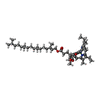
MacromoleculeName: CHLOROPHYLL A / type: ligand / ID: 23 / Number of copies: 70 / Formula: CLA
Molecular weightTheoretical: 893.489 Da
Chemical component information

ChemComp-CLA:
CHLOROPHYLL A

+
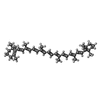
Macromolecule #24: BETA-CAROTENE

MacromoleculeName: BETA-CAROTENE / type: ligand / ID: 24 / Number of copies: 20 / Formula: BCR
Molecular weightTheoretical: 536.873 Da
Chemical component information

ChemComp-BCR:
BETA-CAROTENE

+
Macromolecule #25: 1,2-DI-O-ACYL-3-O-[6-DEOXY-6-SULFO-ALPHA-D-GLUCOPYRANOSYL]-SN-GLYCEROL

MacromoleculeName: 1,2-DI-O-ACYL-3-O-[6-DEOXY-6-SULFO-ALPHA-D-GLUCOPYRANOSYL]-SN-GLYCEROL
type: ligand / ID: 25 / Number of copies: 4 / Formula: SQD
Molecular weightTheoretical: 795.116 Da
Chemical component information

ChemComp-SQD:
1,2-DI-O-ACYL-3-O-[6-DEOXY-6-SULFO-ALPHA-D-GLUCOPYRANOSYL]-SN-GLYCEROL

+
Macromolecule #26: 2,3-DIMETHYL-5-(3,7,11,15,19,23,27,31,35-NONAMETHYL-2,6,10,14,18,...
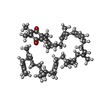
MacromoleculeName: 2,3-DIMETHYL-5-(3,7,11,15,19,23,27,31,35-NONAMETHYL-2,6,10,14,18,22,26,30,34-HEXATRIACONTANONAENYL-2,5-CYCLOHEXADIENE-1,4-DIONE-2,3-DIMETHYL-5-SOLANESYL-1,4-BENZOQUINONE
type: ligand / ID: 26 / Number of copies: 4 / Formula: PL9
Molecular weightTheoretical: 749.201 Da
Chemical component information

ChemComp-PL9:
2,3-DIMETHYL-5-(3,7,11,15,19,23,27,31,35-NONAMETHYL-2,6,10,14,18,22,26,30,34-HEXATRIACONTANONAENYL-2,5-CYCLOHEXADIENE-1,4-DIONE-2,3-DIMETHYL-5-SOLANESYL-1,4-BENZOQUINONE

+
Macromolecule #27: UNKNOWN LIGAND

MacromoleculeName: UNKNOWN LIGAND / type: ligand / ID: 27 / Number of copies: 24 / Formula: UNL
Chemical component information


ChemComp, No image

ChemComp-UNL:
Unknown ligand

+
Macromolecule #28: BICARBONATE ION

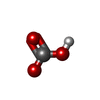
MacromoleculeName: BICARBONATE ION / type: ligand / ID: 28 / Number of copies: 2 / Formula: BCT
Molecular weightTheoretical: 61.017 Da
Chemical component information

ChemComp-BCT:
BICARBONATE ION / pH buffer*YM

+
Macromolecule #29: 1,2-DIPALMITOYL-PHOSPHATIDYL-GLYCEROLE
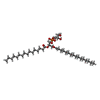
MacromoleculeName: 1,2-DIPALMITOYL-PHOSPHATIDYL-GLYCEROLE / type: ligand / ID: 29 / Number of copies: 10 / Formula: LHG
Molecular weightTheoretical: 722.97 Da
Chemical component information

ChemComp-LHG:
1,2-DIPALMITOYL-PHOSPHATIDYL-GLYCEROLE / phospholipid*YM

+
Macromolecule #30: 1,2-DISTEAROYL-MONOGALACTOSYL-DIGLYCERIDE
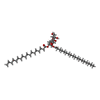
MacromoleculeName: 1,2-DISTEAROYL-MONOGALACTOSYL-DIGLYCERIDE / type: ligand / ID: 30 / Number of copies: 6 / Formula: LMG
Molecular weightTheoretical: 787.158 Da
Chemical component information

ChemComp-LMG:
1,2-DISTEAROYL-MONOGALACTOSYL-DIGLYCERIDE

+
Macromolecule #31: DODECYL-BETA-D-MALTOSIDE
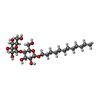
MacromoleculeName: DODECYL-BETA-D-MALTOSIDE / type: ligand / ID: 31 / Number of copies: 6 / Formula: LMT
Molecular weightTheoretical: 510.615 Da
Chemical component information

ChemComp-LMT:
DODECYL-BETA-D-MALTOSIDE / detergent*YM

+
Macromolecule #32: DIGALACTOSYL DIACYL GLYCEROL (DGDG)
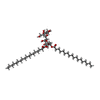
MacromoleculeName: DIGALACTOSYL DIACYL GLYCEROL (DGDG) / type: ligand / ID: 32 / Number of copies: 8 / Formula: DGD
Molecular weightTheoretical: 949.299 Da
Chemical component information

ChemComp-DGD:
DIGALACTOSYL DIACYL GLYCEROL (DGDG)

+
Macromolecule #33: PHEOPHYTIN A

MacromoleculeName: PHEOPHYTIN A / type: ligand / ID: 33 / Number of copies: 4 / Formula: PHO
Molecular weightTheoretical: 871.2 Da
Chemical component information

ChemComp-PHO:
PHEOPHYTIN A

+
Macromolecule #34: PROTOPORPHYRIN IX CONTAINING FE
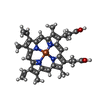
MacromoleculeName: PROTOPORPHYRIN IX CONTAINING FE / type: ligand / ID: 34 / Number of copies: 2 / Formula: HEM
Molecular weightTheoretical: 616.487 Da
Chemical component information

ChemComp-HEM:
PROTOPORPHYRIN IX CONTAINING FE

+
Macromolecule #35: CALCIUM ION

MacromoleculeName: CALCIUM ION / type: ligand / ID: 35 / Number of copies: 2 / Formula: CA
Molecular weightTheoretical: 40.078 Da

+
Macromolecule #36: HEME C

MacromoleculeName: HEME C / type: ligand / ID: 36 / Number of copies: 2 / Formula: HEC
Molecular weightTheoretical: 620.519 Da
Chemical component information

ChemComp-HEC:
HEME C

+
Macromolecule #37: (3R)-beta,beta-caroten-3-ol

MacromoleculeName: (3R)-beta,beta-caroten-3-ol / type: ligand / ID: 37 / Number of copies: 2 / Formula: RRX
Molecular weightTheoretical: 552.872 Da
Chemical component information

ChemComp-RRX:
(3R)-beta,beta-caroten-3-ol

+
Macromolecule #38: water

MacromoleculeName: water / type: ligand / ID: 38 / Number of copies: 1092 / Formula: HOH
Molecular weightTheoretical: 18.015 Da
Chemical component information

ChemComp-HOH:
WATER

-
Experimental details

-
Structure determination

Methodcryo EM
Processingsingle particle reconstruction
Aggregation stateparticle

-
Sample preparation

BufferpH: 6.5
VitrificationCryogen name: ETHANE / Chamber humidity: 100 %

-
Electron microscopy

MicroscopeTFS KRIOS
Image recordingFilm or detector model: FEI FALCON IV (4k x 4k) / Average electron dose: 50.0 e/Å2
Electron beamAcceleration voltage: 300 kV / Electron source: FIELD EMISSION GUN
Electron opticsIllumination mode: FLOOD BEAM / Imaging mode: BRIGHT FIELD / Nominal defocus max: 1.0 µm / Nominal defocus min: 0.2 µm
Experimental equipment
Model: Titan Krios / Image courtesy: FEI Company

+
Image processing

CTF correctionType: PHASE FLIPPING AND AMPLITUDE CORRECTION
Startup modelType of model: PDB ENTRY
PDB model - PDB ID:
Final reconstructionResolution.type: BY AUTHOR / Resolution: 1.96 Å / Resolution method: FSC 0.143 CUT-OFF / Software - Name: RELION / Number images used: 93573
Initial angle assignmentType: NOT APPLICABLE
Final angle assignmentType: NOT APPLICABLE

+
About Yorodumi

-
News

-
Feb 9, 2022. New format data for meta-information of EMDB entries

New format data for meta-information of EMDB entries

  • Version 3 of the EMDB header file is now the official format.
  • The previous official version 1.9 will be removed from the archive.

Related info.:EMDB header

External links:wwPDB to switch to version 3 of the EMDB data model

-
Aug 12, 2020. Covid-19 info

Covid-19 info

URL: https://pdbj.org/emnavi/covid19.php

New page: Covid-19 featured information page in EM Navigator.

Related info.:Covid-19 info / Mar 5, 2020. Novel coronavirus structure data

+
Mar 5, 2020. Novel coronavirus structure data

Novel coronavirus structure data

Related info.:Yorodumi Speices / Aug 12, 2020. Covid-19 info

External links:COVID-19 featured content - PDBj / Molecule of the Month (242):Coronavirus Proteases

+
Jan 31, 2019. EMDB accession codes are about to change! (news from PDBe EMDB page)

EMDB accession codes are about to change! (news from PDBe EMDB page)

  • The allocation of 4 digits for EMDB accession codes will soon come to an end. Whilst these codes will remain in use, new EMDB accession codes will include an additional digit and will expand incrementally as the available range of codes is exhausted. The current 4-digit format prefixed with “EMD-” (i.e. EMD-XXXX) will advance to a 5-digit format (i.e. EMD-XXXXX), and so on. It is currently estimated that the 4-digit codes will be depleted around Spring 2019, at which point the 5-digit format will come into force.
  • The EM Navigator/Yorodumi systems omit the EMD- prefix.

Related info.:Q: What is EMD? / ID/Accession-code notation in Yorodumi/EM Navigator

External links:EMDB Accession Codes are Changing Soon! / Contact to PDBj

+
Jul 12, 2017. Major update of PDB

Major update of PDB

  • wwPDB released updated PDB data conforming to the new PDBx/mmCIF dictionary.
  • This is a major update changing the version number from 4 to 5, and with Remediation, in which all the entries are updated.
  • In this update, many items about electron microscopy experimental information are reorganized (e.g. em_software).
  • Now, EM Navigator and Yorodumi are based on the updated data.

External links:wwPDB Remediation / Enriched Model Files Conforming to OneDep Data Standards Now Available in the PDB FTP Archive

-
Yorodumi

Thousand views of thousand structures

  • Yorodumi is a browser for structure data from EMDB, PDB, SASBDB, etc.
  • This page is also the successor to EM Navigator detail page, and also detail information page/front-end page for Omokage search.
  • The word "yorodu" (or yorozu) is an old Japanese word meaning "ten thousand". "mi" (miru) is to see.

Related info.:EMDB / PDB / SASBDB / Comparison of 3 databanks / Yorodumi Search / Aug 31, 2016. New EM Navigator & Yorodumi / Yorodumi Papers / Jmol/JSmol / Function and homology information / Changes in new EM Navigator and Yorodumi

Read more