[English] 日本語
Yorodumi Papers
- Database of articles cited by EMDB/PDB/SASBDB data -

+
Search query

Keywords
Structure methods
Author
Journal
IF

-
Structure paper

TitleMolecular architecture of OXGR1 reveals an evolutionary conserved mechanisms for metabolite surveillance.
Journal, issue, pagesEMBO J, Year 2026
Publish dateJun 3, 2026
AuthorsXinyue Zhang / Yujie Lu / Xinheng He / Shimeng Guo / Changyao Li / Yu Wang / Yuan Gao / Juxia Yao / Qingning Yuan / Yinshan Tang / Jing Hu / Wen Hu / Zijuan Luo / Kai Wu / Yue Wang / Wanchao Yin / Xin Xie / H Eric Xu / Heng Liu /
PubMed AbstractThe ability of cells to sense and respond to metabolic signals is fundamental to life, yet the molecular mechanisms underlying metabolite surveillance remain incompletely understood. Here, we ...The ability of cells to sense and respond to metabolic signals is fundamental to life, yet the molecular mechanisms underlying metabolite surveillance remain incompletely understood. Here, we elucidate the structural basis of metabolite recognition by OXGR1, a G Protein-Coupled Receptor (GPCR) that senses key intermediates in the tricarboxylic acid (TCA) cycle. Using cryo-electron microscopy, we determined cryo-EM structures of OXGR1 bound to α-ketoglutarate (AKG), itaconate (ITA), and structurally related metabolites succinate (SUC) and maleate (MA). These structures reveal a positively charged binding pocket and an extensive hydrogen-bond network that mediate selective recognition of dicarboxylic acids. In addition, we identify a distinct arrangement of hydrophobic residues that modulates ligand potency and selectivity. Mutational analysis and molecular dynamics simulations further demonstrate that noncanonical micro-switch motifs, including FRY and NLxxY, are essential for ligand recognition and receptor activation. Comparative structural and evolutionary analyses indicate that these mechanisms are conserved across species, underscoring the critical role of OXGR1 in maintaining metabolic homeostasis. Together, our findings define a mechanistic framework for metabolite sensing by OXGR1 and provide a framework for therapeutic modulation of metabolic and inflammatory diseases.
External linksEMBO J / PubMed:42236546
MethodsEM (single particle)
Resolution2.64 - 2.97 Å
Structure data

EMDB-63580, PDB-9m1r:
Cryo-EM structure of AKG bound OXGR1-Gq complex
Method: EM (single particle) / Resolution: 2.66 Å

EMDB-63581, PDB-9m1s:
Cryo-EM structure of Itaconic acid bound OXGR1-Gq complex
Method: EM (single particle) / Resolution: 2.65 Å

EMDB-63583, PDB-9m1u:
Cryo-EM structure of Succinic Acid bound OXGR1-Gq complex
Method: EM (single particle) / Resolution: 2.64 Å

EMDB-64587, PDB-9uxn:
Local refinement of Succinate bound OXGR1
Method: EM (single particle) / Resolution: 2.7 Å

EMDB-64588, PDB-9uxo:
Local refinement of maleic acid bound OXGR1
Method: EM (single particle) / Resolution: 2.97 Å

EMDB-64589, PDB-9uxp:
Local refinement of ITA bound OXGR1
Method: EM (single particle) / Resolution: 2.9 Å

EMDB-64590, PDB-9uxq:
Local refinement of AKG bound OXGR1
Method: EM (single particle) / Resolution: 2.89 Å

EMDB-80947, PDB-26xh:
Cryo-EM structure of Maleic Acid bound OXGR1-Gq complex
Method: EM (single particle) / Resolution: 2.82 Å

Chemicals

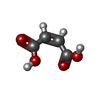
ChemComp-MAE:
MALEIC ACID

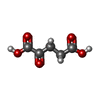
ChemComp-AKG:
2-OXOGLUTARIC ACID

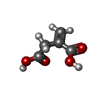
ChemComp-ITN:
2-methylidenebutanedioic acid

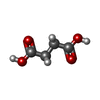
ChemComp-SIN:
SUCCINIC ACID

ChemComp-HOH:
WATER

Source
  • homo sapiens (human)
  • mus musculus (house mouse)
  • lama glama (llama)
KeywordsMEMBRANE PROTEIN/IMMUNE SYSTEM / GPR99 / OXGR1 / Maleic Acid / GPCR / MEMBRANE PROTEIN-IMMUNE SYSTEM complex / MEMBRANE PROTEIN / 2-ketoglutarate; AKG; OXGR1; cryo-EM / Itaconic acid; ITA; OXGR1; cryo-EM / Succinic Acid; OXGR1; cryo-EM / SIGNALING PROTEIN / 2-oxoglutarate / AKG / 2-oxoglutarate receptor 1 / cryo-EM / MA / Itaconate acid / ITA

+
About Yorodumi Papers

-
News

-
Feb 9, 2022. New format data for meta-information of EMDB entries

New format data for meta-information of EMDB entries

  • Version 3 of the EMDB header file is now the official format.
  • The previous official version 1.9 will be removed from the archive.

Related info.:EMDB header

External links:wwPDB to switch to version 3 of the EMDB data model

-
Aug 12, 2020. Covid-19 info

Covid-19 info

URL: https://pdbj.org/emnavi/covid19.php

New page: Covid-19 featured information page in EM Navigator.

Related info.:Covid-19 info / Mar 5, 2020. Novel coronavirus structure data

+
Mar 5, 2020. Novel coronavirus structure data

Novel coronavirus structure data

Related info.:Yorodumi Speices / Aug 12, 2020. Covid-19 info

External links:COVID-19 featured content - PDBj / Molecule of the Month (242):Coronavirus Proteases

+
Jan 31, 2019. EMDB accession codes are about to change! (news from PDBe EMDB page)

EMDB accession codes are about to change! (news from PDBe EMDB page)

  • The allocation of 4 digits for EMDB accession codes will soon come to an end. Whilst these codes will remain in use, new EMDB accession codes will include an additional digit and will expand incrementally as the available range of codes is exhausted. The current 4-digit format prefixed with “EMD-” (i.e. EMD-XXXX) will advance to a 5-digit format (i.e. EMD-XXXXX), and so on. It is currently estimated that the 4-digit codes will be depleted around Spring 2019, at which point the 5-digit format will come into force.
  • The EM Navigator/Yorodumi systems omit the EMD- prefix.

Related info.:Q: What is EMD? / ID/Accession-code notation in Yorodumi/EM Navigator

External links:EMDB Accession Codes are Changing Soon! / Contact to PDBj

+
Jul 12, 2017. Major update of PDB

Major update of PDB

  • wwPDB released updated PDB data conforming to the new PDBx/mmCIF dictionary.
  • This is a major update changing the version number from 4 to 5, and with Remediation, in which all the entries are updated.
  • In this update, many items about electron microscopy experimental information are reorganized (e.g. em_software).
  • Now, EM Navigator and Yorodumi are based on the updated data.

External links:wwPDB Remediation / Enriched Model Files Conforming to OneDep Data Standards Now Available in the PDB FTP Archive

-
Yorodumi Papers

Database of articles cited by EMDB/PDB/SASBDB data

  • Database of articles cited by EMDB, PDB, and SASBDB entries
  • Using PubMed data

Related info.:EMDB / PDB / SASBDB / Yorodumi / EMN Papers / Changes in new EM Navigator and Yorodumi

Read more