[English] 日本語
Yorodumi Papers
- Database of articles cited by EMDB/PDB/SASBDB data -

+
Search query

Keywords
Structure methods
Author
Journal
IF

-
Structure paper

TitleDecoding ligand recognition and constitutive activation of histamine H3 and H4 receptors.
Journal, issue, pagesActa Pharmacol Sin, Vol. 47, Issue 1, Page 186-196, Year 2026
Publish dateAug 28, 2025
AuthorsSan-Shan Jin / Heng Zhang / Jia-Hui Yan / Can-Rong Wu / Xiao-Qing Cai / Kai Wu / Ming-Wei Wang / H Eric Xu / De-Hua Yang / Yi Jiang /
PubMed AbstractHistamine H3 receptor (H3R) and H4 receptor (H4R) are key members of the histamine receptor family, with H3R as a potential target for narcolepsy treatments and H4R as a candidate for next-generation ...Histamine H3 receptor (H3R) and H4 receptor (H4R) are key members of the histamine receptor family, with H3R as a potential target for narcolepsy treatments and H4R as a candidate for next-generation antihistamines for inflammatory and allergic diseases. Although progress has been made in understanding the structure of histamine receptors, the detailed mechanisms of ligand recognition and receptor antagonism for H3R and H4R remain unclear. In this study, using cryo-electron microscopy, we present an inactive structure of H4R bound to a selective antagonist, adriforant, and two Gi-coupled structures of H3R and H4R in complex with histamine. Our structural and mutagenesis analyses provide insights into the selective binding of adriforant to H4R and the recognition of histamine across histamine receptors. Our findings also uncovered distinct antagonistic mechanisms for H3R and H4R and identified the role of aromatic amino acids on extracellular loop 2 in modulating the constitutive activity of H3R and H4R. These findings advance our knowledge of the functional modulation of histamine receptors, providing a foundation for the development of targeted therapeutics for neurological and immune-related disorders.
External linksActa Pharmacol Sin / PubMed:40877594 / PubMed Central
MethodsEM (single particle)
Resolution2.58 - 3.62 Å
Structure data

EMDB-61413, PDB-9jed:
Cryo-EM structure of Histamine-bound Histamine receptor 4 H4R G protein complex
Method: EM (single particle) / Resolution: 2.58 Å

EMDB-61421, PDB-9jeq:
Cryo-EM structure of Histamine-bound Histamine receptor 3 H3R G protein complex
Method: EM (single particle) / Resolution: 3.05 Å

EMDB-61447, PDB-9jg1:
Cryo-EM structure of Adriforant-bound Histamine receptor 4 H4R at inactive state
Method: EM (single particle) / Resolution: 3.62 Å

Chemicals

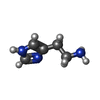
ChemComp-HSM:
HISTAMINE / neurotransmitter, hormone*YM

ChemComp-PO4:
PHOSPHATE ION

ChemComp-HOH:
WATER

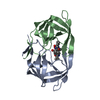
PDB-1ebw:
HIV-1 protease in complex with the inhibitor BEA322

Source
  • homo sapiens (human)
  • mus musculus (house mouse)
  • bos taurus (domestic cattle)
  • escherichia coli (E. coli)
KeywordsMEMBRANE PROTEIN/IMMUNE SYSTEM / Complex / MEMBRANE PROTEIN-IMMUNE SYSTEM complex / MEMBRANE PROTEIN

+
About Yorodumi Papers

-
News

-
Feb 9, 2022. New format data for meta-information of EMDB entries

New format data for meta-information of EMDB entries

  • Version 3 of the EMDB header file is now the official format.
  • The previous official version 1.9 will be removed from the archive.

Related info.:EMDB header

External links:wwPDB to switch to version 3 of the EMDB data model

-
Aug 12, 2020. Covid-19 info

Covid-19 info

URL: https://pdbj.org/emnavi/covid19.php

New page: Covid-19 featured information page in EM Navigator.

Related info.:Covid-19 info / Mar 5, 2020. Novel coronavirus structure data

+
Mar 5, 2020. Novel coronavirus structure data

Novel coronavirus structure data

Related info.:Yorodumi Speices / Aug 12, 2020. Covid-19 info

External links:COVID-19 featured content - PDBj / Molecule of the Month (242):Coronavirus Proteases

+
Jan 31, 2019. EMDB accession codes are about to change! (news from PDBe EMDB page)

EMDB accession codes are about to change! (news from PDBe EMDB page)

  • The allocation of 4 digits for EMDB accession codes will soon come to an end. Whilst these codes will remain in use, new EMDB accession codes will include an additional digit and will expand incrementally as the available range of codes is exhausted. The current 4-digit format prefixed with “EMD-” (i.e. EMD-XXXX) will advance to a 5-digit format (i.e. EMD-XXXXX), and so on. It is currently estimated that the 4-digit codes will be depleted around Spring 2019, at which point the 5-digit format will come into force.
  • The EM Navigator/Yorodumi systems omit the EMD- prefix.

Related info.:Q: What is EMD? / ID/Accession-code notation in Yorodumi/EM Navigator

External links:EMDB Accession Codes are Changing Soon! / Contact to PDBj

+
Jul 12, 2017. Major update of PDB

Major update of PDB

  • wwPDB released updated PDB data conforming to the new PDBx/mmCIF dictionary.
  • This is a major update changing the version number from 4 to 5, and with Remediation, in which all the entries are updated.
  • In this update, many items about electron microscopy experimental information are reorganized (e.g. em_software).
  • Now, EM Navigator and Yorodumi are based on the updated data.

External links:wwPDB Remediation / Enriched Model Files Conforming to OneDep Data Standards Now Available in the PDB FTP Archive

-
Yorodumi Papers

Database of articles cited by EMDB/PDB/SASBDB data

  • Database of articles cited by EMDB, PDB, and SASBDB entries
  • Using PubMed data

Related info.:EMDB / PDB / SASBDB / Yorodumi / EMN Papers / Changes in new EM Navigator and Yorodumi

Read more