 Movie
Movie Controller

[English] 日本語
 Yorodumi
- PDB-9jg1: Cryo-EM structure of Adriforant-bound Histamine receptor 4 H4R at... -
+ Open data

- Basic information
| Entry | Database: PDB / ID: 9jg1 | |||||||||||||||||||||||||||
|---|---|---|---|---|---|---|---|---|---|---|---|---|---|---|---|---|---|---|---|---|---|---|---|---|---|---|---|---|
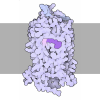
| Title | Cryo-EM structure of Adriforant-bound Histamine receptor 4 H4R at inactive state | |||||||||||||||||||||||||||
 Components Components |
| |||||||||||||||||||||||||||
 Keywords Keywords | MEMBRANE PROTEIN/IMMUNE SYSTEM / Complex / MEMBRANE PROTEIN-IMMUNE SYSTEM complex | |||||||||||||||||||||||||||
| Function / homology |  Function and homology information Function and homology informationHistamine receptors / histamine receptor activity / neurotransmitter receptor activity / adenylate cyclase-inhibiting G protein-coupled acetylcholine receptor signaling pathway / regulation of MAPK cascade / G protein-coupled receptor signaling pathway, coupled to cyclic nucleotide second messenger / electron transport chain / adenylate cyclase-inhibiting G protein-coupled receptor signaling pathway / positive regulation of cytosolic calcium ion concentration / chemical synaptic transmission ...Histamine receptors / histamine receptor activity / neurotransmitter receptor activity / adenylate cyclase-inhibiting G protein-coupled acetylcholine receptor signaling pathway / regulation of MAPK cascade / G protein-coupled receptor signaling pathway, coupled to cyclic nucleotide second messenger / electron transport chain / adenylate cyclase-inhibiting G protein-coupled receptor signaling pathway / positive regulation of cytosolic calcium ion concentration / chemical synaptic transmission / G alpha (i) signalling events / electron transfer activity / periplasmic space / iron ion binding / inflammatory response / heme binding / synapse / dendrite / plasma membrane Similarity search - Function | |||||||||||||||||||||||||||
| Biological species |  Homo sapiens (human) Homo sapiens (human)  Escherichia coli (E. coli) Escherichia coli (E. coli) | |||||||||||||||||||||||||||
| Method | ELECTRON MICROSCOPY / single particle reconstruction / cryo EM / Resolution: 3.62 Å | |||||||||||||||||||||||||||
 Authors Authors | Jin, S.S. / Zhang, H. / Jiang, Y. | |||||||||||||||||||||||||||
| Funding support |  China, 1items China, 1items
| |||||||||||||||||||||||||||
 Citation Citation | Journal: Acta Pharmacol Sin / Year: 2026 Title: Decoding ligand recognition and constitutive activation of histamine H3 and H4 receptors. Authors: San-Shan Jin / Heng Zhang / Jia-Hui Yan / Can-Rong Wu / Xiao-Qing Cai / Kai Wu / Ming-Wei Wang / H Eric Xu / De-Hua Yang / Yi Jiang / Abstract: Histamine H3 receptor (H3R) and H4 receptor (H4R) are key members of the histamine receptor family, with H3R as a potential target for narcolepsy treatments and H4R as a candidate for next-generation ...Histamine H3 receptor (H3R) and H4 receptor (H4R) are key members of the histamine receptor family, with H3R as a potential target for narcolepsy treatments and H4R as a candidate for next-generation antihistamines for inflammatory and allergic diseases. Although progress has been made in understanding the structure of histamine receptors, the detailed mechanisms of ligand recognition and receptor antagonism for H3R and H4R remain unclear. In this study, using cryo-electron microscopy, we present an inactive structure of H4R bound to a selective antagonist, adriforant, and two Gi-coupled structures of H3R and H4R in complex with histamine. Our structural and mutagenesis analyses provide insights into the selective binding of adriforant to H4R and the recognition of histamine across histamine receptors. Our findings also uncovered distinct antagonistic mechanisms for H3R and H4R and identified the role of aromatic amino acids on extracellular loop 2 in modulating the constitutive activity of H3R and H4R. These findings advance our knowledge of the functional modulation of histamine receptors, providing a foundation for the development of targeted therapeutics for neurological and immune-related disorders. | |||||||||||||||||||||||||||
| History |
|
- Structure visualization
| Structure viewer | Molecule: MolmilJmol/JSmol |
|---|
- Downloads & links
-Download
| PDBx/mmCIF format | 9jg1.cif.gz | 125.1 KB | Display | PDBx/mmCIF format |
|---|---|---|---|---|
| PDB format | pdb9jg1.ent.gz | Display | PDB format | |
| PDBx/mmJSON format | 9jg1.json.gz | Tree view | PDBx/mmJSON format | |
| Others |  Other downloads Other downloads |
-Validation report
| Arichive directory | https://data.pdbj.org/pub/pdb/validation_reports/jg/9jg1ftp://data.pdbj.org/pub/pdb/validation_reports/jg/9jg1 | HTTPS FTP |
|---|
-Related structure data
| Related structure data |  61447MC  9jedC  9jeqC M: map data used to model this data C: citing same article ( |
|---|---|
| Similar structure data |


-Links
 PDBj
PDBj

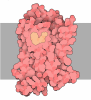
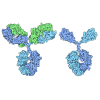
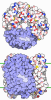
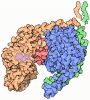
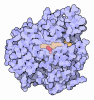
- Assembly
| Deposited unit | 
|
|---|---|
| 1 |
|
-Components
| #1: Protein | Mass: 48922.727 Da / Num. of mol.: 1 Source method: isolated from a genetically manipulated source Source: (gene. exp.) Homo sapiens (human), (gene. exp.) Escherichia coli (E. coli)Gene: HRH4, GPCR105, cybC / Production host:  Trichoplusia ni (cabbage looper) / References: UniProt: Q9H3N8, UniProt: P0ABE7 Trichoplusia ni (cabbage looper) / References: UniProt: Q9H3N8, UniProt: P0ABE7 |
|---|---|
| #2: Antibody | Mass: 24371.076 Da / Num. of mol.: 1 Source method: isolated from a genetically manipulated source Source: (gene. exp.) Homo sapiens (human) / Production host: Trichoplusia ni (cabbage looper) |
| #3: Antibody | Mass: 23977.793 Da / Num. of mol.: 1 Source method: isolated from a genetically manipulated source Source: (gene. exp.) Homo sapiens (human) / Production host: Trichoplusia ni (cabbage looper) |
| #4: Chemical | ChemComp-A1EBW / Mass: 262.354 Da / Num. of mol.: 1 / Source method: obtained synthetically / Formula: C13H22N6 / Feature type: SUBJECT OF INVESTIGATION |
| Has ligand of interest | Y |
| Has protein modification | Y |
-Experimental details
-Experiment
| Experiment | Method: ELECTRON MICROSCOPY |
|---|---|
| EM experiment | Aggregation state: PARTICLE / 3D reconstruction method: single particle reconstruction |
- Sample preparation
| Component | Name: Cryo-EM structure of Histamine-bound Histamine receptor 3 H3R G protein complex Type: COMPLEX / Entity ID: #1-#3 / Source: MULTIPLE SOURCES |
|---|---|
| Source (natural) | Organism: Homo sapiens (human) |
| Source (recombinant) | Organism: Trichoplusia ni (cabbage looper) |
| Buffer solution | pH: 7.2 |
| Specimen | Embedding applied: NO / Shadowing applied: NO / Staining applied: NO / Vitrification applied: YES |
| Vitrification | Cryogen name: ETHANE |
- Electron microscopy imaging
| Experimental equipment | 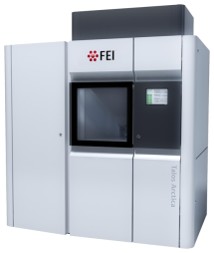 Model: Talos Arctica / Image courtesy: FEI Company |
|---|---|
| Microscopy | Model: FEI TECNAI ARCTICA |
| Electron gun | Electron source:  FIELD EMISSION GUN / Accelerating voltage: 50 kV / Illumination mode: SPOT SCAN FIELD EMISSION GUN / Accelerating voltage: 50 kV / Illumination mode: SPOT SCAN |
| Electron lens | Mode: DIFFRACTION / Nominal defocus max: 1800 nm / Nominal defocus min: 1200 nm |
| Image recording | Electron dose: 50 e/Å2 / Film or detector model: GATAN K3 BIOQUANTUM (6k x 4k) |
- Processing
| EM software |
| |||||||||
|---|---|---|---|---|---|---|---|---|---|---|
| CTF correction | Type: PHASE FLIPPING AND AMPLITUDE CORRECTION | |||||||||
| 3D reconstruction | Resolution: 3.62 Å / Resolution method: FSC 0.143 CUT-OFF / Num. of particles: 132359 / Symmetry type: POINT |
