[English] 日本語
Yorodumi Papers
- Database of articles cited by EMDB/PDB/SASBDB data -

+
Search query

Keywords
Structure methods
Author
Journal
IF

-
Structure paper

TitleStructural characterisation of the fungal Pmt4 homodimer.
Journal, issue, pagesNat Commun, Vol. 16, Issue 1, Page 11134, Year 2025
Publish dateDec 14, 2025
AuthorsMelanie A McDowell / Klemens Wild / Francesco Fiorentino / Daniela Bausewein / Anke Metschies / Antonella Chiapparino / Yvonne Hackmann / Florestan L Bilsing / David Brenske / Sofia Mortensen / Di Wu / Carol V Robinson / Sabine Strahl / Irmgard Sinning /
PubMed AbstractProtein O-mannosyltransferases (PMTs) are conserved endoplasmic reticulum membrane-embedded enzymes responsible for the transfer of mannose from dolichol phosphate-mannose (Dol-P-Man) to ...Protein O-mannosyltransferases (PMTs) are conserved endoplasmic reticulum membrane-embedded enzymes responsible for the transfer of mannose from dolichol phosphate-mannose (Dol-P-Man) to serine/threonine-rich protein substrates or unfolded proteins. PMTs from three subfamilies form obligate dimers with different substrate specificities and require the concerted action of their transmembrane domains (TMDs) and a luminal MIR domain for catalysis. Here, we present structures, native mass spectrometry, and structure-based mutagenesis of the fungal Pmt4 homodimer. The core fold of the TMDs and MIR domain is conserved with the Pmt1-Pmt2 heterodimer, indicating a shared catalytic mechanism. Distinct from Pmt4, the MIR domain interacts in cis with the TMDs of the same subunit and has a β-hairpin insertion required for O-mannosylation of substrates. We further identify a cytosolic binding site for substrate Dol-P-Man within the Pmt4 TMDs, which is conserved amongst PMTs and important for in vivo activity. Thus, we provide a framework to understand the substrate specificity and regulation of the Pmt4 homodimer.
External linksNat Commun / PubMed:41392315 / PubMed Central
MethodsEM (single particle) / X-ray diffraction
Resolution1.22 - 3.4 Å
Structure data

EMDB-52631, PDB-9i5k:
Structure of the Chaetomium thermophilum Pmt4 homodimer (C2 symmetry)
Method: EM (single particle) / Resolution: 3.2 Å

EMDB-52632, PDB-9i5l:
Structure of the Chaetomium thermophilum Pmt4 homodimer (C1 symmetry)
Method: EM (single particle) / Resolution: 3.4 Å

PDB-9fd0:
Structure of the Saccharomyces cerevisiae Pmt4-MIR domain with bound ligands
Method: X-RAY DIFFRACTION / Resolution: 1.35 Å

PDB-9fd1:
Structure of the Chaetomium thermophilum Pmt4-MIR domain with bound ligands
Method: X-RAY DIFFRACTION / Resolution: 1.22 Å

Chemicals

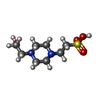
ChemComp-EPE:
4-(2-HYDROXYETHYL)-1-PIPERAZINE ETHANESULFONIC ACID / pH buffer*YM

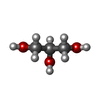
ChemComp-GOL:
GLYCEROL

ChemComp-HOH:
WATER

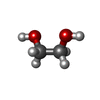
ChemComp-EDO:
1,2-ETHANEDIOL

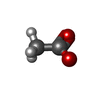
ChemComp-ACT:
ACETATE ION

ChemComp-NA:
Unknown entry

PDB-1i0n:
1.3 A STRUCTURE OF THE A-DECAMER GCGTATACGC WITH A SINGLE 2'-O-METHYL-[TRI(OXYETHYL)] THYMINE IN PLACE OF T6, MEDIUM RB-SALT

PDB-1i0m:
1.05 A STRUCTURE OF THE A-DECAMER GCGTATACGC WITH A SINGLE 2'-O-FLUOROETHYL THYMINE IN PLACE OF T6, HIGH RB-SALT

Source
  • thermochaetoides thermophila (fungus)
  • saccharomyces cerevisiae (brewer's yeast)

  • chaetomium (fungus)
KeywordsPEPTIDE BINDING PROTEIN / Protein O-mannosylation / glycosylation / ER luminal domain / b-trefoil / ligand binding / processivity / thermostability / MEMBRANE PROTEIN / homodimer / ER / biogenesis

+
About Yorodumi Papers

-
News

-
Feb 9, 2022. New format data for meta-information of EMDB entries

New format data for meta-information of EMDB entries

  • Version 3 of the EMDB header file is now the official format.
  • The previous official version 1.9 will be removed from the archive.

Related info.:EMDB header

External links:wwPDB to switch to version 3 of the EMDB data model

-
Aug 12, 2020. Covid-19 info

Covid-19 info

URL: https://pdbj.org/emnavi/covid19.php

New page: Covid-19 featured information page in EM Navigator.

Related info.:Covid-19 info / Mar 5, 2020. Novel coronavirus structure data

+
Mar 5, 2020. Novel coronavirus structure data

Novel coronavirus structure data

Related info.:Yorodumi Speices / Aug 12, 2020. Covid-19 info

External links:COVID-19 featured content - PDBj / Molecule of the Month (242):Coronavirus Proteases

+
Jan 31, 2019. EMDB accession codes are about to change! (news from PDBe EMDB page)

EMDB accession codes are about to change! (news from PDBe EMDB page)

  • The allocation of 4 digits for EMDB accession codes will soon come to an end. Whilst these codes will remain in use, new EMDB accession codes will include an additional digit and will expand incrementally as the available range of codes is exhausted. The current 4-digit format prefixed with “EMD-” (i.e. EMD-XXXX) will advance to a 5-digit format (i.e. EMD-XXXXX), and so on. It is currently estimated that the 4-digit codes will be depleted around Spring 2019, at which point the 5-digit format will come into force.
  • The EM Navigator/Yorodumi systems omit the EMD- prefix.

Related info.:Q: What is EMD? / ID/Accession-code notation in Yorodumi/EM Navigator

External links:EMDB Accession Codes are Changing Soon! / Contact to PDBj

+
Jul 12, 2017. Major update of PDB

Major update of PDB

  • wwPDB released updated PDB data conforming to the new PDBx/mmCIF dictionary.
  • This is a major update changing the version number from 4 to 5, and with Remediation, in which all the entries are updated.
  • In this update, many items about electron microscopy experimental information are reorganized (e.g. em_software).
  • Now, EM Navigator and Yorodumi are based on the updated data.

External links:wwPDB Remediation / Enriched Model Files Conforming to OneDep Data Standards Now Available in the PDB FTP Archive

-
Yorodumi Papers

Database of articles cited by EMDB/PDB/SASBDB data

  • Database of articles cited by EMDB, PDB, and SASBDB entries
  • Using PubMed data

Related info.:EMDB / PDB / SASBDB / Yorodumi / EMN Papers / Changes in new EM Navigator and Yorodumi

Read more