[English] 日本語
Yorodumi Papers
- Database of articles cited by EMDB/PDB/SASBDB data -

+
Search query

Keywords
Structure methods
Author
Journal
IF

-
Structure paper

TitleStructural, Mechanistic and Phylogenetic Insights Into a Freshwater Actinorhodopsin.
Journal, issue, pagesJ Mol Biol, Vol. 438, Issue 9, Page 169725, Year 2026
Publish dateFeb 18, 2026
AuthorsNadia Djabeur / Jean-Marc Jeckelmann / Nooraldeen Ayoub / Daniel Harder / Dimitrios Fotiadis /
PubMed AbstractActinorhodopsins represent a unique subgroup of microbial rhodopsins, predominantly found in non-marine Actinobacteria and proposed to contribute to the global energy cycle. Despite their ecological ...Actinorhodopsins represent a unique subgroup of microbial rhodopsins, predominantly found in non-marine Actinobacteria and proposed to contribute to the global energy cycle. Despite their ecological significance, structural information on this family has remained scarce. Here, we present the high-resolution three-dimensional structure of the pentameric actinorhodopsin RlActR from the actinobacterium Rhodoluna lacicola, as determined by cryo-electron microscopy and single-particle 3D reconstruction. The structure provides molecular insights into key functional amino acid residues involved in retinal cofactor binding and the proton translocation pathway. In addition to describing the organization of the retinal Schiff base region, we present a comparative analysis of this region in RlActR and in prototypical microbial rhodopsins from two distinct phyla, namely, the green-light-absorbing proteorhodopsin from Bacteria and bacteriorhodopsin from Archaea. We also describe the amino acid interactions at the oligomerization interface that stabilize the pentamer. Furthermore, the structure reveals a pentameric architecture with a lipid-filled central cavity and lipid-occupied, membrane-facing interprotomer crevices, further highlighting molecular interactions that stabilize the assembly. Phylogenetic analysis and structural comparisons with selected microbial rhodopsins exhibiting light-driven proton-pumping activity position RlActR within a distinct group of proton-pumping rhodopsins, underscoring its evolutionary and functional relevance.
External linksJ Mol Biol / PubMed:41720298
MethodsEM (single particle)
Resolution2.84 Å
Structure data

EMDB-52114, PDB-9hfk:
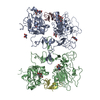
Cryo-EM structure of the freshwater actinorhodopsin, Rhodoluna lacicola (RlActR)
Method: EM (single particle) / Resolution: 2.84 Å

Chemicals

PDB-1inb:
Unknown entry

PDB-1ivo:
Crystal Structure of the Complex of Human Epidermal Growth Factor and Receptor Extracellular Domains.

PDB-1inc:
CRYSTAL STRUCTURES OF THE COMPLEX OF PORCINE PANCREATIC ELASTASE WITH TWO VALINE-DERIVED BENZOXAZINONE INHIBITORS

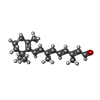
ChemComp-RET:
RETINAL

Source
  • rhodoluna lacicola (bacteria)
KeywordsPROTON TRANSPORT / bacterial / rhodopsin / fresh-water / proton transporter

+
About Yorodumi Papers

-
News

-
Feb 9, 2022. New format data for meta-information of EMDB entries

New format data for meta-information of EMDB entries

  • Version 3 of the EMDB header file is now the official format.
  • The previous official version 1.9 will be removed from the archive.

Related info.:EMDB header

External links:wwPDB to switch to version 3 of the EMDB data model

-
Aug 12, 2020. Covid-19 info

Covid-19 info

URL: https://pdbj.org/emnavi/covid19.php

New page: Covid-19 featured information page in EM Navigator.

Related info.:Covid-19 info / Mar 5, 2020. Novel coronavirus structure data

+
Mar 5, 2020. Novel coronavirus structure data

Novel coronavirus structure data

Related info.:Yorodumi Speices / Aug 12, 2020. Covid-19 info

External links:COVID-19 featured content - PDBj / Molecule of the Month (242):Coronavirus Proteases

+
Jan 31, 2019. EMDB accession codes are about to change! (news from PDBe EMDB page)

EMDB accession codes are about to change! (news from PDBe EMDB page)

  • The allocation of 4 digits for EMDB accession codes will soon come to an end. Whilst these codes will remain in use, new EMDB accession codes will include an additional digit and will expand incrementally as the available range of codes is exhausted. The current 4-digit format prefixed with “EMD-” (i.e. EMD-XXXX) will advance to a 5-digit format (i.e. EMD-XXXXX), and so on. It is currently estimated that the 4-digit codes will be depleted around Spring 2019, at which point the 5-digit format will come into force.
  • The EM Navigator/Yorodumi systems omit the EMD- prefix.

Related info.:Q: What is EMD? / ID/Accession-code notation in Yorodumi/EM Navigator

External links:EMDB Accession Codes are Changing Soon! / Contact to PDBj

+
Jul 12, 2017. Major update of PDB

Major update of PDB

  • wwPDB released updated PDB data conforming to the new PDBx/mmCIF dictionary.
  • This is a major update changing the version number from 4 to 5, and with Remediation, in which all the entries are updated.
  • In this update, many items about electron microscopy experimental information are reorganized (e.g. em_software).
  • Now, EM Navigator and Yorodumi are based on the updated data.

External links:wwPDB Remediation / Enriched Model Files Conforming to OneDep Data Standards Now Available in the PDB FTP Archive

-
Yorodumi Papers

Database of articles cited by EMDB/PDB/SASBDB data

  • Database of articles cited by EMDB, PDB, and SASBDB entries
  • Using PubMed data

Related info.:EMDB / PDB / SASBDB / Yorodumi / EMN Papers / Changes in new EM Navigator and Yorodumi

Read more