 Movie
Movie Controller

[English] 日本語
 Yorodumi
- EMDB-52114: Cryo-EM structure of the freshwater actinorhodopsin, Rhodoluna la... -
+ Open data

- Basic information
| Entry |  | |||||||||
|---|---|---|---|---|---|---|---|---|---|---|
| Title | Cryo-EM structure of the freshwater actinorhodopsin, Rhodoluna lacicola (RlActR) | |||||||||
 Map data Map data | Cryo-electron microscopy (cryo-EM) density map of actinorhodin from Rhodoluna lacicola (RlActR), refined to a resolution of 2.8 Angstrom following local refinement procedures. | |||||||||
 Sample Sample |
| |||||||||
 Keywords Keywords | bacterial / rhodopsin / fresh-water / proton transporter / PROTON TRANSPORT | |||||||||
| Function / homology | Bacterial rhodopsins signature 1. / Rhodopsin, retinal binding site / Bacteriorhodopsin-like protein / Archaeal/bacterial/fungal rhodopsins / Bacteriorhodopsin-like protein / monoatomic ion channel activity / membrane / Putative actinorhodopsin Function and homology information Function and homology information | |||||||||
| Biological species |  Rhodoluna lacicola (bacteria) Rhodoluna lacicola (bacteria) | |||||||||
| Method | single particle reconstruction / cryo EM / Resolution: 2.84 Å | |||||||||
 Authors Authors | Djabeur N / Jeckelmann J-M / Fotiadis D | |||||||||
| Funding support |  Switzerland, 1 items Switzerland, 1 items
| |||||||||
 Citation Citation | Journal: J Mol Biol / Year: 2026 Title: Structural, Mechanistic and Phylogenetic Insights Into a Freshwater Actinorhodopsin. Authors: Nadia Djabeur / Jean-Marc Jeckelmann / Nooraldeen Ayoub / Daniel Harder / Dimitrios Fotiadis / Abstract: Actinorhodopsins represent a unique subgroup of microbial rhodopsins, predominantly found in non-marine Actinobacteria and proposed to contribute to the global energy cycle. Despite their ecological ...Actinorhodopsins represent a unique subgroup of microbial rhodopsins, predominantly found in non-marine Actinobacteria and proposed to contribute to the global energy cycle. Despite their ecological significance, structural information on this family has remained scarce. Here, we present the high-resolution three-dimensional structure of the pentameric actinorhodopsin RlActR from the actinobacterium Rhodoluna lacicola, as determined by cryo-electron microscopy and single-particle 3D reconstruction. The structure provides molecular insights into key functional amino acid residues involved in retinal cofactor binding and the proton translocation pathway. In addition to describing the organization of the retinal Schiff base region, we present a comparative analysis of this region in RlActR and in prototypical microbial rhodopsins from two distinct phyla, namely, the green-light-absorbing proteorhodopsin from Bacteria and bacteriorhodopsin from Archaea. We also describe the amino acid interactions at the oligomerization interface that stabilize the pentamer. Furthermore, the structure reveals a pentameric architecture with a lipid-filled central cavity and lipid-occupied, membrane-facing interprotomer crevices, further highlighting molecular interactions that stabilize the assembly. Phylogenetic analysis and structural comparisons with selected microbial rhodopsins exhibiting light-driven proton-pumping activity position RlActR within a distinct group of proton-pumping rhodopsins, underscoring its evolutionary and functional relevance. | |||||||||
| History |
|
- Structure visualization
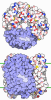
| Supplemental images |
|---|

- Downloads & links
-EMDB archive
| Map data | emd_52114.map.gz | 49.5 MB | EMDB map data format | |
|---|---|---|---|---|
| Header (meta data) | emd-52114-v30.xmlemd-52114.xml | 23.6 KB 23.6 KB | Display Display | EMDB header |
| FSC (resolution estimation) | emd_52114_fsc.xml | 7.9 KB | Display | FSC data file |
| Images |  emd_52114.png emd_52114.png | 74.9 KB | ||
| Filedesc metadata | emd-52114.cif.gz | 7.2 KB | ||
| Others | emd_52114_half_map_1.map.gzemd_52114_half_map_2.map.gz | 48.8 MB 48.8 MB | ||
| Archive directory |  https://data.pdbj.org/pub/emdb/structures/EMD-52114ftp://data.pdbj.org/pub/emdb/structures/EMD-52114 https://data.pdbj.org/pub/emdb/structures/EMD-52114ftp://data.pdbj.org/pub/emdb/structures/EMD-52114 | HTTPS FTP |
-Related structure data
| Related structure data |  9hfkMC M: atomic model generated by this map C: citing same article ( |
|---|---|
| Similar structure data |
-Links
| EMDB pages | EMDB (EBI/PDBe) / EMDataResource |
|---|---|
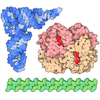
| Related items in Molecule of the Month |
-Map
| File | Download / File: emd_52114.map.gz / Format: CCP4 / Size: 52.7 MB / Type: IMAGE STORED AS FLOATING POINT NUMBER (4 BYTES) | ||||||||||||||||||||||||||||||||||||
|---|---|---|---|---|---|---|---|---|---|---|---|---|---|---|---|---|---|---|---|---|---|---|---|---|---|---|---|---|---|---|---|---|---|---|---|---|---|
| Annotation | Cryo-electron microscopy (cryo-EM) density map of actinorhodin from Rhodoluna lacicola (RlActR), refined to a resolution of 2.8 Angstrom following local refinement procedures. | ||||||||||||||||||||||||||||||||||||
| Projections & slices | Image control
Images are generated by Spider. | ||||||||||||||||||||||||||||||||||||
| Voxel size | X=Y=Z: 0.731 Å | ||||||||||||||||||||||||||||||||||||
| Density |
| ||||||||||||||||||||||||||||||||||||
| Symmetry | Space group: 1 | ||||||||||||||||||||||||||||||||||||
| Details | EMDB XML:
|
 Z (Sec.)
 Y (Row.)
 X (Col.)


-Supplemental data
-Half map: Cryo-electron microscopy (cryo-EM) Half-map A of actinorhodopsin from...
| File | emd_52114_half_map_1.map | ||||||||||||
|---|---|---|---|---|---|---|---|---|---|---|---|---|---|
| Annotation | Cryo-electron microscopy (cryo-EM) Half-map A of actinorhodopsin from Rhodoluna lacicola (RlActR) | ||||||||||||
| Projections & Slices |
| ||||||||||||
| Density Histograms |


-Half map: Cryo-electron microscopy (cryo-EM) Half-map B of actinorhodopsin from...
| File | emd_52114_half_map_2.map | ||||||||||||
|---|---|---|---|---|---|---|---|---|---|---|---|---|---|
| Annotation | Cryo-electron microscopy (cryo-EM) Half-map B of actinorhodopsin from Rhodoluna lacicola (RlActR) | ||||||||||||
| Projections & Slices |
| ||||||||||||
| Density Histograms |


- Sample components
-Entire : Pentamer of the actinorhodopsin
| Entire | Name: Pentamer of the actinorhodopsin |
|---|---|
| Components |
|
-Supramolecule #1: Pentamer of the actinorhodopsin
| Supramolecule | Name: Pentamer of the actinorhodopsin / type: complex / ID: 1 / Parent: 0 / Macromolecule list: #1 |
|---|---|
| Source (natural) | Organism: Rhodoluna lacicola (bacteria) / Strain: MWH-Ta8 / Location in cell: Membrane |
| Molecular weight | Theoretical: 226 KDa |
-Macromolecule #1: Bacteriorhodopsin
| Macromolecule | Name: Bacteriorhodopsin / type: protein_or_peptide / ID: 1 Details: A covalently bond, i.e. a Schiff base between Lys234 and retinal is present, ensuring accurate representation of the retinal-lysine linkage in the protein structure. Actinorhodopsin Number of copies: 5 / Enantiomer: LEVO |
|---|---|
| Source (natural) | Organism: Rhodoluna lacicola (bacteria) / Strain: MWH-Ta8 |
| Molecular weight | Theoretical: 30.087166 KDa |
| Recombinant expression | Organism:  Escherichia coli BL21(DE3) (bacteria) Escherichia coli BL21(DE3) (bacteria) |
| Sequence | String: MNTLSNALDN GQFNLVYNIL SLGIASMLFT AIFLFVARER VLPRYRIAVM VSATVTAIAA YHYFRMFDNF SHAFAGAENN PDAYNVGYR YVDWLLTVPL LLVELVAVLA LAKAAQSSIL NRLVPAAAAM IVLGYPGDAK LDIWGIAPSV WGLLSTIPFL Y ILYVLFIE ...String: MNTLSNALDN GQFNLVYNIL SLGIASMLFT AIFLFVARER VLPRYRIAVM VSATVTAIAA YHYFRMFDNF SHAFAGAENN PDAYNVGYR YVDWLLTVPL LLVELVAVLA LAKAAQSSIL NRLVPAAAAM IVLGYPGDAK LDIWGIAPSV WGLLSTIPFL Y ILYVLFIE LGKSLSRQSE AVQKKVKILR LLLIATWGVY PITFILAMGT PPGAPFNASE FVAREVGYSI ADILAKCLFG LI IYSIARI KSAEDDKEFA KAEFKDALEG HHHHH UniProtKB: Putative actinorhodopsin |
-Macromolecule #2: [(2~{R})-1-[2-azanylethoxy(oxidanyl)phosphoryl]oxy-3-dodecanoylox...
| Macromolecule | Name: [(2~{R})-1-[2-azanylethoxy(oxidanyl)phosphoryl]oxy-3-dodecanoyloxy-propan-2-yl]-tridecnoate type: ligand / ID: 2 / Number of copies: 5 / Formula: A1INB |
|---|---|
| Molecular weight | Theoretical: 593.773 Da |
-Macromolecule #3: [(2~{R})-1-[2-azanylethoxy(oxidanyl)phosphoryl]oxy-3-dodecanoylox...
| Macromolecule | Name: [(2~{R})-1-[2-azanylethoxy(oxidanyl)phosphoryl]oxy-3-dodecanoyloxy-propan-2-yl] octadecanoate type: ligand / ID: 3 / Number of copies: 5 / Formula: A1IVO |
|---|---|
| Molecular weight | Theoretical: 663.906 Da |
-Macromolecule #4: [(2~{R})-1-[2-azanylethoxy(oxidanyl)phosphoryl]oxy-3-nonanoyloxy-...
| Macromolecule | Name: [(2~{R})-1-[2-azanylethoxy(oxidanyl)phosphoryl]oxy-3-nonanoyloxy-propan-2-yl] (~{E})-octadec-9-enoate type: ligand / ID: 4 / Number of copies: 5 / Formula: A1INC |
|---|---|
| Molecular weight | Theoretical: 619.81 Da |
-Macromolecule #5: RETINAL
| Macromolecule | Name: RETINAL / type: ligand / ID: 5 / Number of copies: 5 / Formula: RET |
|---|---|
| Molecular weight | Theoretical: 284.436 Da |
| Chemical component information | 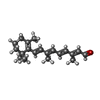 ChemComp-RET: |
-Experimental details
-Structure determination
| Method | cryo EM |
|---|---|
 Processing Processing | single particle reconstruction |
| Aggregation state | particle |
-Sample preparation
| Concentration | 2.5 mg/mL | |||||||||||||||
|---|---|---|---|---|---|---|---|---|---|---|---|---|---|---|---|---|
| Buffer | pH: 7.5 Component:
Details: Elution buffer B (20 mM BTP-HCl pH 7.5 adjusted at 4 degree, 150 mM NaCl, 200 mM L-histidine, 0.25% (w/v) Cymal-5) | |||||||||||||||
| Vitrification | Cryogen name: ETHANE / Chamber humidity: 100 % / Chamber temperature: 277.15 K / Instrument: FEI VITROBOT MARK IV Details: In brief, grids were incubated for 30 seconds, and excess liquid blotted off for 5 seconds applying a blotting force of -6 at 4 degrees and a relative humidity of about 100% before plunging ...Details: In brief, grids were incubated for 30 seconds, and excess liquid blotted off for 5 seconds applying a blotting force of -6 at 4 degrees and a relative humidity of about 100% before plunging into liquid ethane (-177 degrees to -171 degrees).. |
- Electron microscopy
| Microscope | TFS KRIOS |
|---|---|
| Specialist optics | Energy filter - Name: TFS Selectris X / Energy filter - Slit width: 10 eV |
| Image recording | Film or detector model: TFS FALCON 4i (4k x 4k) / Digitization - Dimensions - Width: 4096 pixel / Digitization - Dimensions - Height: 4096 pixel / Number grids imaged: 1 / Number real images: 9890 / Average exposure time: 0.00313 sec. / Average electron dose: 1.01 e/Å2 |
| Electron beam | Acceleration voltage: 300 kV / Electron source:  FIELD EMISSION GUN FIELD EMISSION GUN |
| Electron optics | C2 aperture diameter: 50.01 µm / Illumination mode: SPOT SCAN / Imaging mode: BRIGHT FIELD / Cs: 2.7 mm / Nominal defocus max: 2.2 µm / Nominal defocus min: 1.0 µm / Nominal magnification: 165000 |
| Sample stage | Specimen holder model: FEI TITAN KRIOS AUTOGRID HOLDER / Cooling holder cryogen: NITROGEN |
| Experimental equipment |  Model: Titan Krios / Image courtesy: FEI Company |
+Image processing

-Atomic model buiding 1
| Initial model | Chain - Source name: Other / Chain - Initial model type: in silico model / Details: created by modelAngelo |
|---|---|
| Details | Shiff base bond created between K234 and RETINAL (RET) |
| Output model | PDB-9hfk: |
