 Movie
Movie Controller

[English] 日本語
 Yorodumi
- PDB-9hfk: Cryo-EM structure of the freshwater actinorhodopsin, Rhodoluna la... -
+ Open data

- Basic information
| Entry | Database: PDB / ID: 9hfk | ||||||||||||||||||||||||
|---|---|---|---|---|---|---|---|---|---|---|---|---|---|---|---|---|---|---|---|---|---|---|---|---|---|
| Title | Cryo-EM structure of the freshwater actinorhodopsin, Rhodoluna lacicola (RlActR) | ||||||||||||||||||||||||
 Components Components | Bacteriorhodopsin | ||||||||||||||||||||||||
 Keywords Keywords | PROTON TRANSPORT / bacterial / rhodopsin / fresh-water / proton transporter | ||||||||||||||||||||||||
| Function / homology |  Function and homology information Function and homology information | ||||||||||||||||||||||||
| Biological species |  Rhodoluna lacicola (bacteria) Rhodoluna lacicola (bacteria) | ||||||||||||||||||||||||
| Method | ELECTRON MICROSCOPY / single particle reconstruction / cryo EM / Resolution: 2.84 Å | ||||||||||||||||||||||||
 Authors Authors | Djabeur, N. / Jeckelmann, J.-M. / Fotiadis, D. | ||||||||||||||||||||||||
| Funding support |  Switzerland, 1items Switzerland, 1items
| ||||||||||||||||||||||||
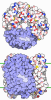
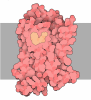
 Citation Citation | Journal: J Mol Biol / Year: 2026 Title: Structural, Mechanistic and Phylogenetic Insights Into a Freshwater Actinorhodopsin. Authors: Nadia Djabeur / Jean-Marc Jeckelmann / Nooraldeen Ayoub / Daniel Harder / Dimitrios Fotiadis / Abstract: Actinorhodopsins represent a unique subgroup of microbial rhodopsins, predominantly found in non-marine Actinobacteria and proposed to contribute to the global energy cycle. Despite their ecological ...Actinorhodopsins represent a unique subgroup of microbial rhodopsins, predominantly found in non-marine Actinobacteria and proposed to contribute to the global energy cycle. Despite their ecological significance, structural information on this family has remained scarce. Here, we present the high-resolution three-dimensional structure of the pentameric actinorhodopsin RlActR from the actinobacterium Rhodoluna lacicola, as determined by cryo-electron microscopy and single-particle 3D reconstruction. The structure provides molecular insights into key functional amino acid residues involved in retinal cofactor binding and the proton translocation pathway. In addition to describing the organization of the retinal Schiff base region, we present a comparative analysis of this region in RlActR and in prototypical microbial rhodopsins from two distinct phyla, namely, the green-light-absorbing proteorhodopsin from Bacteria and bacteriorhodopsin from Archaea. We also describe the amino acid interactions at the oligomerization interface that stabilize the pentamer. Furthermore, the structure reveals a pentameric architecture with a lipid-filled central cavity and lipid-occupied, membrane-facing interprotomer crevices, further highlighting molecular interactions that stabilize the assembly. Phylogenetic analysis and structural comparisons with selected microbial rhodopsins exhibiting light-driven proton-pumping activity position RlActR within a distinct group of proton-pumping rhodopsins, underscoring its evolutionary and functional relevance. | ||||||||||||||||||||||||
| History |
|
- Structure visualization
| Structure viewer | Molecule: MolmilJmol/JSmol |
|---|
- Downloads & links
-Download
| PDBx/mmCIF format | 9hfk.cif.gz | 469.1 KB | Display | PDBx/mmCIF format |
|---|---|---|---|---|
| PDB format | pdb9hfk.ent.gz | Display | PDB format | |
| PDBx/mmJSON format | 9hfk.json.gz | Tree view | PDBx/mmJSON format | |
| Others |  Other downloads Other downloads |
-Validation report
| Arichive directory | https://data.pdbj.org/pub/pdb/validation_reports/hf/9hfkftp://data.pdbj.org/pub/pdb/validation_reports/hf/9hfk | HTTPS FTP |
|---|
-Related structure data
| Related structure data |  52114MC M: map data used to model this data C: citing same article ( |
|---|---|
| Similar structure data |
-Links
 PDBj
PDBj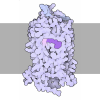
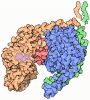
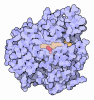
- Assembly
| Deposited unit | 
|
|---|---|
| 1 |
|
-Components
| #1: Protein | Mass: 30087.166 Da / Num. of mol.: 5 Source method: isolated from a genetically manipulated source Details: Freshwater bacterium / Source: (gene. exp.) Rhodoluna lacicola (bacteria) / Strain: MWH-Ta8 / Gene: Rhola_00012080 / Plasmid: pZUDF21 / Cell (production host): Bacterial cell / Production host:  Escherichia coli BL21(DE3) (bacteria) / Variant (production host): C43 / References: UniProt: C0K2L3 Escherichia coli BL21(DE3) (bacteria) / Variant (production host): C43 / References: UniProt: C0K2L3#2: Chemical | ChemComp-A1INB / [( Mass: 593.773 Da / Num. of mol.: 5 / Source method: obtained synthetically / Formula: C30H60NO8P / Feature type: SUBJECT OF INVESTIGATION #3: Chemical | ChemComp-A1IVO / [( Mass: 663.906 Da / Num. of mol.: 5 / Source method: obtained synthetically / Formula: C35H70NO8P #4: Chemical | ChemComp-A1INC / [( Mass: 619.810 Da / Num. of mol.: 5 / Source method: obtained synthetically / Formula: C32H62NO8P #5: Chemical | ChemComp-RET / 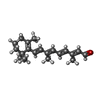 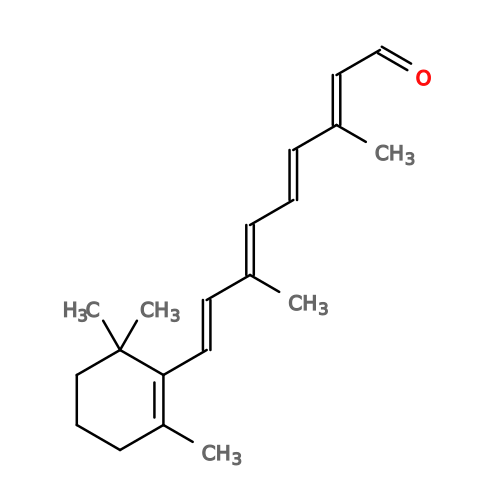 Mass: 284.436 Da / Num. of mol.: 5 / Source method: obtained synthetically / Formula: C20H28O / Feature type: SUBJECT OF INVESTIGATION Mass: 284.436 Da / Num. of mol.: 5 / Source method: obtained synthetically / Formula: C20H28O / Feature type: SUBJECT OF INVESTIGATIONHas ligand of interest | Y | Has protein modification | Y | |
|---|
-Experimental details
-Experiment
| Experiment | Method: ELECTRON MICROSCOPY |
|---|---|
| EM experiment | Aggregation state: PARTICLE / 3D reconstruction method: single particle reconstruction |
- Sample preparation
| Component | Name: Pentamer of the actinorhodopsin / Type: COMPLEX / Entity ID: #1 / Source: RECOMBINANT | |||||||||||||||||||||||||
|---|---|---|---|---|---|---|---|---|---|---|---|---|---|---|---|---|---|---|---|---|---|---|---|---|---|---|
| Molecular weight | Value: 0.226 MDa / Experimental value: NO | |||||||||||||||||||||||||
| Source (natural) | Organism: Rhodoluna lacicola (bacteria) / Strain: MWH-Ta8 / Cellular location: Membrane | |||||||||||||||||||||||||
| Source (recombinant) | Organism: Escherichia coli C43(DE3) / Strain: C43(DE3) / Cell: Bacterial cell / Plasmid: pZUDF21 | |||||||||||||||||||||||||
| Buffer solution | pH: 7.5 Details: Elution buffer B (20 mM BTP-HCl pH 7.5 adjusted at 4 degree, 150 mM NaCl, 200 mM L-histidine, 0.25% (w/v) Cymal-5) | |||||||||||||||||||||||||
| Buffer component |
| |||||||||||||||||||||||||
| Specimen | Conc.: 2.5 mg/ml / Embedding applied: NO / Shadowing applied: NO / Staining applied: NO / Vitrification applied: YES | |||||||||||||||||||||||||
| Vitrification | Instrument: FEI VITROBOT MARK IV / Cryogen name: ETHANE / Humidity: 100 % / Chamber temperature: 277.15 K Details: In brief, grids were incubated for 30 seconds, and excess liquid blotted off for 5 seconds applying a blotting force of -6 at 4 degrees and a relative humidity of about 100% before plunging ...Details: In brief, grids were incubated for 30 seconds, and excess liquid blotted off for 5 seconds applying a blotting force of -6 at 4 degrees and a relative humidity of about 100% before plunging into liquid ethane (-177 degrees to -171 degrees). |
- Electron microscopy imaging
| Experimental equipment |  Model: Titan Krios / Image courtesy: FEI Company |
|---|---|
| Microscopy | Model: TFS KRIOS |
| Electron gun | Electron source:  FIELD EMISSION GUN / Accelerating voltage: 300 kV / Illumination mode: SPOT SCAN FIELD EMISSION GUN / Accelerating voltage: 300 kV / Illumination mode: SPOT SCAN |
| Electron lens | Mode: BRIGHT FIELD / Nominal magnification: 165000 X / Nominal defocus max: 2200 nm / Nominal defocus min: 1000 nm / Cs: 2.7 mm / C2 aperture diameter: 50.01 µm / Alignment procedure: COMA FREE |
| Specimen holder | Cryogen: NITROGEN / Specimen holder model: FEI TITAN KRIOS AUTOGRID HOLDER |
| Image recording | Average exposure time: 0.00313 sec. / Electron dose: 1.01 e/Å2 / Film or detector model: TFS FALCON 4i (4k x 4k) / Num. of grids imaged: 1 / Num. of real images: 9890 |
| EM imaging optics | Energyfilter name: TFS Selectris X / Energyfilter slit width: 10 eV |
| Image scans | Sampling size: 14 µm / Width: 4096 / Height: 4096 |
- Processing
| EM software |
| ||||||||||||||||||||||||||||||||||||||||
|---|---|---|---|---|---|---|---|---|---|---|---|---|---|---|---|---|---|---|---|---|---|---|---|---|---|---|---|---|---|---|---|---|---|---|---|---|---|---|---|---|---|
| CTF correction | Type: PHASE FLIPPING AND AMPLITUDE CORRECTION | ||||||||||||||||||||||||||||||||||||||||
| Particle selection | Num. of particles selected: 431658 Details: a non-template-driven convolutional neural network (CNN) based-particle picking was performed within CrYOLO (version 1.5). A total of 431,658 particles were selected with the pre-trained ...Details: a non-template-driven convolutional neural network (CNN) based-particle picking was performed within CrYOLO (version 1.5). A total of 431,658 particles were selected with the pre-trained general model and extracted from the remaining 8170 dose-weighted micrographs with Relion4 | ||||||||||||||||||||||||||||||||||||||||
| Symmetry | Point symmetry: C5 (5 fold cyclic) | ||||||||||||||||||||||||||||||||||||||||
| 3D reconstruction | Resolution: 2.84 Å / Resolution method: FSC 0.143 CUT-OFF / Num. of particles: 184961 / Algorithm: FOURIER SPACE / Num. of class averages: 1 / Symmetry type: POINT | ||||||||||||||||||||||||||||||||||||||||
| Atomic model building | Details: Shiff base bond created between K234 and RETINAL (RET) | ||||||||||||||||||||||||||||||||||||||||
| Atomic model building | Details: created by modelAngelo / Source name: Other / Type: in silico model |
