[English] 日本語
Yorodumi Papers
- Database of articles cited by EMDB/PDB/SASBDB data -

+
Search query

Keywords
Structure methods
Author
Journal
IF

-
Structure paper

TitleMolecular mechanism of ultrafast transport by plasma membrane Ca-ATPases.
Journal, issue, pagesNature, Vol. 646, Issue 8083, Page 236-245, Year 2025
Publish dateAug 20, 2025
AuthorsDeivanayagabarathy Vinayagam / Oleg Sitsel / Uwe Schulte / Cristina E Constantin / Wout Oosterheert / Daniel Prumbaum / Gerd Zolles / Bernd Fakler / Stefan Raunser /
PubMed AbstractTight control of intracellular Ca levels is fundamental as they are used to control numerous signal transduction pathways. Plasma membrane Ca-ATPases (PMCAs) have a crucial role in this process by ...Tight control of intracellular Ca levels is fundamental as they are used to control numerous signal transduction pathways. Plasma membrane Ca-ATPases (PMCAs) have a crucial role in this process by extruding Ca against a steep concentration gradient from the cytosol to the extracellular space. Although new details of PMCA biology are constantly being uncovered, the structural basis of the most distinguishing features of these pumps, namely, transport rates in the kilohertz range and regulation of activity by the plasma membrane phospholipid PtdIns(4,5)P, has so far remained elusive. Here we present the structures of mouse PMCA2 in the presence and absence of its accessory subunit neuroplastin in eight different stages of its transport cycle. Combined with whole-cell recordings that accurately track PMCA-mediated Ca extrusion in intact cells, these structures enable us to establish the first comprehensive transport model for a PMCA, reveal the role of disease-causing mutations and uncover the structural underpinnings of regulatory PMCA-phospholipid interaction. The transport cycle-dependent dynamics of PtdIns(4,5)P are fundamental for its role as a 'latch' promoting the fast release of Ca and opening a passageway for counter-ions. These actions are required for maintaining the ultra-fast transport cycle. Moreover, we identify the PtdIns(4,5)P-binding site as an unanticipated target for drug-mediated manipulation of intracellular Ca levels. Our work provides detailed structural insights into the uniquely fast operation of native PMCA-type Ca pumps and its control by membrane lipids and drugs.
External linksNature / PubMed:40836084 / PubMed Central
MethodsEM (single particle) / X-ray diffraction
Resolution2.03 - 3.7 Å
Structure data

EMDB-51544, PDB-9gsd:
Cryo-EM structure of mouse PMCA-NPTN complex captured in E2 state (BEF3)
Method: EM (single particle) / Resolution: 3.04 Å

EMDB-51545, PDB-9gse:
Cryo-EM structure of mouse PMCA-NPTN complex captured in E1 state without calcium
Method: EM (single particle) / Resolution: 3.64 Å

EMDB-51546, PDB-9gsf:
Mouse PMCA-NPTN complex captured in E1-ATP state without calcium
Method: EM (single particle) / Resolution: 3.35 Å

EMDB-51547, PDB-9gsg:
Cryo-EM structure of mouse PMCA-NPTN complex captured in E2-Pi state (ALF4)
Method: EM (single particle) / Resolution: 2.83 Å

EMDB-51548, PDB-9gsh:
Cryo-EM structure of PMCA-NPTN complex captured in E1-Ca-ATP state
Method: EM (single particle) / Resolution: 3.13 Å

EMDB-51549, PDB-9gsi:
Cryo-EM structure of mouse PMCA captured in E1-ATP in the presence of Calcium
Method: EM (single particle) / Resolution: 3.39 Å

EMDB-51558, PDB-9gsy:
Cryo-EM structure of mouse PMCA captured in E2-P state (BEF3)
Method: EM (single particle) / Resolution: 3.52 Å

EMDB-51560, PDB-9gtb:
Cryo-EM structure of Mouse PMCA-NPTN complex captured in E1-Ca state
Method: EM (single particle) / Resolution: 3.5 Å

EMDB-51625: Cryo-EM map of the complete PMCA-NPTN complex captured in E1-Ca state
Method: EM (single particle) / Resolution: 3.7 Å

PDB-9gti:
X-ray crystal structure of mouse NPTN N-terminal domain
Method: X-RAY DIFFRACTION / Resolution: 2.03 Å

Chemicals

ChemComp-MG:
Unknown entry

ChemComp-KXP:
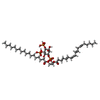
(2S)-1-{[(R)-hydroxy{[(1R,2R,3S,4R,5R,6S)-2,3,6-trihydroxy-4,5-bis(phosphonooxy)cyclohexyl]oxy}phosphoryl]oxy}-3-(octadecanoyloxy)propan-2-yl icosa-5,8,11,14-tetraenoate

ChemComp-BEF:
BERYLLIUM TRIFLUORIDE ION

ChemComp-NAG:
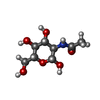
2-acetamido-2-deoxy-beta-D-glucopyranose

ChemComp-HOH:
WATER

ChemComp-ANP:
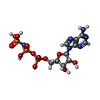
PHOSPHOAMINOPHOSPHONIC ACID-ADENYLATE ESTER / AMP-PNP, energy-carrying molecule analogue*YM

ChemComp-ALF:
TETRAFLUOROALUMINATE ION

ChemComp-CA:
Unknown entry

ChemComp-PEG:
DI(HYDROXYETHYL)ETHER

ChemComp-EPE:
4-(2-HYDROXYETHYL)-1-PIPERAZINE ETHANESULFONIC ACID / pH buffer*YM

Source
  • mus musculus (house mouse)
KeywordsMEMBRANE PROTEIN / Calcium pump / Ptype-Atpase / Calcium Transporter / P-type Atpase / antiporter / CELL ADHESION / Ig like domain / cell surface protein / Membrane associated

+
About Yorodumi Papers

-
News

-
Feb 9, 2022. New format data for meta-information of EMDB entries

New format data for meta-information of EMDB entries

  • Version 3 of the EMDB header file is now the official format.
  • The previous official version 1.9 will be removed from the archive.

Related info.:EMDB header

External links:wwPDB to switch to version 3 of the EMDB data model

-
Aug 12, 2020. Covid-19 info

Covid-19 info

URL: https://pdbj.org/emnavi/covid19.php

New page: Covid-19 featured information page in EM Navigator.

Related info.:Covid-19 info / Mar 5, 2020. Novel coronavirus structure data

+
Mar 5, 2020. Novel coronavirus structure data

Novel coronavirus structure data

Related info.:Yorodumi Speices / Aug 12, 2020. Covid-19 info

External links:COVID-19 featured content - PDBj / Molecule of the Month (242):Coronavirus Proteases

+
Jan 31, 2019. EMDB accession codes are about to change! (news from PDBe EMDB page)

EMDB accession codes are about to change! (news from PDBe EMDB page)

  • The allocation of 4 digits for EMDB accession codes will soon come to an end. Whilst these codes will remain in use, new EMDB accession codes will include an additional digit and will expand incrementally as the available range of codes is exhausted. The current 4-digit format prefixed with “EMD-” (i.e. EMD-XXXX) will advance to a 5-digit format (i.e. EMD-XXXXX), and so on. It is currently estimated that the 4-digit codes will be depleted around Spring 2019, at which point the 5-digit format will come into force.
  • The EM Navigator/Yorodumi systems omit the EMD- prefix.

Related info.:Q: What is EMD? / ID/Accession-code notation in Yorodumi/EM Navigator

External links:EMDB Accession Codes are Changing Soon! / Contact to PDBj

+
Jul 12, 2017. Major update of PDB

Major update of PDB

  • wwPDB released updated PDB data conforming to the new PDBx/mmCIF dictionary.
  • This is a major update changing the version number from 4 to 5, and with Remediation, in which all the entries are updated.
  • In this update, many items about electron microscopy experimental information are reorganized (e.g. em_software).
  • Now, EM Navigator and Yorodumi are based on the updated data.

External links:wwPDB Remediation / Enriched Model Files Conforming to OneDep Data Standards Now Available in the PDB FTP Archive

-
Yorodumi Papers

Database of articles cited by EMDB/PDB/SASBDB data

  • Database of articles cited by EMDB, PDB, and SASBDB entries
  • Using PubMed data

Related info.:EMDB / PDB / SASBDB / Yorodumi / EMN Papers / Changes in new EM Navigator and Yorodumi

Read more