[English] 日本語
Yorodumi Papers
- Database of articles cited by EMDB/PDB/SASBDB data -

+
Search query

Keywords
Structure methods
Author
Journal
IF

-
Structure paper

TitleCryo-EM structures of a protein pore reveal a cluster of cholesterol molecules and diverse roles of membrane lipids.
Journal, issue, pagesNat Commun, Vol. 16, Issue 1, Page 2972, Year 2025
Publish dateMar 26, 2025
AuthorsGašper Šolinc / Marija Srnko / Franci Merzel / Ana Crnković / Mirijam Kozorog / Marjetka Podobnik / Gregor Anderluh /
PubMed AbstractThe structure and function of membrane proteins depend on their interactions with lipids that constitute membranes. Actinoporins are α-pore-forming proteins that bind preferentially to sphingomyelin- ...The structure and function of membrane proteins depend on their interactions with lipids that constitute membranes. Actinoporins are α-pore-forming proteins that bind preferentially to sphingomyelin-containing membranes, where they oligomerize and form transmembrane pores. Through a comprehensive cryo-electron microscopic analysis of a pore formed by an actinoporin Fav from the coral Orbicella faveolata, we show that the octameric pore interacts with 112 lipids in the upper leaflet of the membrane, reveal the roles of lipids, and demonstrate that the actinoporin surface is suited for binding multiple receptor sphingomyelin molecules. When cholesterol is present in the membrane, it forms a cluster of four molecules associated with each protomer. Atomistic simulations support the structural data and reveal additional effects of the pore on the lipid membrane. These data reveal a complex network of protein-lipid and lipid-lipid interactions and an underrated role of lipids in the structure and function of transmembrane protein complexes.
External linksNat Commun / PubMed:40140423 / PubMed Central
MethodsEM (single particle) / X-ray diffraction
Resolution1.5 - 3.6 Å
Structure data

EMDB-50057, PDB-9eym:
The structure of solubilized octameric pore of actinoporin Fav prepared on DOPC:sphingomyelin membranes
Method: EM (single particle) / Resolution: 2.6 Å

EMDB-50058, PDB-9eyn:
The structure of solubilized octameric pore of actinoporin Fav prepared on DOPC, cholesterol, sphingomyelin membranes
Method: EM (single particle) / Resolution: 3.06 Å

EMDB-50059, PDB-9eyo:
The structure of solubilized octameric pore of actinoporin Fav prepared on POPG, cholesterol, sphingomyelin membranes
Method: EM (single particle) / Resolution: 2.86 Å

EMDB-50060: The octameric pore of actinoporin Fav prepared on DOPC:sphingomyelin:cholesterol containing nanodiscs
Method: EM (single particle) / Resolution: 3.6 Å

PDB-9eyl:
dN53 deletion variant of monomeric Fav - actinoporin from Orbicella faveolata
Method: X-RAY DIFFRACTION / Resolution: 1.5 Å

Chemicals

ChemComp-SO4:
SULFATE ION

ChemComp-144:
TRIS-HYDROXYMETHYL-METHYL-AMMONIUM

ChemComp-HOH:
WATER

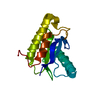
PDB-1h8m:
Solution structure of ykt6

ChemComp-CLR:
CHOLESTEROL

Source
  • orbicella faveolata (invertebrata)
KeywordsTOXIN / Actinoporin / Pore-forming toxin / Orbicella faveolata / Pore / Octamer / Transmembrane pore / Nanopore / cholesterol

+
About Yorodumi Papers

-
News

-
Feb 9, 2022. New format data for meta-information of EMDB entries

New format data for meta-information of EMDB entries

  • Version 3 of the EMDB header file is now the official format.
  • The previous official version 1.9 will be removed from the archive.

Related info.:EMDB header

External links:wwPDB to switch to version 3 of the EMDB data model

-
Aug 12, 2020. Covid-19 info

Covid-19 info

URL: https://pdbj.org/emnavi/covid19.php

New page: Covid-19 featured information page in EM Navigator.

Related info.:Covid-19 info / Mar 5, 2020. Novel coronavirus structure data

+
Mar 5, 2020. Novel coronavirus structure data

Novel coronavirus structure data

Related info.:Yorodumi Speices / Aug 12, 2020. Covid-19 info

External links:COVID-19 featured content - PDBj / Molecule of the Month (242):Coronavirus Proteases

+
Jan 31, 2019. EMDB accession codes are about to change! (news from PDBe EMDB page)

EMDB accession codes are about to change! (news from PDBe EMDB page)

  • The allocation of 4 digits for EMDB accession codes will soon come to an end. Whilst these codes will remain in use, new EMDB accession codes will include an additional digit and will expand incrementally as the available range of codes is exhausted. The current 4-digit format prefixed with “EMD-” (i.e. EMD-XXXX) will advance to a 5-digit format (i.e. EMD-XXXXX), and so on. It is currently estimated that the 4-digit codes will be depleted around Spring 2019, at which point the 5-digit format will come into force.
  • The EM Navigator/Yorodumi systems omit the EMD- prefix.

Related info.:Q: What is EMD? / ID/Accession-code notation in Yorodumi/EM Navigator

External links:EMDB Accession Codes are Changing Soon! / Contact to PDBj

+
Jul 12, 2017. Major update of PDB

Major update of PDB

  • wwPDB released updated PDB data conforming to the new PDBx/mmCIF dictionary.
  • This is a major update changing the version number from 4 to 5, and with Remediation, in which all the entries are updated.
  • In this update, many items about electron microscopy experimental information are reorganized (e.g. em_software).
  • Now, EM Navigator and Yorodumi are based on the updated data.

External links:wwPDB Remediation / Enriched Model Files Conforming to OneDep Data Standards Now Available in the PDB FTP Archive

-
Yorodumi Papers

Database of articles cited by EMDB/PDB/SASBDB data

  • Database of articles cited by EMDB, PDB, and SASBDB entries
  • Using PubMed data

Related info.:EMDB / PDB / SASBDB / Yorodumi / EMN Papers / Changes in new EM Navigator and Yorodumi

Read more