 Movie
Movie Controller

[English] 日本語
 Yorodumi
- PDB-9eyl: dN53 deletion variant of monomeric Fav - actinoporin from Orbicel... -
+ Open data

- Basic information
| Entry | Database: PDB / ID: 9eyl | ||||||||||||
|---|---|---|---|---|---|---|---|---|---|---|---|---|---|
| Title | dN53 deletion variant of monomeric Fav - actinoporin from Orbicella faveolata | ||||||||||||
 Components Components | dN53_Fav | ||||||||||||
 Keywords Keywords | TOXIN / Actinoporin / Pore-forming toxin / Orbicella faveolata | ||||||||||||
| Function / homology | TRIS-HYDROXYMETHYL-METHYL-AMMONIUM Function and homology information Function and homology information | ||||||||||||
| Biological species |  Orbicella faveolata (invertebrata) Orbicella faveolata (invertebrata) | ||||||||||||
| Method |  X-RAY DIFFRACTION / SYNCHROTRON / MOLECULAR REPLACEMENT / Resolution: 1.5 Å X-RAY DIFFRACTION / SYNCHROTRON / MOLECULAR REPLACEMENT / Resolution: 1.5 Å | ||||||||||||
 Authors Authors | Solinc, G. / Svigelj, T. / Anderluh, G. / Podobnik, M. | ||||||||||||
| Funding support |  Slovenia, Slovenia,  United Kingdom, 3items United Kingdom, 3items
| ||||||||||||
 Citation Citation | Journal: Nat Commun / Year: 2025 Title: Cryo-EM structures of a protein pore reveal a cluster of cholesterol molecules and diverse roles of membrane lipids. Authors: Gašper Šolinc / Marija Srnko / Franci Merzel / Ana Crnković / Mirijam Kozorog / Marjetka Podobnik / Gregor Anderluh / Abstract: The structure and function of membrane proteins depend on their interactions with lipids that constitute membranes. Actinoporins are α-pore-forming proteins that bind preferentially to sphingomyelin- ...The structure and function of membrane proteins depend on their interactions with lipids that constitute membranes. Actinoporins are α-pore-forming proteins that bind preferentially to sphingomyelin-containing membranes, where they oligomerize and form transmembrane pores. Through a comprehensive cryo-electron microscopic analysis of a pore formed by an actinoporin Fav from the coral Orbicella faveolata, we show that the octameric pore interacts with 112 lipids in the upper leaflet of the membrane, reveal the roles of lipids, and demonstrate that the actinoporin surface is suited for binding multiple receptor sphingomyelin molecules. When cholesterol is present in the membrane, it forms a cluster of four molecules associated with each protomer. Atomistic simulations support the structural data and reveal additional effects of the pore on the lipid membrane. These data reveal a complex network of protein-lipid and lipid-lipid interactions and an underrated role of lipids in the structure and function of transmembrane protein complexes. | ||||||||||||
| History |
|
- Structure visualization
| Structure viewer | Molecule: MolmilJmol/JSmol |
|---|
- Downloads & links
-Download
| PDBx/mmCIF format | 9eyl.cif.gz | 59.6 KB | Display | PDBx/mmCIF format |
|---|---|---|---|---|
| PDB format | pdb9eyl.ent.gz | 41.1 KB | Display | PDB format |
| PDBx/mmJSON format | 9eyl.json.gz | Tree view | PDBx/mmJSON format | |
| Others |  Other downloads Other downloads |
-Validation report
| Arichive directory | https://data.pdbj.org/pub/pdb/validation_reports/ey/9eylftp://data.pdbj.org/pub/pdb/validation_reports/ey/9eyl | HTTPS FTP |
|---|
-Related structure data


-Links
 PDBj
PDBj- Assembly
| Deposited unit | 
| |||||||||
|---|---|---|---|---|---|---|---|---|---|---|
| 1 |
| |||||||||
| Unit cell |
| |||||||||
| Components on special symmetry positions |
|
-Components
| #1: Protein | Mass: 23002.561 Da / Num. of mol.: 1 / Mutation: dN53 Source method: isolated from a genetically manipulated source Details: This protein was expressed with an N-terminal deletion of 53 residues compared to the wild type. The deletion construct has three additional residues at the N-terminal (GHM) from the expression system. Source: (gene. exp.) Orbicella faveolata (invertebrata) / Plasmid: pET28a (+)Details (production host): modified pET28a (+) plasmid with the N-terminal 6-histidine tag and TEV restriction site ENLYFQGHM Production host:   Escherichia coli BL21(DE3) (bacteria) Escherichia coli BL21(DE3) (bacteria) | ||||||||
|---|---|---|---|---|---|---|---|---|---|
| #2: Chemical |  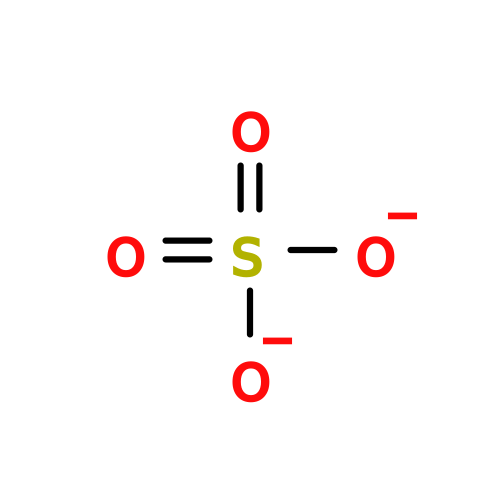 Mass: 96.063 Da / Num. of mol.: 2 / Source method: isolated from a natural source / Formula: SO4 Mass: 96.063 Da / Num. of mol.: 2 / Source method: isolated from a natural source / Formula: SO4#3: Chemical | ChemComp-144 / |   Mass: 122.143 Da / Num. of mol.: 1 / Source method: obtained synthetically / Formula: C4H12NO3 Mass: 122.143 Da / Num. of mol.: 1 / Source method: obtained synthetically / Formula: C4H12NO3#4: Water | ChemComp-HOH / |  Mass: 18.015 Da / Num. of mol.: 274 / Source method: isolated from a natural source / Formula: H2O Mass: 18.015 Da / Num. of mol.: 274 / Source method: isolated from a natural source / Formula: H2OHas ligand of interest | N | Has protein modification | Y | |
-Experimental details
-Experiment
| Experiment | Method: X-RAY DIFFRACTION / Number of used crystals: 1 |
|---|
- Sample preparation
| Crystal | Density Matthews: 2.14 Å3/Da / Density % sol: 42.65 % / Description: hexagonal rods |
|---|---|
| Crystal grow | Temperature: 293.15 K / Method: vapor diffusion, hanging drop / Details: 1.8 M Li2SO4 / PH range: 6-8 |
-Data collection
| Diffraction | Mean temperature: 100 K / Serial crystal experiment: N |
|---|---|
| Diffraction source | Source: SYNCHROTRON / Site: ELETTRA  / Beamline: 5.2R / Wavelength: 1 Å / Beamline: 5.2R / Wavelength: 1 Å |
| Detector | Type: DECTRIS PILATUS 2M / Detector: PIXEL / Date: May 31, 2017 |
| Radiation | Protocol: SINGLE WAVELENGTH / Monochromatic (M) / Laue (L): M / Scattering type: x-ray |
| Radiation wavelength | Wavelength: 1 Å / Relative weight: 1 |
| Reflection | Resolution: 1.5→45.8 Å / Num. obs: 32274 / % possible obs: 99.95 % / Redundancy: 10.4 % / Biso Wilson estimate: 11.89 Å2 / CC1/2: 0.999 / CC star: 1 / Rmerge(I) obs: 0.09948 / Rpim(I) all: 0.03232 / Rrim(I) all: 0.1047 / Net I/σ(I): 18.73 |
| Reflection shell | Resolution: 1.5→1.554 Å / Redundancy: 10.1 % / Rmerge(I) obs: 0.7893 / Mean I/σ(I) obs: 3.25 / Num. unique obs: 3195 / CC1/2: 0.887 / CC star: 0.969 / Rpim(I) all: 0.26 / Rrim(I) all: 0.8317 / % possible all: 99.59 |
- Processing
| Software |
| |||||||||||||||||||||||||||||||||||||||||||||||||||||||||||||||||||||||||||||||||||||||||||||||||||||||||
|---|---|---|---|---|---|---|---|---|---|---|---|---|---|---|---|---|---|---|---|---|---|---|---|---|---|---|---|---|---|---|---|---|---|---|---|---|---|---|---|---|---|---|---|---|---|---|---|---|---|---|---|---|---|---|---|---|---|---|---|---|---|---|---|---|---|---|---|---|---|---|---|---|---|---|---|---|---|---|---|---|---|---|---|---|---|---|---|---|---|---|---|---|---|---|---|---|---|---|---|---|---|---|---|---|---|---|
| Refinement | Method to determine structure: MOLECULAR REPLACEMENT / Resolution: 1.5→45.8 Å / SU ML: 0.16 / Cross valid method: FREE R-VALUE / σ(F): 1.37 / Phase error: 17.9 / Stereochemistry target values: ML
| |||||||||||||||||||||||||||||||||||||||||||||||||||||||||||||||||||||||||||||||||||||||||||||||||||||||||
| Solvent computation | Shrinkage radii: 0.9 Å / VDW probe radii: 1.1 Å / Solvent model: FLAT BULK SOLVENT MODEL | |||||||||||||||||||||||||||||||||||||||||||||||||||||||||||||||||||||||||||||||||||||||||||||||||||||||||
| Refinement step | Cycle: LAST / Resolution: 1.5→45.8 Å
| |||||||||||||||||||||||||||||||||||||||||||||||||||||||||||||||||||||||||||||||||||||||||||||||||||||||||
| Refine LS restraints |
| |||||||||||||||||||||||||||||||||||||||||||||||||||||||||||||||||||||||||||||||||||||||||||||||||||||||||
| LS refinement shell |
|
