[English] 日本語
Yorodumi Papers
- Database of articles cited by EMDB/PDB/SASBDB data -

+
Search query

Keywords
Structure methods
Author
Journal
IF

-
Structure paper

TitleFunctional and structural characterization of F-ATPase with common ancestral core domains in stator ring.
Journal, issue, pagesProtein Sci, Vol. 34, Issue 11, Page e70345, Year 2025
Publish dateOct 24, 2025
AuthorsAya K Suzuki / Ryutaro Furukawa / Meghna Sobti / Simon H J Brown / Alastair G Stewart / Satoshi Akanuma / Hiroshi Ueno / Hiroyuki Noji /
PubMed AbstractExtant F-ATPases exhibit diverse rotational stepping behaviors-3-, 6-, or 9-step cycles-yet the evolutionary origin of these patterns remains unclear. Here, we used ancestral sequence reconstruction ...Extant F-ATPases exhibit diverse rotational stepping behaviors-3-, 6-, or 9-step cycles-yet the evolutionary origin of these patterns remains unclear. Here, we used ancestral sequence reconstruction to infer the catalytic β and non-catalytic α subunits of a putative ancestral F-ATPase. We then fused their functionally critical domains into the thermostable F from Bacillus PS3, yielding a stable chimeric enzyme. Cryo-EM revealed two distinct conformational states-binding and catalytic dwell states-separated by a ~34° rotation of the γ subunit, suggesting a fundamental six-step mechanism akin to that of extant six-stepping F-ATPases. Single-molecule rotation assays with ATP and the slowly hydrolyzed ATP analog ATPγS demonstrated that the chimeric motor is intrinsically a six-stepper, pausing at binding and catalytic dwell positions separated by 32.1°, although the binding dwell is significantly prolonged by an unknown mechanism. These findings indicate that F-ATPase was originally a six-stepper and diversified into 3-, 6- and 9-step forms in evolutionary adaptation. Based on these results, we discuss plausible features of the entire FF complex, along with potential physiological contexts in the last universal common ancestor and related lineages.
External linksProtein Sci / PubMed:41131942 / PubMed Central
MethodsEM (single particle)
Resolution2.46 - 2.77 Å
Structure data

EMDB-49839, PDB-9nvl:
ATPase Hybrid F1 with the ancestral core domains Binding Dwell
Method: EM (single particle) / Resolution: 2.46 Å

EMDB-49840, PDB-9nvm:
ATPase Hybrid F1 with the ancestral core domains Catalytic Dwell
Method: EM (single particle) / Resolution: 2.58 Å

EMDB-49841: ATPase hybrid F1 with the ancestral core domains Hexamer without stalk Binding dwell
Method: EM (single particle) / Resolution: 2.77 Å

EMDB-49842: ATPase hybrid F1 with the ancestral core domains Tetramer with stalk Binding Dwell
Method: EM (single particle) / Resolution: 2.46 Å

EMDB-49843: ATPase hybrid F1 with the ancestral core domains Tetramer no stalk Binding Dwell
Method: EM (single particle) / Resolution: 2.68 Å

Chemicals

ChemComp-MG:
Unknown entry

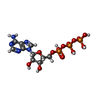
ChemComp-ATP:
ADENOSINE-5'-TRIPHOSPHATE / ATP, energy-carrying molecule*YM

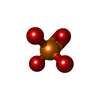
ChemComp-PO4:
PHOSPHATE ION

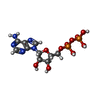
ChemComp-ADP:
ADENOSINE-5'-DIPHOSPHATE / ADP, energy-carrying molecule*YM

Source
  • bacillus sp. ps3 (bacteria)
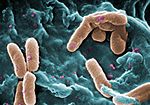
  • pseudomonas aeruginosa (bacteria)
KeywordsELECTRON TRANSPORT / single particle / Ancestral ATPase / Enerygy

+
About Yorodumi Papers

-
News

-
Feb 9, 2022. New format data for meta-information of EMDB entries

New format data for meta-information of EMDB entries

  • Version 3 of the EMDB header file is now the official format.
  • The previous official version 1.9 will be removed from the archive.

Related info.:EMDB header

External links:wwPDB to switch to version 3 of the EMDB data model

-
Aug 12, 2020. Covid-19 info

Covid-19 info

URL: https://pdbj.org/emnavi/covid19.php

New page: Covid-19 featured information page in EM Navigator.

Related info.:Covid-19 info / Mar 5, 2020. Novel coronavirus structure data

+
Mar 5, 2020. Novel coronavirus structure data

Novel coronavirus structure data

Related info.:Yorodumi Speices / Aug 12, 2020. Covid-19 info

External links:COVID-19 featured content - PDBj / Molecule of the Month (242):Coronavirus Proteases

+
Jan 31, 2019. EMDB accession codes are about to change! (news from PDBe EMDB page)

EMDB accession codes are about to change! (news from PDBe EMDB page)

  • The allocation of 4 digits for EMDB accession codes will soon come to an end. Whilst these codes will remain in use, new EMDB accession codes will include an additional digit and will expand incrementally as the available range of codes is exhausted. The current 4-digit format prefixed with “EMD-” (i.e. EMD-XXXX) will advance to a 5-digit format (i.e. EMD-XXXXX), and so on. It is currently estimated that the 4-digit codes will be depleted around Spring 2019, at which point the 5-digit format will come into force.
  • The EM Navigator/Yorodumi systems omit the EMD- prefix.

Related info.:Q: What is EMD? / ID/Accession-code notation in Yorodumi/EM Navigator

External links:EMDB Accession Codes are Changing Soon! / Contact to PDBj

+
Jul 12, 2017. Major update of PDB

Major update of PDB

  • wwPDB released updated PDB data conforming to the new PDBx/mmCIF dictionary.
  • This is a major update changing the version number from 4 to 5, and with Remediation, in which all the entries are updated.
  • In this update, many items about electron microscopy experimental information are reorganized (e.g. em_software).
  • Now, EM Navigator and Yorodumi are based on the updated data.

External links:wwPDB Remediation / Enriched Model Files Conforming to OneDep Data Standards Now Available in the PDB FTP Archive

-
Yorodumi Papers

Database of articles cited by EMDB/PDB/SASBDB data

  • Database of articles cited by EMDB, PDB, and SASBDB entries
  • Using PubMed data

Related info.:EMDB / PDB / SASBDB / Yorodumi / EMN Papers / Changes in new EM Navigator and Yorodumi

Read more