[English] 日本語
Yorodumi Papers
- Database of articles cited by EMDB/PDB/SASBDB data -

+
Search query

Keywords
Structure methods
Author
Journal
IF

-
Structure paper

TitleAntibodies disrupt bacterial adhesion by ligand mimicry and allosteric interference.
Journal, issue, pagesNat Commun, Vol. 16, Issue 1, Page 10590, Year 2025
Publish dateNov 26, 2025
AuthorsKelli L Hvorecny / Gianluca Interlandi / Tim S Veth / Pavel Aprikian / Anna Manchenko / Veronika L Tchesnokova / Miles S Dickinson / Joel D Quispe / Nicholas M Riley / Rachel E Klevit / Pearl Magala / Evgeni V Sokurenko / Justin M Kollman /
PubMed AbstractA critical step in infections is the attachment of microorganisms to host cells using lectins that bind glycans, making lectins promising antimicrobial targets. Upon binding mannosylated glycans, ...A critical step in infections is the attachment of microorganisms to host cells using lectins that bind glycans, making lectins promising antimicrobial targets. Upon binding mannosylated glycans, FimH, an adhesin in E. coli, undergoes an allosteric transition from an inactive to an active conformation that can act as a catch-bond. Distinct monoclonal antibodies that alter FimH glycan binding are available, but the mechanisms of action remain unclear. Here, we use cryo-electron microscopy, mass spectrometry, adhesion assays, and molecular dynamics simulations to determine the structure-function relationships underlying antibody-FimH binding. Our study demonstrates four mechanisms of action: ligand mimicry by an N-linked, high-mannose glycan; stabilization of the ligand pocket in the inactive state; conformational trapping of the active and inactive states; and locking of the ligand pocket through long-range allosteric effects. These structures reveal multiple mechanisms of antibody responses to an allosteric protein and provide blueprints for antimicrobials that target adhesins.
External linksNat Commun / PubMed:41298446 / PubMed Central
MethodsEM (single particle)
Resolution3.1 - 5.8 Å
Structure data

EMDB-48183, PDB-9me4:
Antibody fragments from mAb475 and mAb824 bound to the adhesin protein FimH
Method: EM (single particle) / Resolution: 3.2 Å

EMDB-48184, PDB-9me5:
Antibody fragments from mAb824 and mAb926 bound to the adhesin protein FimH
Method: EM (single particle) / Resolution: 3.1 Å

EMDB-48185, PDB-9me6:
Antibody fragments from mAb21, mAb475, and mAb824 bound to the adhesin protein FimH
Method: EM (single particle) / Resolution: 3.2 Å

EMDB-48186, PDB-9me7:
Antibody fragments from mAb21 and mAb824 bound to the adhesin protein FimH containing alpha-methyl mannose
Method: EM (single particle) / Resolution: 3.1 Å

EMDB-48187: Antibody fragments from mAb21 and mAb475 bound to the fimbrial tip protein, FimH
Method: EM (single particle) / Resolution: 5.8 Å

EMDB-71842, PDB-9ptm:
Antibody fragment from mAb824 bound to the adhesin protein FimH.
Method: EM (single particle) / Resolution: 3.4 Å

Chemicals

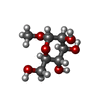
ChemComp-MMA:
methyl alpha-D-mannopyranoside

Source
  • escherichia coli (E. coli)
  • mus musculus (house mouse)
  • escherichia coli k-12 (bacteria)
KeywordsCELL ADHESION/IMMUNE SYSTEM / Fimbrial tip / Lectin domain / Antibody fragments / Antibody-target complex / CELL ADHESION / CELL ADHESION-IMMUNE SYSTEM complex

+
About Yorodumi Papers

-
News

-
Feb 9, 2022. New format data for meta-information of EMDB entries

New format data for meta-information of EMDB entries

  • Version 3 of the EMDB header file is now the official format.
  • The previous official version 1.9 will be removed from the archive.

Related info.:EMDB header

External links:wwPDB to switch to version 3 of the EMDB data model

-
Aug 12, 2020. Covid-19 info

Covid-19 info

URL: https://pdbj.org/emnavi/covid19.php

New page: Covid-19 featured information page in EM Navigator.

Related info.:Covid-19 info / Mar 5, 2020. Novel coronavirus structure data

+
Mar 5, 2020. Novel coronavirus structure data

Novel coronavirus structure data

Related info.:Yorodumi Speices / Aug 12, 2020. Covid-19 info

External links:COVID-19 featured content - PDBj / Molecule of the Month (242):Coronavirus Proteases

+
Jan 31, 2019. EMDB accession codes are about to change! (news from PDBe EMDB page)

EMDB accession codes are about to change! (news from PDBe EMDB page)

  • The allocation of 4 digits for EMDB accession codes will soon come to an end. Whilst these codes will remain in use, new EMDB accession codes will include an additional digit and will expand incrementally as the available range of codes is exhausted. The current 4-digit format prefixed with “EMD-” (i.e. EMD-XXXX) will advance to a 5-digit format (i.e. EMD-XXXXX), and so on. It is currently estimated that the 4-digit codes will be depleted around Spring 2019, at which point the 5-digit format will come into force.
  • The EM Navigator/Yorodumi systems omit the EMD- prefix.

Related info.:Q: What is EMD? / ID/Accession-code notation in Yorodumi/EM Navigator

External links:EMDB Accession Codes are Changing Soon! / Contact to PDBj

+
Jul 12, 2017. Major update of PDB

Major update of PDB

  • wwPDB released updated PDB data conforming to the new PDBx/mmCIF dictionary.
  • This is a major update changing the version number from 4 to 5, and with Remediation, in which all the entries are updated.
  • In this update, many items about electron microscopy experimental information are reorganized (e.g. em_software).
  • Now, EM Navigator and Yorodumi are based on the updated data.

External links:wwPDB Remediation / Enriched Model Files Conforming to OneDep Data Standards Now Available in the PDB FTP Archive

-
Yorodumi Papers

Database of articles cited by EMDB/PDB/SASBDB data

  • Database of articles cited by EMDB, PDB, and SASBDB entries
  • Using PubMed data

Related info.:EMDB / PDB / SASBDB / Yorodumi / EMN Papers / Changes in new EM Navigator and Yorodumi

Read more