[English] 日本語
Yorodumi Papers
- Database of articles cited by EMDB/PDB/SASBDB data -

+
Search query

Keywords
Structure methods
Author
Journal
IF

-
Structure paper

TitleA polycyclic scaffold identified by structure-based drug design effectively inhibits the human P2X7 receptor.
Journal, issue, pagesNat Commun, Vol. 16, Issue 1, Page 8283, Year 2025
Publish dateSep 15, 2025
AuthorsAdam C Oken / Andreea L Turcu / Eva Tzortzini / Kyriakos Georgiou / Jessica Nagel / Franka G Westermann / Marta Barniol-Xicota / Jonas Seidler / Ga-Ram Kim / So-Deok Lee / Annette Nicke / Yong-Chul Kim / Christa E Müller / Antonios Kolocouris / Santiago Vázquez / Steven E Mansoor /
PubMed AbstractThe P2X7 receptor is an ATP-gated ion channel that activates inflammatory pathways involved in diseases such as cancer, atherosclerosis, and neurodegeneration. However, despite the potential benefits ...The P2X7 receptor is an ATP-gated ion channel that activates inflammatory pathways involved in diseases such as cancer, atherosclerosis, and neurodegeneration. However, despite the potential benefits of blocking overactive signaling, no P2X7 receptor antagonists have been approved for clinical use. Understanding species-specific pharmacological effects of existing antagonists has been challenging, in part due to the dearth of molecular information on receptor orthologs. Here, to identify distinct molecular features in the human receptor, we determine high-resolution cryo-EM structures of the full-length wild-type human P2X7 receptor in apo closed and ATP-bound open state conformations and draw comparisons with structures of other orthologs. We also report a cryo-EM structure of the human receptor in complex with an adamantane-based inhibitor, which we leverage, in conjunction with functional data and molecular dynamics simulations, to design a potent and selective antagonist with a unique polycyclic scaffold. Functional and structural analysis reveal how this optimized ligand, termed UB-MBX-46, interacts with the classical allosteric pocket of the human P2X7 receptor with subnanomolar potency and high selectivity, revealing its significant therapeutic potential.
External linksNat Commun / PubMed:40954149 / PubMed Central
MethodsEM (single particle)
Resolution2.48 - 2.95 Å
Structure data

EMDB-47490, PDB-9e3m:
Cryo-EM structure of the human P2X7 receptor in the apo closed state
Method: EM (single particle) / Resolution: 2.48 Å

EMDB-47491, PDB-9e3n:
Cryo-EM structure of the human P2X7 receptor in the ATP-bound open state
Method: EM (single particle) / Resolution: 2.95 Å

EMDB-47492, PDB-9e3o:
Cryo-EM structure of the human P2X7 receptor in the UB-ALT-P30-bound inhibited state
Method: EM (single particle) / Resolution: 2.76 Å

EMDB-47493, PDB-9e3p:
Cryo-EM structure of the human P2X7 receptor in the UB-MBX-46-bound inhibited state
Method: EM (single particle) / Resolution: 2.53 Å

EMDB-47494, PDB-9e3q:
Cryo-EM structure of the mouse P2X7 receptor in the apo closed state
Method: EM (single particle) / Resolution: 2.53 Å

Chemicals

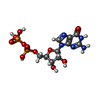
ChemComp-GDP:
GUANOSINE-5'-DIPHOSPHATE / GDP, energy-carrying molecule*YM

ChemComp-ZN:
Unknown entry

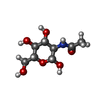
ChemComp-NAG:
2-acetamido-2-deoxy-beta-D-glucopyranose

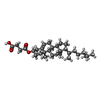
ChemComp-Y01:
CHOLESTEROL HEMISUCCINATE

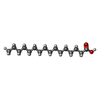
ChemComp-PLM:
PALMITIC ACID

ChemComp-NA:
Unknown entry

ChemComp-HOH:
WATER

ChemComp-ATP:
ADENOSINE-5'-TRIPHOSPHATE / ATP, energy-carrying molecule*YM

PDB-1bd8:
STRUCTURE OF CDK INHIBITOR P19INK4D

PDB-1bd9:
HUMAN PHOSPHATIDYLETHANOLAMINE BINDING PROTEIN

Source
  • homo sapiens (human)
  • mus musculus (house mouse)
KeywordsMEMBRANE PROTEIN / Ion Channel / Ligand-Gated Ion Channel / P2X Receptor / P2XR / Allosteric Antagonist / Agonist

+
About Yorodumi Papers

-
News

-
Feb 9, 2022. New format data for meta-information of EMDB entries

New format data for meta-information of EMDB entries

  • Version 3 of the EMDB header file is now the official format.
  • The previous official version 1.9 will be removed from the archive.

Related info.:EMDB header

External links:wwPDB to switch to version 3 of the EMDB data model

-
Aug 12, 2020. Covid-19 info

Covid-19 info

URL: https://pdbj.org/emnavi/covid19.php

New page: Covid-19 featured information page in EM Navigator.

Related info.:Covid-19 info / Mar 5, 2020. Novel coronavirus structure data

+
Mar 5, 2020. Novel coronavirus structure data

Novel coronavirus structure data

Related info.:Yorodumi Speices / Aug 12, 2020. Covid-19 info

External links:COVID-19 featured content - PDBj / Molecule of the Month (242):Coronavirus Proteases

+
Jan 31, 2019. EMDB accession codes are about to change! (news from PDBe EMDB page)

EMDB accession codes are about to change! (news from PDBe EMDB page)

  • The allocation of 4 digits for EMDB accession codes will soon come to an end. Whilst these codes will remain in use, new EMDB accession codes will include an additional digit and will expand incrementally as the available range of codes is exhausted. The current 4-digit format prefixed with “EMD-” (i.e. EMD-XXXX) will advance to a 5-digit format (i.e. EMD-XXXXX), and so on. It is currently estimated that the 4-digit codes will be depleted around Spring 2019, at which point the 5-digit format will come into force.
  • The EM Navigator/Yorodumi systems omit the EMD- prefix.

Related info.:Q: What is EMD? / ID/Accession-code notation in Yorodumi/EM Navigator

External links:EMDB Accession Codes are Changing Soon! / Contact to PDBj

+
Jul 12, 2017. Major update of PDB

Major update of PDB

  • wwPDB released updated PDB data conforming to the new PDBx/mmCIF dictionary.
  • This is a major update changing the version number from 4 to 5, and with Remediation, in which all the entries are updated.
  • In this update, many items about electron microscopy experimental information are reorganized (e.g. em_software).
  • Now, EM Navigator and Yorodumi are based on the updated data.

External links:wwPDB Remediation / Enriched Model Files Conforming to OneDep Data Standards Now Available in the PDB FTP Archive

-
Yorodumi Papers

Database of articles cited by EMDB/PDB/SASBDB data

  • Database of articles cited by EMDB, PDB, and SASBDB entries
  • Using PubMed data

Related info.:EMDB / PDB / SASBDB / Yorodumi / EMN Papers / Changes in new EM Navigator and Yorodumi

Read more