 Movie
Movie Controller

[English] 日本語
 Yorodumi
- PDB-9e3q: Cryo-EM structure of the mouse P2X7 receptor in the apo closed state -
+ Open data

- Basic information
| Entry | Database: PDB / ID: 9e3q | |||||||||
|---|---|---|---|---|---|---|---|---|---|---|
| Title | Cryo-EM structure of the mouse P2X7 receptor in the apo closed state | |||||||||
 Components Components | P2X purinoceptor 7 | |||||||||
 Keywords Keywords | MEMBRANE PROTEIN / Ion Channel / Ligand-Gated Ion Channel / P2X Receptor / P2XR / Allosteric Antagonist / Agonist | |||||||||
| Function / homology |  Function and homology information Function and homology informationPlatelet homeostasis / NAD transport / positive regulation of lymphocyte apoptotic process / phospholipid transfer to membrane / regulation of presynaptic dense core granule exocytosis / Elevation of cytosolic Ca2+ levels / positive regulation of bleb assembly / The NLRP3 inflammasome / phagolysosome assembly / positive regulation of cytoskeleton organization ...Platelet homeostasis / NAD transport / positive regulation of lymphocyte apoptotic process / phospholipid transfer to membrane / regulation of presynaptic dense core granule exocytosis / Elevation of cytosolic Ca2+ levels / positive regulation of bleb assembly / The NLRP3 inflammasome / phagolysosome assembly / positive regulation of cytoskeleton organization / positive regulation of monoatomic ion transmembrane transport / plasma membrane organization / purinergic nucleotide receptor signaling pathway / positive regulation of prostaglandin secretion / positive regulation of interleukin-1 alpha production / collagen metabolic process / extracellularly ATP-gated monoatomic cation channel activity / purinergic nucleotide receptor activity / bleb assembly / ATP export / positive regulation of catalytic activity / pore complex assembly / negative regulation of cell volume / positive regulation of gamma-aminobutyric acid secretion / plasma membrane phospholipid scrambling / response to fluid shear stress / vesicle budding from membrane / programmed cell death / bleb / ceramide biosynthetic process / negative regulation of bone resorption / T cell proliferation / positive regulation of ossification / cell volume homeostasis / skeletal system morphogenesis / cellular response to dsRNA / phospholipid translocation / response to zinc ion / T cell homeostasis / positive regulation of bone mineralization / positive regulation of glutamate secretion / response to ATP / protein homotrimerization / positive regulation of MAP kinase activity / regulation of sodium ion transport / sodium channel activity / membrane protein ectodomain proteolysis / positive regulation of mitochondrial depolarization / positive regulation of calcium ion transport into cytosol / positive regulation of NLRP3 inflammasome complex assembly / response to electrical stimulus / synaptic vesicle exocytosis / homeostasis of number of cells within a tissue / membrane depolarization / response to mechanical stimulus / potassium channel activity / monoatomic cation transport / extrinsic apoptotic signaling pathway / response to bacterium / neuronal action potential / release of sequestered calcium ion into cytosol / negative regulation of MAPK cascade / reactive oxygen species metabolic process / sensory perception of pain / protein catabolic process / positive regulation of glycolytic process / positive regulation of T cell mediated cytotoxicity / apoptotic signaling pathway / positive regulation of protein secretion / positive regulation of cytokine production / positive regulation of interleukin-1 beta production / protein serine/threonine kinase activator activity / mitochondrion organization / neuromuscular junction / lipopolysaccharide binding / protein processing / cell morphogenesis / response to calcium ion / positive regulation of interleukin-6 production / positive regulation of protein phosphorylation / gene expression / calcium ion transmembrane transport / calcium ion transport / terminal bouton / cell-cell junction / nuclear envelope / response to lipopolysaccharide / channel activity / signaling receptor activity / scaffold protein binding / positive regulation of MAPK cascade / protein phosphorylation / cell surface receptor signaling pathway / postsynapse / defense response to Gram-positive bacterium / response to xenobiotic stimulus / positive regulation of apoptotic process / inflammatory response / copper ion binding / external side of plasma membrane Similarity search - Function | |||||||||
| Biological species |   Mus musculus (house mouse) Mus musculus (house mouse) | |||||||||
| Method | ELECTRON MICROSCOPY / single particle reconstruction / cryo EM / Resolution: 2.53 Å | |||||||||
 Authors Authors | Oken, A.C. / Turcu, A.L. / Vazquez, S. / Mansoor, S.E. | |||||||||
| Funding support |  United States, 2items United States, 2items
| |||||||||
 Citation Citation | Journal: Nat Commun / Year: 2025 Title: A polycyclic scaffold identified by structure-based drug design effectively inhibits the human P2X7 receptor. Authors: Adam C Oken / Andreea L Turcu / Eva Tzortzini / Kyriakos Georgiou / Jessica Nagel / Franka G Westermann / Marta Barniol-Xicota / Jonas Seidler / Ga-Ram Kim / So-Deok Lee / Annette Nicke / ...Authors: Adam C Oken / Andreea L Turcu / Eva Tzortzini / Kyriakos Georgiou / Jessica Nagel / Franka G Westermann / Marta Barniol-Xicota / Jonas Seidler / Ga-Ram Kim / So-Deok Lee / Annette Nicke / Yong-Chul Kim / Christa E Müller / Antonios Kolocouris / Santiago Vázquez / Steven E Mansoor /     Abstract: The P2X7 receptor is an ATP-gated ion channel that activates inflammatory pathways involved in diseases such as cancer, atherosclerosis, and neurodegeneration. However, despite the potential benefits ...The P2X7 receptor is an ATP-gated ion channel that activates inflammatory pathways involved in diseases such as cancer, atherosclerosis, and neurodegeneration. However, despite the potential benefits of blocking overactive signaling, no P2X7 receptor antagonists have been approved for clinical use. Understanding species-specific pharmacological effects of existing antagonists has been challenging, in part due to the dearth of molecular information on receptor orthologs. Here, to identify distinct molecular features in the human receptor, we determine high-resolution cryo-EM structures of the full-length wild-type human P2X7 receptor in apo closed and ATP-bound open state conformations and draw comparisons with structures of other orthologs. We also report a cryo-EM structure of the human receptor in complex with an adamantane-based inhibitor, which we leverage, in conjunction with functional data and molecular dynamics simulations, to design a potent and selective antagonist with a unique polycyclic scaffold. Functional and structural analysis reveal how this optimized ligand, termed UB-MBX-46, interacts with the classical allosteric pocket of the human P2X7 receptor with subnanomolar potency and high selectivity, revealing its significant therapeutic potential. | |||||||||
| History |
|
- Structure visualization
| Structure viewer | Molecule: MolmilJmol/JSmol |
|---|
- Downloads & links
-Download
| PDBx/mmCIF format | 9e3q.cif.gz | 308.1 KB | Display | PDBx/mmCIF format |
|---|---|---|---|---|
| PDB format | pdb9e3q.ent.gz | 250.7 KB | Display | PDB format |
| PDBx/mmJSON format | 9e3q.json.gz | Tree view | PDBx/mmJSON format | |
| Others |  Other downloads Other downloads |
-Validation report
| Arichive directory | https://data.pdbj.org/pub/pdb/validation_reports/e3/9e3qftp://data.pdbj.org/pub/pdb/validation_reports/e3/9e3q | HTTPS FTP |
|---|
-Related structure data
| Related structure data |  47494MC  9e3mC  9e3nC  9e3oC  9e3pC M: map data used to model this data C: citing same article ( |
|---|---|
| Similar structure data |


-Links
 PDBj
PDBj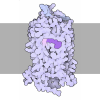
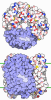
- Assembly
| Deposited unit | 
|
|---|---|
| 1 |
|
-Components
-Protein / Sugars , 2 types, 9 molecules ABC
| #1: Protein | Mass: 68476.148 Da / Num. of mol.: 3 Source method: isolated from a genetically manipulated source Source: (gene. exp.) Mus musculus (house mouse) / Gene: P2rx7, P2x7 / Cell line (production host): HEK293 GNTI- / Production host:  Homo sapiens (human) / References: UniProt: Q9Z1M0 Homo sapiens (human) / References: UniProt: Q9Z1M0#4: Sugar | ChemComp-NAG / 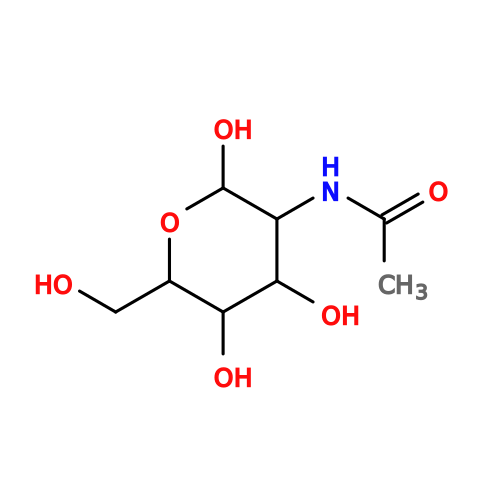 Type: D-saccharide, beta linking / Mass: 221.208 Da / Num. of mol.: 6 / Source method: obtained synthetically / Formula: C8H15NO6 Type: D-saccharide, beta linking / Mass: 221.208 Da / Num. of mol.: 6 / Source method: obtained synthetically / Formula: C8H15NO6 |
|---|
-Non-polymers , 5 types, 218 molecules 

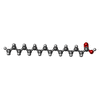


| #2: Chemical | 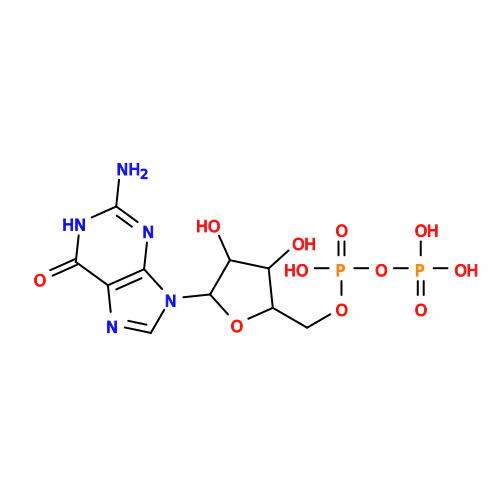 Type: RNA linking / Mass: 443.201 Da / Num. of mol.: 3 / Source method: obtained synthetically / Formula: C10H15N5O11P2 / Feature type: SUBJECT OF INVESTIGATION / Comment: GDP, energy-carrying molecule*YM Type: RNA linking / Mass: 443.201 Da / Num. of mol.: 3 / Source method: obtained synthetically / Formula: C10H15N5O11P2 / Feature type: SUBJECT OF INVESTIGATION / Comment: GDP, energy-carrying molecule*YM#3: Chemical | ChemComp-ZN /  Mass: 65.409 Da / Num. of mol.: 6 / Source method: obtained synthetically / Formula: Zn / Feature type: SUBJECT OF INVESTIGATION Mass: 65.409 Da / Num. of mol.: 6 / Source method: obtained synthetically / Formula: Zn / Feature type: SUBJECT OF INVESTIGATION#5: Chemical | ChemComp-PLM / 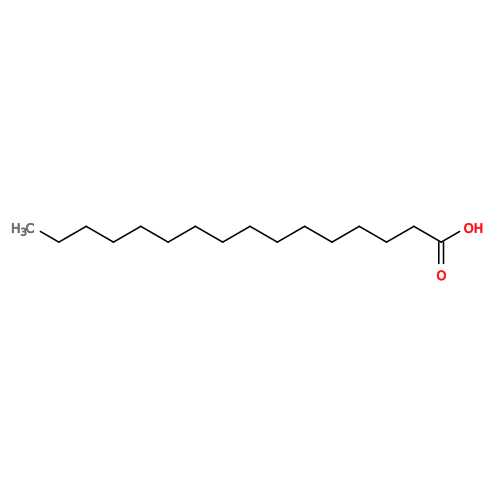 Mass: 256.424 Da / Num. of mol.: 15 Mass: 256.424 Da / Num. of mol.: 15Source method: isolated from a genetically manipulated source Formula: C16H32O2 / Source: (gene. exp.) Mus musculus (house mouse) / Cell line (production host): HEK293 GNTI- / Production host: Homo sapiens (human) / Feature type: SUBJECT OF INVESTIGATION#6: Chemical | ChemComp-NA / |  Mass: 22.990 Da / Num. of mol.: 1 / Source method: obtained synthetically / Formula: Na / Feature type: SUBJECT OF INVESTIGATION Mass: 22.990 Da / Num. of mol.: 1 / Source method: obtained synthetically / Formula: Na / Feature type: SUBJECT OF INVESTIGATION#7: Water | ChemComp-HOH / | Mass: 18.015 Da / Num. of mol.: 193 / Source method: isolated from a natural source / Formula: H2O |
|---|
-Details
| Has ligand of interest | Y |
|---|---|
| Has protein modification | Y |
-Experimental details
-Experiment
| Experiment | Method: ELECTRON MICROSCOPY |
|---|---|
| EM experiment | Aggregation state: PARTICLE / 3D reconstruction method: single particle reconstruction |
- Sample preparation
| Component | Name: Membrane protein / Type: COMPLEX / Entity ID: #1 / Source: RECOMBINANT |
|---|---|
| Source (natural) | Organism: Mus musculus (house mouse) |
| Source (recombinant) | Organism: Homo sapiens (human) / Cell: HEK293 GNTI- |
| Buffer solution | pH: 7 |
| Specimen | Embedding applied: NO / Shadowing applied: NO / Staining applied: NO / Vitrification applied: YES |
| Vitrification | Instrument: FEI VITROBOT MARK IV / Cryogen name: ETHANE |
- Electron microscopy imaging
| Experimental equipment |  Model: Titan Krios / Image courtesy: FEI Company |
|---|---|
| Microscopy | Model: TFS KRIOS |
| Electron gun | Electron source:  FIELD EMISSION GUN / Accelerating voltage: 300 kV / Illumination mode: FLOOD BEAM FIELD EMISSION GUN / Accelerating voltage: 300 kV / Illumination mode: FLOOD BEAM |
| Electron lens | Mode: BRIGHT FIELD / Nominal magnification: 130000 X / Nominal defocus max: 1500 nm / Nominal defocus min: 900 nm / Cs: 2.7 mm / C2 aperture diameter: 70 µm |
| Specimen holder | Specimen holder model: FEI TITAN KRIOS AUTOGRID HOLDER |
| Image recording | Electron dose: 45 e/Å2 / Film or detector model: GATAN K3 BIOQUANTUM (6k x 4k) / Num. of real images: 15909 |
| EM imaging optics | Energyfilter slit width: 20 eV |
- Processing
| EM software | Name: PHENIX / Category: model refinement | ||||||||||||||||||||||||
|---|---|---|---|---|---|---|---|---|---|---|---|---|---|---|---|---|---|---|---|---|---|---|---|---|---|
| CTF correction | Type: PHASE FLIPPING AND AMPLITUDE CORRECTION | ||||||||||||||||||||||||
| Symmetry | Point symmetry: C3 (3 fold cyclic) | ||||||||||||||||||||||||
| 3D reconstruction | Resolution: 2.53 Å / Resolution method: FSC 0.143 CUT-OFF / Num. of particles: 370251 / Symmetry type: POINT | ||||||||||||||||||||||||
| Refine LS restraints |
|
