[English] 日本語
Yorodumi Papers
- Database of articles cited by EMDB/PDB/SASBDB data -

+
Search query

Keywords
Structure methods
Author
Journal
IF

-
Structure paper

TitleThe structures of protein kinase A in complex with CFTR: Mechanisms of phosphorylation and noncatalytic activation.
Journal, issue, pagesProc Natl Acad Sci U S A, Vol. 121, Issue 46, Page e2409049121, Year 2024
Publish dateNov 12, 2024
AuthorsKarol Fiedorczuk / Iordan Iordanov / Csaba Mihályi / Andras Szollosi / László Csanády / Jue Chen /
PubMed AbstractProtein kinase A (PKA) is a key regulator of cellular functions by selectively phosphorylating numerous substrates, including ion channels, enzymes, and transcription factors. It has long served as a ...Protein kinase A (PKA) is a key regulator of cellular functions by selectively phosphorylating numerous substrates, including ion channels, enzymes, and transcription factors. It has long served as a model system for understanding the eukaryotic kinases. Using cryoelectron microscopy, we present complex structures of the PKA catalytic subunit (PKA-C) bound to a full-length protein substrate, the cystic fibrosis transmembrane conductance regulator (CFTR)-an ion channel vital to human health. CFTR gating requires phosphorylation of its regulatory (R) domain. Unphosphorylated CFTR engages PKA-C at two locations, establishing two "catalytic stations" near to, but not directly involving, the R domain. This configuration, coupled with the conformational flexibility of the R domain, permits transient interactions of the eleven spatially separated phosphorylation sites. Furthermore, we determined two structures of the open-pore CFTR stabilized by PKA-C, providing a molecular basis to understand how PKA-C stimulates CFTR currents even in the absence of phosphorylation.
External linksProc Natl Acad Sci U S A / PubMed:39495916 / PubMed Central
MethodsEM (single particle)
Resolution2.8 - 9.0 Å
Structure data

EMDB-47235, PDB-9dw4:
Dephosphorylated CFTR in 1:1 complex with PKA-C (site II)
Method: EM (single particle) / Resolution: 9.0 Å

EMDB-47236, PDB-9dw5:
Dephosphorylated CFTR in 1:1 complex with PKA-C (site I)
Method: EM (single particle) / Resolution: 3.8 Å

EMDB-47237, PDB-9dw7:
Dephosphorylated CFTR in 1:2 complex with PKA-C
Method: EM (single particle) / Resolution: 6.0 Å

EMDB-47238, PDB-9dw8:
Dephosphorylated (E1371Q)CFTR in complex with PKA-C
Method: EM (single particle) / Resolution: 3.5 Å

EMDB-47239, PDB-9dw9:
Phosphorylated (E1371Q)CFTR in complex with PKA-C
Method: EM (single particle) / Resolution: 2.8 Å

Chemicals

ChemComp-MG:
Unknown entry

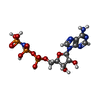
ChemComp-ANP:
PHOSPHOAMINOPHOSPHONIC ACID-ADENYLATE ESTER / AMP-PNP, energy-carrying molecule analogue*YM

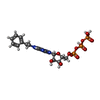
ChemComp-B44:
N-(2-phenylethyl)adenosine 5'-(tetrahydrogen triphosphate)

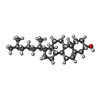
ChemComp-CLR:
CHOLESTEROL

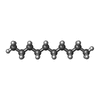
ChemComp-D10:
DECANE

ChemComp-ATP:
ADENOSINE-5'-TRIPHOSPHATE / ATP, energy-carrying molecule*YM

ChemComp-CL:
Unknown entry

ChemComp-UND:
UNDECANE

ChemComp-HOH:
WATER

Source
  • bos taurus (domestic cattle)
  • homo sapiens (human)
KeywordsHYDROLASE / CFTR / PKA / complex

+
About Yorodumi Papers

-
News

-
Feb 9, 2022. New format data for meta-information of EMDB entries

New format data for meta-information of EMDB entries

  • Version 3 of the EMDB header file is now the official format.
  • The previous official version 1.9 will be removed from the archive.

Related info.:EMDB header

External links:wwPDB to switch to version 3 of the EMDB data model

-
Aug 12, 2020. Covid-19 info

Covid-19 info

URL: https://pdbj.org/emnavi/covid19.php

New page: Covid-19 featured information page in EM Navigator.

Related info.:Covid-19 info / Mar 5, 2020. Novel coronavirus structure data

+
Mar 5, 2020. Novel coronavirus structure data

Novel coronavirus structure data

Related info.:Yorodumi Speices / Aug 12, 2020. Covid-19 info

External links:COVID-19 featured content - PDBj / Molecule of the Month (242):Coronavirus Proteases

+
Jan 31, 2019. EMDB accession codes are about to change! (news from PDBe EMDB page)

EMDB accession codes are about to change! (news from PDBe EMDB page)

  • The allocation of 4 digits for EMDB accession codes will soon come to an end. Whilst these codes will remain in use, new EMDB accession codes will include an additional digit and will expand incrementally as the available range of codes is exhausted. The current 4-digit format prefixed with “EMD-” (i.e. EMD-XXXX) will advance to a 5-digit format (i.e. EMD-XXXXX), and so on. It is currently estimated that the 4-digit codes will be depleted around Spring 2019, at which point the 5-digit format will come into force.
  • The EM Navigator/Yorodumi systems omit the EMD- prefix.

Related info.:Q: What is EMD? / ID/Accession-code notation in Yorodumi/EM Navigator

External links:EMDB Accession Codes are Changing Soon! / Contact to PDBj

+
Jul 12, 2017. Major update of PDB

Major update of PDB

  • wwPDB released updated PDB data conforming to the new PDBx/mmCIF dictionary.
  • This is a major update changing the version number from 4 to 5, and with Remediation, in which all the entries are updated.
  • In this update, many items about electron microscopy experimental information are reorganized (e.g. em_software).
  • Now, EM Navigator and Yorodumi are based on the updated data.

External links:wwPDB Remediation / Enriched Model Files Conforming to OneDep Data Standards Now Available in the PDB FTP Archive

-
Yorodumi Papers

Database of articles cited by EMDB/PDB/SASBDB data

  • Database of articles cited by EMDB, PDB, and SASBDB entries
  • Using PubMed data

Related info.:EMDB / PDB / SASBDB / Yorodumi / EMN Papers / Changes in new EM Navigator and Yorodumi

Read more