[English] 日本語
Yorodumi Papers
- Database of articles cited by EMDB/PDB/SASBDB data -

+
Search query

Keywords
Structure methods
Author
Journal
IF

-
Structure paper

TitleStructural basis of opioid receptor activation by PCP and ketamine.
Journal, issue, pagesNat. Struct. Mol. Biol., Year 2026
Publish dateJun 25, 2025 (structure data deposition date)
AuthorsQianru Jiang / Jianming Han / Eve J Fine / Nokomis Ramos-Gonzalez / Vipin Ashok Rangari / Micaela V Ruiz / Madalyn L Critz / Carl-Mikael Suomivuori / Jing Wang / Talia L Albert / Kyle Whiddon / Kunpeng Li / Michael J Robertson / Xi-Ping Huang / Benjamin B Land / Susruta Majumdar / Jonathan F Fay / Ron O Dror / Tao Che /
PubMed AbstractKetamine offers rapid relief for treatment-resistant depression and severe pain in the clinic, providing immediate benefits that traditional medications often fail to deliver. While its antagonistic ...Ketamine offers rapid relief for treatment-resistant depression and severe pain in the clinic, providing immediate benefits that traditional medications often fail to deliver. While its antagonistic action at the N-methyl-D-aspartate receptor (NMDAR) is a key mechanism, ketamine's dual nature as both a promising treatment and a drug with abuse potential suggests its therapeutic effects extend beyond NMDAR inhibition. Here we provide structural evidence of human opioid receptors bound to ketamine and its parent analog phencyclidine (PCP), supporting that both ligands can directly bind and activate opioid receptors. The structures, together with site-directed mutagenesis and structure-activity relationship studies, identify key motifs involved in ketamine and PCP recognition and efficacy modulation. Furthermore, we determine the structure of the ligand-free state of human κ opioid receptor, revealing molecular details before ligand engagement. Compared to PCP, ketamine displays more notable binding dynamics in the orthosteric site that may contribute to its unique pharmacology at opioid receptors. Our findings highlight the importance of including opioid receptors to fully understand ketamine's versatility in clinical settings.
External linksNat. Struct. Mol. Biol. / PubMed:42332075
MethodsEM (single particle)
Resolution2.5 - 3.43 Å
Structure data

PDB-9pa1:
PCP bound kappa-opioid receptor in complex with Gi1
Method: ELECTRON MICROSCOPY / Resolution: 2.63 Å

PDB-9pa2:
PCP bound mu-opioid receptor in complex with Gi1
Method: ELECTRON MICROSCOPY / Resolution: 2.86 Å

PDB-9pa3:
3-OH-PCP bound mu-opioid receptor in complex with Gi1
Method: ELECTRON MICROSCOPY / Resolution: 3.05 Å

PDB-9pa4:
(S)-ketamine bound kappa-opioid receptor in complex with Gi1
Method: ELECTRON MICROSCOPY / Resolution: 2.5 Å

PDB-9pa5:
(S)-ketamine bound mu-opioid receptor in complex with Gi1
Method: ELECTRON MICROSCOPY / Resolution: 2.92 Å

PDB-9pa6:
Ligand-free kappa-opioid receptor in complex with Gi1
Method: ELECTRON MICROSCOPY / Resolution: 3.43 Å

Chemicals

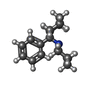
ChemComp-1PC:
1-(PHENYL-1-CYCLOHEXYL)PIPERIDINE

PDB-1che:
Unknown entry

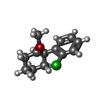
ChemComp-JC9:
(2~{S})-2-(2-chlorophenyl)-2-(methylamino)cyclohexan-1-one

Source
  • escherichia coli (E. coli)
  • homo sapiens (human)
  • mus musculus (house mouse)
KeywordsSIGNALING PROTEIN / kappa opioid receptor / mu-opioid receptor / GPCR

+
About Yorodumi Papers

-
News

-
Feb 9, 2022. New format data for meta-information of EMDB entries

New format data for meta-information of EMDB entries

  • Version 3 of the EMDB header file is now the official format.
  • The previous official version 1.9 will be removed from the archive.

Related info.:EMDB header

External links:wwPDB to switch to version 3 of the EMDB data model

-
Aug 12, 2020. Covid-19 info

Covid-19 info

URL: https://pdbj.org/emnavi/covid19.php

New page: Covid-19 featured information page in EM Navigator.

Related info.:Covid-19 info / Mar 5, 2020. Novel coronavirus structure data

+
Mar 5, 2020. Novel coronavirus structure data

Novel coronavirus structure data

Related info.:Yorodumi Speices / Aug 12, 2020. Covid-19 info

External links:COVID-19 featured content - PDBj / Molecule of the Month (242):Coronavirus Proteases

+
Jan 31, 2019. EMDB accession codes are about to change! (news from PDBe EMDB page)

EMDB accession codes are about to change! (news from PDBe EMDB page)

  • The allocation of 4 digits for EMDB accession codes will soon come to an end. Whilst these codes will remain in use, new EMDB accession codes will include an additional digit and will expand incrementally as the available range of codes is exhausted. The current 4-digit format prefixed with “EMD-” (i.e. EMD-XXXX) will advance to a 5-digit format (i.e. EMD-XXXXX), and so on. It is currently estimated that the 4-digit codes will be depleted around Spring 2019, at which point the 5-digit format will come into force.
  • The EM Navigator/Yorodumi systems omit the EMD- prefix.

Related info.:Q: What is EMD? / ID/Accession-code notation in Yorodumi/EM Navigator

External links:EMDB Accession Codes are Changing Soon! / Contact to PDBj

+
Jul 12, 2017. Major update of PDB

Major update of PDB

  • wwPDB released updated PDB data conforming to the new PDBx/mmCIF dictionary.
  • This is a major update changing the version number from 4 to 5, and with Remediation, in which all the entries are updated.
  • In this update, many items about electron microscopy experimental information are reorganized (e.g. em_software).
  • Now, EM Navigator and Yorodumi are based on the updated data.

External links:wwPDB Remediation / Enriched Model Files Conforming to OneDep Data Standards Now Available in the PDB FTP Archive

-
Yorodumi Papers

Database of articles cited by EMDB/PDB/SASBDB data

  • Database of articles cited by EMDB, PDB, and SASBDB entries
  • Using PubMed data

Related info.:EMDB / PDB / SASBDB / Yorodumi / EMN Papers / Changes in new EM Navigator and Yorodumi

Read more