[English] 日本語
Yorodumi Papers
- Database of articles cited by EMDB/PDB/SASBDB data -

+
Search query

Keywords
Structure methods
Author
Journal
IF

-
Structure paper

TitleStructure of the pre-initiation complex explains CMGE biogenesis.
Journal, issue, pagesNature, Year 2026
Publish dateFeb 23, 2026 (structure data deposition date)
AuthorsThomas Pühringer / Berta Canal / Giacomo Palm / Agata Butryn / Emma C Couves / Oliver Willhoft / Jacob S Lewis / John F X Diffley / Alessandro Costa /
PubMed AbstractWhen cells enter S phase, bidirectional DNA replication is initiated through the kinase-regulated recruitment of three activators (Cdc45, GINS and Pol ε) to a duplex-DNA-loaded double hexamer of ...When cells enter S phase, bidirectional DNA replication is initiated through the kinase-regulated recruitment of three activators (Cdc45, GINS and Pol ε) to a duplex-DNA-loaded double hexamer of minichromosome maintenance (MCM) ATPases. Together, these proteins form two CMGE helicases that establish divergent replication forks as they become separated. Here, to gain an understanding of CMGE biogenesis, we reconstituted the pre-initiation complex with purified yeast proteins. The cryo-electron-microscopy structure shows a set of firing factors caught in the act of assembling two symmetrical CMGEs. We show how stepwise complex formation reshapes MCM in preparation for DNA opening, and we explain how ATP promotes firing-factor ejection and CMGE maturation. We find that although Sld2 facilitates the recruitment of GINS to MCM, as expected, it also aids the efficient separation of the CMGE dimer, and is essential for the ejection of the lagging strand from MCM. These findings have direct implications for our understanding of the metazoan Sld2 orthologue, RECQL4, and point to a replication-fork establishment mechanism that is conserved across eukaryotes.
External linksNature / PubMed:42310460
MethodsEM (single particle)
Resolution2.7 - 3.7 Å
Structure data

PDB-28vy:
sCMGE assembled on ARS1 DNA with Sld2 and RPA
Method: ELECTRON MICROSCOPY / Resolution: 2.7 Å

PDB-9rhi:
pre-Initiation Complex on ARS1 DNA (monomer)
Method: ELECTRON MICROSCOPY / Resolution: 3.2 Å

PDB-9rhj:
Pre-Initiation Complex on ARS1 DNA (dimer)
Method: ELECTRON MICROSCOPY / Resolution: 3.4 Å

PDB-9rhl:
Phospho-DH bound by Sld3-MBD on ARS1 DNA
Method: ELECTRON MICROSCOPY / Resolution: 3.1 Å

PDB-9rhm:
Phospho-MCM double hexamer bound to Sld3-Sld7-Cdc45 on ARS1 DNA
Method: ELECTRON MICROSCOPY / Resolution: 3.7 Å

Chemicals

ChemComp-MG:
Unknown entry

ChemComp-ZN:
Unknown entry

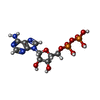
ChemComp-ADP:
ADENOSINE-5'-DIPHOSPHATE / ADP, energy-carrying molecule*YM

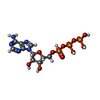
ChemComp-ATP:
ADENOSINE-5'-TRIPHOSPHATE / ATP, energy-carrying molecule*YM

Source
  • saccharomyces cerevisiae (brewer's yeast)

  • synthetic construct (others)
KeywordsREPLICATION / Macromolecular complex / DNA / ATPase / Helicase MCM2-7 / Macromolecular Complex DNA ATPase Helicase MCM2-7 / Helicase / MCM2-7

+
About Yorodumi Papers

-
News

-
Feb 9, 2022. New format data for meta-information of EMDB entries

New format data for meta-information of EMDB entries

  • Version 3 of the EMDB header file is now the official format.
  • The previous official version 1.9 will be removed from the archive.

Related info.:EMDB header

External links:wwPDB to switch to version 3 of the EMDB data model

-
Aug 12, 2020. Covid-19 info

Covid-19 info

URL: https://pdbj.org/emnavi/covid19.php

New page: Covid-19 featured information page in EM Navigator.

Related info.:Covid-19 info / Mar 5, 2020. Novel coronavirus structure data

+
Mar 5, 2020. Novel coronavirus structure data

Novel coronavirus structure data

Related info.:Yorodumi Speices / Aug 12, 2020. Covid-19 info

External links:COVID-19 featured content - PDBj / Molecule of the Month (242):Coronavirus Proteases

+
Jan 31, 2019. EMDB accession codes are about to change! (news from PDBe EMDB page)

EMDB accession codes are about to change! (news from PDBe EMDB page)

  • The allocation of 4 digits for EMDB accession codes will soon come to an end. Whilst these codes will remain in use, new EMDB accession codes will include an additional digit and will expand incrementally as the available range of codes is exhausted. The current 4-digit format prefixed with “EMD-” (i.e. EMD-XXXX) will advance to a 5-digit format (i.e. EMD-XXXXX), and so on. It is currently estimated that the 4-digit codes will be depleted around Spring 2019, at which point the 5-digit format will come into force.
  • The EM Navigator/Yorodumi systems omit the EMD- prefix.

Related info.:Q: What is EMD? / ID/Accession-code notation in Yorodumi/EM Navigator

External links:EMDB Accession Codes are Changing Soon! / Contact to PDBj

+
Jul 12, 2017. Major update of PDB

Major update of PDB

  • wwPDB released updated PDB data conforming to the new PDBx/mmCIF dictionary.
  • This is a major update changing the version number from 4 to 5, and with Remediation, in which all the entries are updated.
  • In this update, many items about electron microscopy experimental information are reorganized (e.g. em_software).
  • Now, EM Navigator and Yorodumi are based on the updated data.

External links:wwPDB Remediation / Enriched Model Files Conforming to OneDep Data Standards Now Available in the PDB FTP Archive

-
Yorodumi Papers

Database of articles cited by EMDB/PDB/SASBDB data

  • Database of articles cited by EMDB, PDB, and SASBDB entries
  • Using PubMed data

Related info.:EMDB / PDB / SASBDB / Yorodumi / EMN Papers / Changes in new EM Navigator and Yorodumi

Read more