[English] 日本語
Yorodumi Papers
- Database of articles cited by EMDB/PDB/SASBDB data -

+
Search query

Keywords
Structure methods
Author
Journal
IF

-
Structure paper

TitleExtracellular nanobody screening using conformationally stable GPCR variants.
Journal, issue, pagesProc Natl Acad Sci U S A, Vol. 122, Issue 45, Page e2508879122, Year 2025
Publish dateNov 11, 2025
AuthorsXin Zhang / Kaixuan Gao / Jia Nie / Hengyu Meng / Xiaoou Sun / Jiawei Zhao / Xiangyu Liu /
PubMed AbstractG protein-coupled receptors (GPCRs) are prominent drug targets that have attracted intensive efforts in drug screening. Binding-based screening methods for GPCR ligands often require conformationally ...G protein-coupled receptors (GPCRs) are prominent drug targets that have attracted intensive efforts in drug screening. Binding-based screening methods for GPCR ligands often require conformationally stable, purified receptors. However, obtaining large quantities of GPCRs in stable states, particularly with unoccupied extracellular ligand-binding pockets and especially in their active conformations, remains challenging due to the inherent dynamic nature of these receptors. To address this challenge, we propose a universal approach for stabilizing GPCRs in specific conformations. Using the M1 muscarinic acetylcholine receptor (M1R) as a model, we successfully stabilized M1R in its active conformation through de novo design of a fusion protein, and further demonstrated the generalizability of this strategy by applying it to other GPCRs. We screened a synthetic yeast display library of nanobodies against both the stabilized active-state and previously reported inactive-state M1R, identifying several nanobodies that specifically recognize each conformation. This method not only facilitates the stabilization of GPCRs in desired states but also provides valuable tools for developing more selective therapeutic agents, enhancing drug discovery efficiency and specificity.
External linksProc Natl Acad Sci U S A / PubMed:41187083 / PubMed Central
MethodsEM (single particle)
Resolution2.88 - 3.62 Å
Structure data

EMDB-63988, PDB-9uap:
cryo-EM structure of ligand-free active-state M1 muscarinic acetylcholine receptor with alpha5 helix of G11 protein complex
Method: EM (single particle) / Resolution: 3.62 Å

EMDB-63998, PDB-9uaz:
Cryo-EM structure of the M1 muscarinic acetylcholine receptor bound to atropine and nanobody NbA12
Method: EM (single particle) / Resolution: 3.29 Å

EMDB-64050, PDB-9ucp:
cryo-EM structure of M1 muscarinic acetylcholine receptor-alpha5 helix of G11 protein complex bound to iperoxo and nanobody Nb1B4
Method: EM (single particle) / Resolution: 2.88 Å

Chemicals

PDB-1ebt:
HEMOGLOBIN I FROM THE CLAM LUCINA PECTINATA BOUND WITH CYANIDE

ChemComp-IXO:
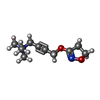
4-(4,5-dihydro-1,2-oxazol-3-yloxy)-N,N,N-trimethylbut-2-yn-1-aminium

Source
  • homo sapiens (human)
  • vicugna pacos (alpaca)
KeywordsMEMBRANE PROTEIN / GPCR / active-state / ligand-free / de novo protein / inactive-state / atropine / nanobody / MEMBRANE PROTEIN/IMMUNE SYSTEM / MEMBRANE PROTEIN-IMMUNE SYSTEM complex

+
About Yorodumi Papers

-
News

-
Feb 9, 2022. New format data for meta-information of EMDB entries

New format data for meta-information of EMDB entries

  • Version 3 of the EMDB header file is now the official format.
  • The previous official version 1.9 will be removed from the archive.

Related info.:EMDB header

External links:wwPDB to switch to version 3 of the EMDB data model

-
Aug 12, 2020. Covid-19 info

Covid-19 info

URL: https://pdbj.org/emnavi/covid19.php

New page: Covid-19 featured information page in EM Navigator.

Related info.:Covid-19 info / Mar 5, 2020. Novel coronavirus structure data

+
Mar 5, 2020. Novel coronavirus structure data

Novel coronavirus structure data

Related info.:Yorodumi Speices / Aug 12, 2020. Covid-19 info

External links:COVID-19 featured content - PDBj / Molecule of the Month (242):Coronavirus Proteases

+
Jan 31, 2019. EMDB accession codes are about to change! (news from PDBe EMDB page)

EMDB accession codes are about to change! (news from PDBe EMDB page)

  • The allocation of 4 digits for EMDB accession codes will soon come to an end. Whilst these codes will remain in use, new EMDB accession codes will include an additional digit and will expand incrementally as the available range of codes is exhausted. The current 4-digit format prefixed with “EMD-” (i.e. EMD-XXXX) will advance to a 5-digit format (i.e. EMD-XXXXX), and so on. It is currently estimated that the 4-digit codes will be depleted around Spring 2019, at which point the 5-digit format will come into force.
  • The EM Navigator/Yorodumi systems omit the EMD- prefix.

Related info.:Q: What is EMD? / ID/Accession-code notation in Yorodumi/EM Navigator

External links:EMDB Accession Codes are Changing Soon! / Contact to PDBj

+
Jul 12, 2017. Major update of PDB

Major update of PDB

  • wwPDB released updated PDB data conforming to the new PDBx/mmCIF dictionary.
  • This is a major update changing the version number from 4 to 5, and with Remediation, in which all the entries are updated.
  • In this update, many items about electron microscopy experimental information are reorganized (e.g. em_software).
  • Now, EM Navigator and Yorodumi are based on the updated data.

External links:wwPDB Remediation / Enriched Model Files Conforming to OneDep Data Standards Now Available in the PDB FTP Archive

-
Yorodumi Papers

Database of articles cited by EMDB/PDB/SASBDB data

  • Database of articles cited by EMDB, PDB, and SASBDB entries
  • Using PubMed data

Related info.:EMDB / PDB / SASBDB / Yorodumi / EMN Papers / Changes in new EM Navigator and Yorodumi

Read more