[English] 日本語
Yorodumi Papers
- Database of articles cited by EMDB/PDB/SASBDB data -

+
Search query

Keywords
Structure methods
Author
Journal
IF

-
Structure paper

TitleCryo-EM structural analyses reveal a unique role for elongation factor G2 (EF-G2) in Mycobacteria.
Journal, issue, pagesFEBS J, Vol. 292, Issue 24, Page 6533-6556, Year 2025
Publish dateJun 26, 2025
AuthorsPriya Baid / Jayati Sengupta /
PubMed AbstractThe gene-encoding translation elongation factor G (EF-G) has undergone gene duplication across various bacterial species including Mycobacteria, and in mammalian mitochondria, leading to the ...The gene-encoding translation elongation factor G (EF-G) has undergone gene duplication across various bacterial species including Mycobacteria, and in mammalian mitochondria, leading to the emergence of the paralogue elongation factor G2 (EF-G2). Our study reveals that mycobacterial EF-G2, unlike EF-G1, neither participates in ribosome-recycling nor significantly contributes to overall translation, suggesting that it plays an alternative role in Mycobacteria. Remarkably, our investigation found a significant overexpression of mycobacterial EF-G2 during the stationary growth phase. Moreover, EF-G2 lacks ribosome-dependent GTPase activity, an observation consistent with previous reports. Cryo-EM analysis of the M. smegmatis 70S ribosome purified from the nutrient-starved (stationary) phase and complexed with EF-G2 unveiled the structural basis for its inability to hydrolyse GTP in a ribosome-dependent manner. Furthermore, we report an unprecedented binding mode of two EF-G2 copies on the 50S ribosomal subunit that impedes subunit association, thereby preventing the formation of active 70S ribosomes. Thus, instead of performing canonical functions, mycobacterial EF-G2 acts as a translation repressor during nutrient starvation. Altogether, our findings shed light on the multifaceted mechanisms by which EF-G2 modulates protein synthesis under nutrient-limited conditions, providing insights into adaptive strategies employed by Mycobacteria to survive in hostile environments.
External linksFEBS J / PubMed:40569974
MethodsEM (single particle)
Resolution3.6 - 4.7 Å
Structure data

EMDB-61959, PDB-9k0z:
EF-G2 bound 70S ribosome complex of M. smegmatis
Method: EM (single particle) / Resolution: 4.7 Å

EMDB-61960, PDB-9k10:
EF-G2 bound 50S ribosome subunit complex of M. smegmatis
Method: EM (single particle) / Resolution: 3.6 Å

Chemicals

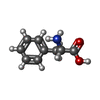
ChemComp-PHE:
PHENYLALANINE

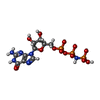
ChemComp-GNP:
PHOSPHOAMINOPHOSPHONIC ACID-GUANYLATE ESTER / GppNHp, GMPPNP, energy-carrying molecule analogue*YM

ChemComp-MG:
Unknown entry

ChemComp-ZN:
Unknown entry

Source
  • mycolicibacterium smegmatis mc2 155 (bacteria)

KeywordsRIBOSOME / Mycobacterium 70S ribosome / stationary phase / elongation factor G2 / non-canonical factor / Mycobacterium 50S ribosomal subunit

+
About Yorodumi Papers

-
News

-
Feb 9, 2022. New format data for meta-information of EMDB entries

New format data for meta-information of EMDB entries

  • Version 3 of the EMDB header file is now the official format.
  • The previous official version 1.9 will be removed from the archive.

Related info.:EMDB header

External links:wwPDB to switch to version 3 of the EMDB data model

-
Aug 12, 2020. Covid-19 info

Covid-19 info

URL: https://pdbj.org/emnavi/covid19.php

New page: Covid-19 featured information page in EM Navigator.

Related info.:Covid-19 info / Mar 5, 2020. Novel coronavirus structure data

+
Mar 5, 2020. Novel coronavirus structure data

Novel coronavirus structure data

Related info.:Yorodumi Speices / Aug 12, 2020. Covid-19 info

External links:COVID-19 featured content - PDBj / Molecule of the Month (242):Coronavirus Proteases

+
Jan 31, 2019. EMDB accession codes are about to change! (news from PDBe EMDB page)

EMDB accession codes are about to change! (news from PDBe EMDB page)

  • The allocation of 4 digits for EMDB accession codes will soon come to an end. Whilst these codes will remain in use, new EMDB accession codes will include an additional digit and will expand incrementally as the available range of codes is exhausted. The current 4-digit format prefixed with “EMD-” (i.e. EMD-XXXX) will advance to a 5-digit format (i.e. EMD-XXXXX), and so on. It is currently estimated that the 4-digit codes will be depleted around Spring 2019, at which point the 5-digit format will come into force.
  • The EM Navigator/Yorodumi systems omit the EMD- prefix.

Related info.:Q: What is EMD? / ID/Accession-code notation in Yorodumi/EM Navigator

External links:EMDB Accession Codes are Changing Soon! / Contact to PDBj

+
Jul 12, 2017. Major update of PDB

Major update of PDB

  • wwPDB released updated PDB data conforming to the new PDBx/mmCIF dictionary.
  • This is a major update changing the version number from 4 to 5, and with Remediation, in which all the entries are updated.
  • In this update, many items about electron microscopy experimental information are reorganized (e.g. em_software).
  • Now, EM Navigator and Yorodumi are based on the updated data.

External links:wwPDB Remediation / Enriched Model Files Conforming to OneDep Data Standards Now Available in the PDB FTP Archive

-
Yorodumi Papers

Database of articles cited by EMDB/PDB/SASBDB data

  • Database of articles cited by EMDB, PDB, and SASBDB entries
  • Using PubMed data

Related info.:EMDB / PDB / SASBDB / Yorodumi / EMN Papers / Changes in new EM Navigator and Yorodumi

Read more