 Movie
Movie Controller
 Structure viewers
 About Yorodumi Papers


+Search query
-Structure paper
| Title | Structural basis for substrate selectivity by site-one protease revealed by studies with a small-molecule inhibitor. |
|---|---|
| Journal, issue, pages | Proc Natl Acad Sci U S A, Vol. 122, Issue 18, Page e2426931122, Year 2025 |
| Publish date | May 6, 2025 |
 Authors Authors | Ashley V Bullington / Ilaria Micallo / Bilkish Bajaj / Pankaj Kumar / Netanya Schlamowitz / Aurora Silva / Sebastian Hendrix / Noam Zelcer / Daniel L Kober /   |
| PubMed Abstract | Site-one protease (S1P) carries out the first proteolytic step to activate membrane-bound effector proteins in the Golgi. S1P matures through an autocatalytic process that begins in the endoplasmic ...Site-one protease (S1P) carries out the first proteolytic step to activate membrane-bound effector proteins in the Golgi. S1P matures through an autocatalytic process that begins in the endoplasmic reticulum (ER) and culminates with the displacement of its inhibitory pro-domain by its cofactor, sterol regulatory element binding protein-regulating gene (SPRING). Spatial control of S1P activity and substrate localization underpins signaling pathways governing, among others, lipogenesis, ER stress, and lysosome biogenesis. The factors governing these pathways are activated by S1P-mediated proteolysis upon their regulated transport from the ER to the Golgi. S1P cleaves substrates with the recognition sequence RX(L/I/V)Z, where X is any residue other than Cys or Pro and Z is preferably Leu or Lys. However, the structural basis for substrate recognition by S1P has remained unknown. Here, we used the small molecule PF-429242, a competitive inhibitor of S1P, to investigate substrate recognition by the S1P/SPRING complex. We determined the structure of S1P/SPRING bound to PF-429242 and found that PF-429242 binds S1P in the same pocket that recognizes the substrate's conserved P Arg. Further structural analysis suggests that S1P requires a conformation change to accommodate the substrate's P (L/I/V) residue. We designed an S1P mutation (I308A) to reduce the steric clash at the P position and generated an S1P that was resistant to PF-429242 in biochemical and cell culture assays. Our findings reveal selectivity in the recognition of substrates by S1P and provide a roadmap for the rational design of improved S1P inhibitors. |
 External links External links | Proc Natl Acad Sci U S A / PubMed:40299693 / PubMed Central |
| Methods | EM (single particle) |
| Resolution | 2.4 Å |
| Structure data | EMDB-45892, PDB-9csd: |
| Chemicals | 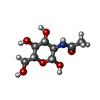 ChemComp-NAG:  PDB-1azu:  ChemComp-CA:  ChemComp-HOH: |
| Source |
|
 Keywords Keywords | MEMBRANE PROTEIN/INHIBITOR / protease / complex / inhibitor / MEMBRANE PROTEIN / MEMBRANE PROTEIN-INHIBITOR complex |


 homo sapiens (human)