[English] 日本語
Yorodumi Papers
- Database of articles cited by EMDB/PDB/SASBDB data -

+
Search query

Keywords
Structure methods
Author
Journal
IF

-
Structure paper

TitleStructure-guided design of partial agonists at an opioid receptor.
Journal, issue, pagesNat Commun, Vol. 16, Issue 1, Page 2518, Year 2025
Publish dateMar 13, 2025
AuthorsBalazs R Varga / Sarah M Bernhard / Amal El Daibani / Saheem A Zaidi / Jordy H Lam / Jhoan Aguilar / Kevin Appourchaux / Antonina L Nazarova / Alexa Kouvelis / Ryosuke Shinouchi / Haylee R Hammond / Shainnel O Eans / Violetta Weinreb / Elyssa B Margolis / Jonathan F Fay / Xi-Ping Huang / Amynah Pradhan / Vsevolod Katritch / Jay P McLaughlin / Susruta Majumdar / Tao Che /
PubMed AbstractChronic pain and opioid overdose deaths highlight the need for non-addictive analgesics with novel mechanisms. The δ opioid receptor (δOR) is a promising target, as it lacks the respiratory ...Chronic pain and opioid overdose deaths highlight the need for non-addictive analgesics with novel mechanisms. The δ opioid receptor (δOR) is a promising target, as it lacks the respiratory depression associated with µ opioid receptor (µOR) agonists. However, early δOR full agonists caused seizures, limiting their clinical use. Partial δOR agonists may offer more controlled receptor activation than full agonists, but their development has been hindered by uncertainty regarding the molecular mechanism of partial agonism. Here we show that C6-Quino, a bitopic ligand developed through structure-based design, acts as a selective δOR partial agonist. Functional studies reveal that C6-Quino shows differential activity at G-protein and arrestin pathways and interacts with the sodium binding pocket, confirmed through cryo-EM analysis. C6-Quino demonstrates oral activity, analgesic activity in chronic pain models without causing δOR-related seizures and µOR-related adverse effects which have limited opioid usage in recent times. This discovery outlines a new strategy for developing δOR-targeted analgesics and provides a framework for optimizing signaling profiles of other Class A GPCRs.
External linksNat Commun / PubMed:40082451 / PubMed Central
MethodsEM (single particle)
Resolution2.62 - 2.8 Å
Structure data

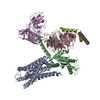
EMDB-45581, PDB-9cgj:
CryoEM structure of delta opioid receptor bound to G proteins and a partial agonist
Method: EM (single particle) / Resolution: 2.8 Å

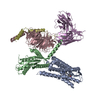
EMDB-45582, PDB-9cgk:
CryoEM structure of delta opioid receptor bound to G proteins and a full bitopic agonist
Method: EM (single particle) / Resolution: 2.62 Å

Chemicals

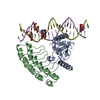
PDB-1awc:
MOUSE GABP ALPHA/BETA DOMAIN BOUND TO DNA

PDB-1awd:
FERREDOXIN [2FE-2S] OXIDIZED FORM FROM CHLORELLA FUSCA

Source
  • homo sapiens (human)
  • mus musculus (house mouse)
KeywordsMEMBRANE PROTEIN / GPCR / Delta OPIOID Receptor / bitopic ligand

+
About Yorodumi Papers

-
News

-
Feb 9, 2022. New format data for meta-information of EMDB entries

New format data for meta-information of EMDB entries

  • Version 3 of the EMDB header file is now the official format.
  • The previous official version 1.9 will be removed from the archive.

Related info.:EMDB header

External links:wwPDB to switch to version 3 of the EMDB data model

-
Aug 12, 2020. Covid-19 info

Covid-19 info

URL: https://pdbj.org/emnavi/covid19.php

New page: Covid-19 featured information page in EM Navigator.

Related info.:Covid-19 info / Mar 5, 2020. Novel coronavirus structure data

+
Mar 5, 2020. Novel coronavirus structure data

Novel coronavirus structure data

Related info.:Yorodumi Speices / Aug 12, 2020. Covid-19 info

External links:COVID-19 featured content - PDBj / Molecule of the Month (242):Coronavirus Proteases

+
Jan 31, 2019. EMDB accession codes are about to change! (news from PDBe EMDB page)

EMDB accession codes are about to change! (news from PDBe EMDB page)

  • The allocation of 4 digits for EMDB accession codes will soon come to an end. Whilst these codes will remain in use, new EMDB accession codes will include an additional digit and will expand incrementally as the available range of codes is exhausted. The current 4-digit format prefixed with “EMD-” (i.e. EMD-XXXX) will advance to a 5-digit format (i.e. EMD-XXXXX), and so on. It is currently estimated that the 4-digit codes will be depleted around Spring 2019, at which point the 5-digit format will come into force.
  • The EM Navigator/Yorodumi systems omit the EMD- prefix.

Related info.:Q: What is EMD? / ID/Accession-code notation in Yorodumi/EM Navigator

External links:EMDB Accession Codes are Changing Soon! / Contact to PDBj

+
Jul 12, 2017. Major update of PDB

Major update of PDB

  • wwPDB released updated PDB data conforming to the new PDBx/mmCIF dictionary.
  • This is a major update changing the version number from 4 to 5, and with Remediation, in which all the entries are updated.
  • In this update, many items about electron microscopy experimental information are reorganized (e.g. em_software).
  • Now, EM Navigator and Yorodumi are based on the updated data.

External links:wwPDB Remediation / Enriched Model Files Conforming to OneDep Data Standards Now Available in the PDB FTP Archive

-
Yorodumi Papers

Database of articles cited by EMDB/PDB/SASBDB data

  • Database of articles cited by EMDB, PDB, and SASBDB entries
  • Using PubMed data

Related info.:EMDB / PDB / SASBDB / Yorodumi / EMN Papers / Changes in new EM Navigator and Yorodumi

Read more