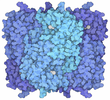
- EMDB-24733: Oxytocin receptor (OTR) bound to oxytocin in complex with a heter... -
+
Open data
ID or keywords:
Loading...
-
Basic information
Entry
Database: EMDB / ID: EMD-24733
Title
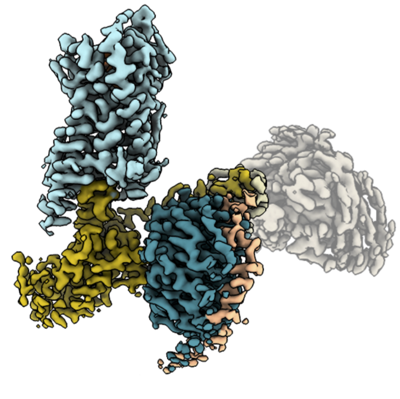
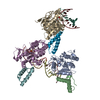
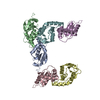
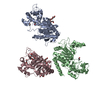
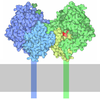
Oxytocin receptor (OTR) bound to oxytocin in complex with a heterotrimeric Gq protein
Map data
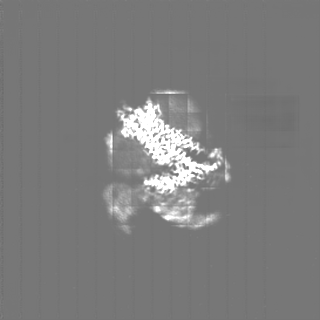
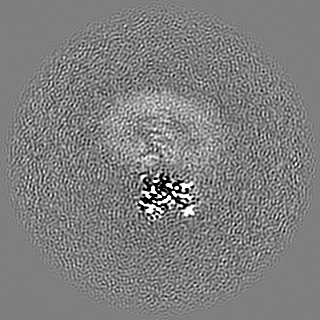
Combined map from local refinements
Sample
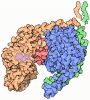
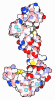
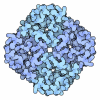
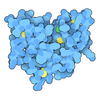
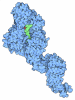
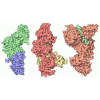
Complex: Oxytocin receptor signaling complex with oxytocin and miniGq and an scFv
Complex: Oxytocin
Protein or peptide: Oxytocin
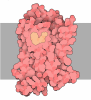
Complex: Oxytocin receptor
Protein or peptide: Oxytocin receptor
Complex: miniGq
Protein or peptide: Guanine nucleotide-binding protein G(I)/G(S)/G(O) subunit gamma-2, Guanine nucleotide-binding protein G(i) subunit alpha-2,Guanine nucleotide-binding protein G(s) subunit alpha isoforms short
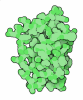
Protein or peptide: Guanine nucleotide-binding protein G(I)/G(S)/G(T) subunit beta-1
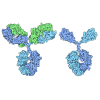
Complex: scFv16
Protein or peptide: scFv16
Ligand: MAGNESIUM ION
Keywords
HORMONE / GPCR COMPLEX / TRANSMEMBRANE RECEPTOR / OXYTOCIN RECEPTOR / OTR / OT / OXTR / G PROTEIN / OXYTOCIN / VASOTOCIN / MEMBRANE PROTEIN / MEMBRANE PROTEIN-NEUROPEPTIDE complex
Function / homology
Function and homology information
oxytocin receptor activity / positive regulation of hindgut contraction / oxytocin receptor binding / neurohypophyseal hormone activity / maternal aggressive behavior / positive regulation of uterine smooth muscle contraction / positive regulation of penile erection / maternal process involved in parturition / Vasopressin-like receptors / regulation of systemic arterial blood pressure by vasopressin ...oxytocin receptor activity / positive regulation of hindgut contraction / oxytocin receptor binding / neurohypophyseal hormone activity / maternal aggressive behavior / positive regulation of uterine smooth muscle contraction / positive regulation of penile erection / maternal process involved in parturition / Vasopressin-like receptors / regulation of systemic arterial blood pressure by vasopressin / vasopressin receptor activity / sperm ejaculation / negative regulation of urine volume / positive regulation of norepinephrine secretion / response to genistein / response to ether / response to sucrose / positive regulation of prostaglandin secretion / grooming behavior / positive regulation of blood pressure / drinking behavior / neuropeptide hormone activity / maternal behavior / positive regulation of ossification / positive regulation of female receptivity / positive regulation of synapse assembly / eating behavior / response to food / male mating behavior / response to electrical stimulus / positive regulation of vasoconstriction / response to retinoic acid / social behavior / response to cAMP / positive regulation of synaptic transmission / neuronal dense core vesicle / cellular response to hormone stimulus / negative regulation of blood pressure / lactation / response to progesterone / regulation of heart rate / secretory granule / response to glucocorticoid / muscle contraction / response to activity / response to amphetamine / response to cocaine / response to prostaglandin E / female pregnancy / response to peptide hormone / memory / Olfactory Signaling Pathway / Activation of the phototransduction cascade / terminal bouton / G protein-coupled acetylcholine receptor signaling pathway / G beta:gamma signalling through PLC beta / Presynaptic function of Kainate receptors / Thromboxane signalling through TP receptor / Activation of G protein gated Potassium channels / Inhibition of voltage gated Ca2+ channels via Gbeta/gamma subunits / G-protein activation / Glucagon signaling in metabolic regulation / G beta:gamma signalling through CDC42 / Prostacyclin signalling through prostacyclin receptor / G beta:gamma signalling through BTK / Synthesis, secretion, and inactivation of Glucagon-like Peptide-1 (GLP-1) / photoreceptor disc membrane / ADP signalling through P2Y purinoceptor 12 / Sensory perception of sweet, bitter, and umami (glutamate) taste / Glucagon-type ligand receptors / Adrenaline,noradrenaline inhibits insulin secretion / response to estradiol / Vasopressin regulates renal water homeostasis via Aquaporins / Glucagon-like Peptide-1 (GLP1) regulates insulin secretion / G alpha (z) signalling events / cellular response to catecholamine stimulus / ADP signalling through P2Y purinoceptor 1 / ADORA2B mediated anti-inflammatory cytokines production / G beta:gamma signalling through PI3Kgamma / adenylate cyclase-activating dopamine receptor signaling pathway / Cooperation of PDCL (PhLP1) and TRiC/CCT in G-protein beta folding / GPER1 signaling / cellular response to prostaglandin E stimulus / heterotrimeric G-protein complex / G alpha (12/13) signalling events / positive regulation of cold-induced thermogenesis / Inactivation, recovery and regulation of the phototransduction cascade / extracellular vesicle / sensory perception of taste / heart development / Thrombin signalling through proteinase activated receptors (PARs) / signaling receptor complex adaptor activity / positive regulation of cytosolic calcium ion concentration / retina development in camera-type eye / GTPase binding / Ca2+ pathway / High laminar flow shear stress activates signaling by PIEZO1 and PECAM1:CDH5:KDR in endothelial cells / G alpha (i) signalling events / G alpha (s) signalling events / phospholipase C-activating G protein-coupled receptor signaling pathway Similarity search - Function
National Institutes of Health/National Institute of General Medical Sciences (NIH/NIGMS)
T32-GM089626
United States
Citation
Journal: Nat Struct Mol Biol / Year: 2022 Title: The oxytocin signaling complex reveals a molecular switch for cation dependence. Authors: Justin G Meyerowitz / Michael J Robertson / Ximena Barros-Álvarez / Ouliana Panova / Robert M Nwokonko / Yang Gao / Georgios Skiniotis / Abstract: Oxytocin (OT) and vasopressin (AVP) are conserved peptide signaling hormones that are critical for diverse processes including osmotic homeostasis, reproduction, lactation and social interaction. OT ...Oxytocin (OT) and vasopressin (AVP) are conserved peptide signaling hormones that are critical for diverse processes including osmotic homeostasis, reproduction, lactation and social interaction. OT acts through the oxytocin receptor (OTR), a magnesium-dependent G protein-coupled receptor that is a therapeutic target for treatment of postpartum hemorrhage, dysfunctional labor and autism. However, the molecular mechanisms that underlie OTR activation by OT and the dependence on magnesium remain unknown. Here we present the wild-type active-state structure of human OTR bound to OT and miniG determined by cryo-EM. The structure reveals a unique activation mechanism adopted by OTR involving both the formation of a Mg coordination complex between OT and the receptor, and disruption of transmembrane helix 7 (TM7) by OT. Our functional assays demonstrate the role of TM7 disruption and provide the mechanism of full agonism by OT and partial agonism by OT analogs. Furthermore, we find that the identity of a single cation-coordinating residue across vasopressin family receptors determines whether the receptor is cation-dependent. Collectively, these results demonstrate how the Mg-dependent OTR is activated by OT, provide essential information for structure-based drug discovery efforts and shed light on the molecular determinants of cation dependence of vasopressin family receptors throughout the animal kingdom.
History
Deposition
Aug 24, 2021
-
Header (metadata) release
Mar 9, 2022
-
Map release
Mar 9, 2022
-
Update
Oct 9, 2024
-
Current status
Oct 9, 2024
Processing site: RCSB / Status: Released
-
Structure visualization
Movie
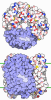
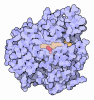
Surface view with section colored by density value
EMPIAR-10936 (Title: Oxytocin receptor (OTR) bound to oxytocin in complex with a heterotrimeric Gq protein Data size: 4.1 TB Data #1: Unaligned multi-frame micrographs of the oxytocin-oxytocin receptor-miniGq complex [micrographs - multiframe])
Entire : Oxytocin receptor signaling complex with oxytocin and miniGq and ...
Entire
Name: Oxytocin receptor signaling complex with oxytocin and miniGq and an scFv
Components
Complex: Oxytocin receptor signaling complex with oxytocin and miniGq and an scFv
Complex: Oxytocin
Protein or peptide: Oxytocin
Complex: Oxytocin receptor
Protein or peptide: Oxytocin receptor
Complex: miniGq
Protein or peptide: Guanine nucleotide-binding protein G(I)/G(S)/G(O) subunit gamma-2, Guanine nucleotide-binding protein G(i) subunit alpha-2,Guanine nucleotide-binding protein G(s) subunit alpha isoforms short
Protein or peptide: Guanine nucleotide-binding protein G(I)/G(S)/G(T) subunit beta-1
Complex: scFv16
Protein or peptide: scFv16
Ligand: MAGNESIUM ION
+
Supramolecule #1: Oxytocin receptor signaling complex with oxytocin and miniGq and ...
Supramolecule
Name: Oxytocin receptor signaling complex with oxytocin and miniGq and an scFv type: complex / ID: 1 / Parent: 0 / Macromolecule list: #1-#5
Name: MAGNESIUM ION / type: ligand / ID: 6 / Number of copies: 1 / Formula: MG
Molecular weight
Theoretical: 24.305 Da
-
Experimental details
-
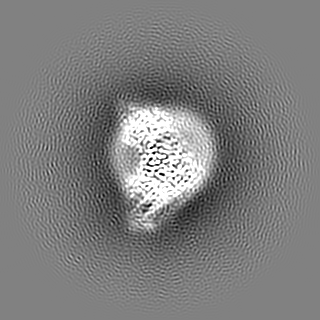
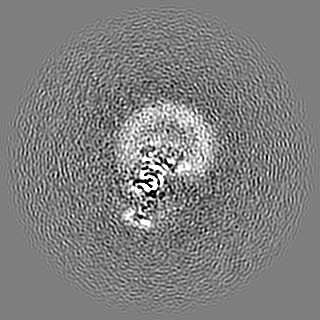
Structure determination
Method
cryo EM
Processing
single particle reconstruction
Aggregation state
particle
-
Sample preparation
Buffer
pH: 7.4
Grid
Model: UltrAuFoil R1.2/1.3 / Material: GOLD / Support film - Material: GOLD / Support film - topology: HOLEY / Pretreatment - Type: GLOW DISCHARGE
Vitrification
Cryogen name: ETHANE
-
Electron microscopy
Microscope
TFS KRIOS
Image recording
Film or detector model: GATAN K3 (6k x 4k) / Number grids imaged: 1 / Number real images: 40 / Average exposure time: 2.497 sec. / Average electron dose: 54.8 e/Å2
Electron beam
Acceleration voltage: 300 kV / Electron source: FIELD EMISSION GUN
In the structure databanks used in Yorodumi, some data are registered as the other names, "COVID-19 virus" and "2019-nCoV". Here are the details of the virus and the list of structure data.
Jan 31, 2019. EMDB accession codes are about to change! (news from PDBe EMDB page)
EMDB accession codes are about to change! (news from PDBe EMDB page)
The allocation of 4 digits for EMDB accession codes will soon come to an end. Whilst these codes will remain in use, new EMDB accession codes will include an additional digit and will expand incrementally as the available range of codes is exhausted. The current 4-digit format prefixed with “EMD-” (i.e. EMD-XXXX) will advance to a 5-digit format (i.e. EMD-XXXXX), and so on. It is currently estimated that the 4-digit codes will be depleted around Spring 2019, at which point the 5-digit format will come into force.
The EM Navigator/Yorodumi systems omit the EMD- prefix.
Related info.:Q: What is EMD? / ID/Accession-code notation in Yorodumi/EM Navigator
Yorodumi is a browser for structure data from EMDB, PDB, SASBDB, etc.
This page is also the successor to EM Navigator detail page, and also detail information page/front-end page for Omokage search.
The word "yorodu" (or yorozu) is an old Japanese word meaning "ten thousand". "mi" (miru) is to see.
Related info.:EMDB / PDB / SASBDB / Comparison of 3 databanks / Yorodumi Search / Aug 31, 2016. New EM Navigator & Yorodumi / Yorodumi Papers / Jmol/JSmol / Function and homology information / Changes in new EM Navigator and Yorodumi
 Movie
Movie Controller

 Yorodumi
 Open data
 Basic information
 Map data
 Sample
 Keywords
 Function and homology information
 Homo sapiens (human) /
 Mus musculus (house mouse)
 Authors
 United States, 1 items
  Citation
 Structure visualization
 Downloads & links
 emd_24733.png
 http://ftp.pdbj.org/pub/emdb/structures/EMD-24733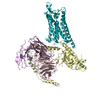



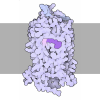
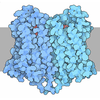
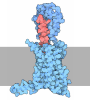
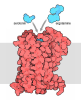


 Z (Sec.)
 Y (Row.)
 X (Col.)


















 Sample components
 Spodoptera frugiperda (fall armyworm)
 Processing
 Electron microscopy
 FIELD EMISSION GUN
