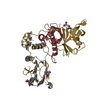
Movie
Movie Controller

[English] 日本語
 Yorodumi
- PDB-9zld: Cryo-EM structure of hepatic amyloid fibril from a variant ATTRV1... -
+ Open data

- Basic information
| Entry | Database: PDB / ID: 9zld | ||||||||||||||||||||||||||||||
|---|---|---|---|---|---|---|---|---|---|---|---|---|---|---|---|---|---|---|---|---|---|---|---|---|---|---|---|---|---|---|---|
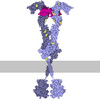
| Title | Cryo-EM structure of hepatic amyloid fibril from a variant ATTRV122delta, single filament morphology | ||||||||||||||||||||||||||||||
 Components Components | Transthyretin | ||||||||||||||||||||||||||||||
 Keywords Keywords | PROTEIN FIBRIL / ATTR / Systemic amyloidosis / V122delta / amyloid | ||||||||||||||||||||||||||||||
| Function / homology |  Function and homology information Function and homology informationDefective visual phototransduction due to STRA6 loss of function / The canonical retinoid cycle in rods (twilight vision) / purine nucleobase metabolic process / hormone binding / Non-integrin membrane-ECM interactions / molecular sequestering activity / Retinoid metabolism and transport / retinoid metabolic process / azurophil granule lumen / Amyloid fiber formation ...Defective visual phototransduction due to STRA6 loss of function / The canonical retinoid cycle in rods (twilight vision) / purine nucleobase metabolic process / hormone binding / Non-integrin membrane-ECM interactions / molecular sequestering activity / Retinoid metabolism and transport / retinoid metabolic process / azurophil granule lumen / Amyloid fiber formation / Neutrophil degranulation / protein-containing complex binding / protein-containing complex / extracellular exosome / extracellular region / identical protein binding Similarity search - Function | ||||||||||||||||||||||||||||||
| Biological species |  Homo sapiens (human) Homo sapiens (human) | ||||||||||||||||||||||||||||||
| Method | ELECTRON MICROSCOPY / helical reconstruction / cryo EM / Resolution: 2.9 Å | ||||||||||||||||||||||||||||||
 Authors Authors | Nguyen, B.A. / Ahmed, Y. / Saelices, L. | ||||||||||||||||||||||||||||||
| Funding support |  United States, 3items United States, 3items
| ||||||||||||||||||||||||||||||
 Citation Citation | Journal: Nat Commun / Year: 2026 Title: Cryo-EM reveals structural variability of apolipoprotein A-I amyloid fibrils across organs, mutations, and clinical presentations. Authors: Binh An Nguyen / Maria Del Carmen Fernandez-Ramirez / Parker Bassett / Virender Singh / Preeti Singh / Maja Pękała / Layla Villalon / Yasmin Ahmed / Andrew Lemoff / Bret Evers / Christian ...Authors: Binh An Nguyen / Maria Del Carmen Fernandez-Ramirez / Parker Bassett / Virender Singh / Preeti Singh / Maja Pękała / Layla Villalon / Yasmin Ahmed / Andrew Lemoff / Bret Evers / Christian Lopez / Barbara Kluve-Beckerman / Lorena Saelices /  Abstract: Hereditary apolipoprotein A-I (AApoA‑I) amyloidosis is a rare systemic disease caused by the deposition of amyloid fibrils formed by apolipoprotein A‑I in multiple organs, leading to severe ...Hereditary apolipoprotein A-I (AApoA‑I) amyloidosis is a rare systemic disease caused by the deposition of amyloid fibrils formed by apolipoprotein A‑I in multiple organs, leading to severe clinical outcomes. With no available therapies or diagnostic tools, defining the structure of AApoA‑I fibrils is crucial to understanding disease mechanisms and guiding intervention. Here we use cryo-electron microscopy to analyze AApoA‑I fibrils from the heart, kidney, liver, and spleen of patients carrying G26R, L90P, and R173P mutations. G26R fibrils, regardless of organ, exhibits untwisted morphologies and cannot be resolved structurally. Conversely, L90P and R173P fibrils display a compact diabolo-shaped conformation in all organs analyzed. Their high-resolution maps enable visualization of cis-Proline 66, which may represent a potential conformational switch during fibril formation. Our findings suggest that mutation-driven polymorphism may influence organ tropism and clinical presentation. This work advances our understanding of AApoA‑I fibril assembly and provides insights toward developing targeted clinical tools. #1: Journal: Commun Biol / Year: 2026 Title: Amyloid fibril polymorphism in the heart and liver of a patient with polyneuropathic ATTRv-V122Δ amyloidosis. Authors: Yasmin Ahmed / Binh An Nguyen / Candace Kelly / Shumaila Afrin / Virender Singh / Bret M Evers / John M Shelton / Christian Lopez Escobar / Preeti Singh / Rose Pedretti / Lanie Wang / Parker ...Authors: Yasmin Ahmed / Binh An Nguyen / Candace Kelly / Shumaila Afrin / Virender Singh / Bret M Evers / John M Shelton / Christian Lopez Escobar / Preeti Singh / Rose Pedretti / Lanie Wang / Parker Bassett / Maria Del Carmen Fernandez-Ramirez / Maja Pekala / Andrew Lemoff / Barbara Kluve-Beckerman / Lorena Saelices / Abstract: ATTR amyloidosis is a phenotypically heterogeneous disease characterized by the pathological deposition of transthyretin in the form of amyloid fibrils into various organs. ATTR amyloidosis may ...ATTR amyloidosis is a phenotypically heterogeneous disease characterized by the pathological deposition of transthyretin in the form of amyloid fibrils into various organs. ATTR amyloidosis may result from mutations in variant (ATTRv) amyloidosis, or aging in wild-type (ATTRwt) amyloidosis. ATTRwt generally manifests as cardiomyopathy, whereas ATTRv may present as polyneuropathy, cardiomyopathy, or mixed, in combination with many other symptoms deriving from multisystem organ involvement. Over 220 different mutational variants of transthyretin have been identified, many of them being linked to specific disease symptoms. Yet, the role of these mutations in explaining differential disease manifestations remains unclear. Using cryo-electron microscopy, here we structurally characterized fibrils from the heart and the liver of an ATTRv patient carrying the V122∆ mutation, which is predominantly associated with polyneuropathy. Our results show that these fibrils are polymorphic, presenting as both single and double filaments. Our study alludes to a structural connection contributing to phenotypic variation in ATTR amyloidosis, as polymorphism in ATTR fibrils may manifest in patients with predominantly polyneuropathic phenotypes. | ||||||||||||||||||||||||||||||
| History |
|
- Structure visualization
| Structure viewer | Molecule: MolmilJmol/JSmol |
|---|
- Downloads & links
-Download
| PDBx/mmCIF format | 9zld.cif.gz | 98.8 KB | Display | PDBx/mmCIF format |
|---|---|---|---|---|
| PDB format | pdb9zld.ent.gz | 74.1 KB | Display | PDB format |
| PDBx/mmJSON format | 9zld.json.gz | Tree view | PDBx/mmJSON format | |
| Others |  Other downloads Other downloads |
-Validation report
| Arichive directory | https://data.pdbj.org/pub/pdb/validation_reports/zl/9zldftp://data.pdbj.org/pub/pdb/validation_reports/zl/9zld | HTTPS FTP |
|---|
-Related structure data
| Related structure data |  74399MC  9pvyC  9pvzC  9pw3C M: map data used to model this data C: citing same article ( |
|---|---|
| Similar structure data |


-Links
 PDBj
PDBj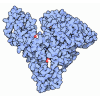
- Assembly
| Deposited unit | 
|
|---|---|
| 1 |
|
-Components
| #1: Protein | Mass: 13678.229 Da / Num. of mol.: 5 / Source method: isolated from a natural source / Source: (natural) Homo sapiens (human) / Organ: Liver / Tissue: Liver / References: UniProt: P02766Has protein modification | N | |
|---|
-Experimental details
-Experiment
| Experiment | Method: ELECTRON MICROSCOPY |
|---|---|
| EM experiment | Aggregation state: FILAMENT / 3D reconstruction method: helical reconstruction |
- Sample preparation
| Component | Name: fibrils of ATTRV122delta / Type: COMPLEX / Details: fibril extracted from the liver, postmortem. / Entity ID: all / Source: NATURAL |
|---|---|
| Source (natural) | Organism: Homo sapiens (human) / Organ: Liver / Tissue: Liver |
| Buffer solution | pH: 7 / Details: ice-chilled water |
| Specimen | Embedding applied: NO / Shadowing applied: NO / Staining applied: NO / Vitrification applied: YES Details: fibrils were extracted from cardiac tissue using a water-based extraction method. |
| Specimen support | Grid material: COPPER / Grid mesh size: 300 divisions/in. / Grid type: Quantifoil R1.2/1.3 |
| Vitrification | Instrument: FEI VITROBOT MARK IV / Cryogen name: ETHANE / Humidity: 100 % / Chamber temperature: 298 K |
- Electron microscopy imaging
| Experimental equipment |  Model: Titan Krios / Image courtesy: FEI Company |
|---|---|
| Microscopy | Model: TFS KRIOS |
| Electron gun | Electron source:  FIELD EMISSION GUN / Accelerating voltage: 300 kV / Illumination mode: FLOOD BEAM FIELD EMISSION GUN / Accelerating voltage: 300 kV / Illumination mode: FLOOD BEAM |
| Electron lens | Mode: BRIGHT FIELD / Nominal defocus max: 2400 nm / Nominal defocus min: 1000 nm |
| Image recording | Average exposure time: 2.06 sec. / Electron dose: 50 e/Å2 / Film or detector model: FEI FALCON IV (4k x 4k) / Num. of grids imaged: 1 / Num. of real images: 4366 |
- Processing
| EM software |
| ||||||||||||||||||||||||||||||||||||||||
|---|---|---|---|---|---|---|---|---|---|---|---|---|---|---|---|---|---|---|---|---|---|---|---|---|---|---|---|---|---|---|---|---|---|---|---|---|---|---|---|---|---|
| CTF correction | Type: PHASE FLIPPING ONLY | ||||||||||||||||||||||||||||||||||||||||
| Helical symmerty | Angular rotation/subunit: -1.19 ° / Axial rise/subunit: 4.82 Å / Axial symmetry: C1 | ||||||||||||||||||||||||||||||||||||||||
| Particle selection | Num. of particles selected: 345559 Details: Initial segment after extraction at box size of 300 pixel | ||||||||||||||||||||||||||||||||||||||||
| 3D reconstruction | Resolution: 2.9 Å / Resolution method: FSC 0.143 CUT-OFF / Num. of particles: 21384 / Symmetry type: HELICAL | ||||||||||||||||||||||||||||||||||||||||
| Atomic model building | B value: 49.97 / Protocol: RIGID BODY FIT / Space: REAL | ||||||||||||||||||||||||||||||||||||||||
| Atomic model building | PDB-ID: 8BDM Pdb chain-ID: A / Accession code: 8BDM / Source name: PDB / Type: experimental model | ||||||||||||||||||||||||||||||||||||||||
| Refinement | Highest resolution: 2.9 Å Stereochemistry target values: REAL-SPACE (WEIGHTED MAP SUM AT ATOM CENTERS) | ||||||||||||||||||||||||||||||||||||||||
| Refine LS restraints |
|