 Movie
Movie Controller

[English] 日本語
 Yorodumi
- PDB-9ytc: Cryo-EM structure of SARS-CoV-2 Omicron neutralizing antibody S21... -
+ Open data

- Basic information
| Entry | Database: PDB / ID: 9ytc | ||||||||||||||||||||||||||||||
|---|---|---|---|---|---|---|---|---|---|---|---|---|---|---|---|---|---|---|---|---|---|---|---|---|---|---|---|---|---|---|---|
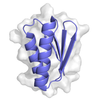
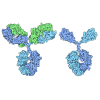
| Title | Cryo-EM structure of SARS-CoV-2 Omicron neutralizing antibody S212 with BA.5 RBD and SP1-77 Fab complex | ||||||||||||||||||||||||||||||
 Components Components |
| ||||||||||||||||||||||||||||||
 Keywords Keywords | VIRAL PROTEIN/IMMUNE SYSTEM / antibody / fab / broadly neutralizing / vdj recombination / humanized mouse model / cdr3 diversity / SARS-COV-2 / ANTIVIRAL PROTEIN / VIRAL PROTEIN-IMMUNE SYSTEM complex | ||||||||||||||||||||||||||||||
| Function / homology |  Function and homology information Function and homology informationsymbiont-mediated disruption of host tissue / Maturation of spike protein / host cell surface / Translation of Structural Proteins / Virion Assembly and Release / Lectin pathway of complement activation / host extracellular region / symbiont-mediated-mediated suppression of host tetherin activity / structural constituent of virion / Induction of Cell-Cell Fusion ...symbiont-mediated disruption of host tissue / Maturation of spike protein / host cell surface / Translation of Structural Proteins / Virion Assembly and Release / Lectin pathway of complement activation / host extracellular region / symbiont-mediated-mediated suppression of host tetherin activity / structural constituent of virion / Induction of Cell-Cell Fusion / positive regulation of viral entry into host cell / Initial triggering of complement / membrane fusion / host cell endoplasmic reticulum-Golgi intermediate compartment membrane / Attachment and Entry / entry receptor-mediated virion attachment to host cell / receptor-mediated virion attachment to host cell / host cell surface receptor binding / symbiont-mediated suppression of host innate immune response / endocytosis involved in viral entry into host cell / receptor ligand activity / fusion of virus membrane with host plasma membrane / fusion of virus membrane with host endosome membrane / viral envelope / symbiont entry into host cell / virion attachment to host cell / host cell plasma membrane / SARS-CoV-2 activates/modulates innate and adaptive immune responses / virion membrane / membrane / identical protein binding / plasma membrane Similarity search - Function | ||||||||||||||||||||||||||||||
| Biological species |  Severe acute respiratory syndrome coronavirus Severe acute respiratory syndrome coronavirus  Mus musculus (house mouse) Mus musculus (house mouse) | ||||||||||||||||||||||||||||||
| Method | ELECTRON MICROSCOPY / single particle reconstruction / cryo EM / Resolution: 2.68 Å | ||||||||||||||||||||||||||||||
 Authors Authors | Batra, H. / Zhang, J. / Jonaid, G. / Kibria, G. / Chen, B. / Alt, F.W. | ||||||||||||||||||||||||||||||
| Funding support |  United States, 2items United States, 2items
| ||||||||||||||||||||||||||||||
 Citation Citation | Journal: Proc Natl Acad Sci U S A / Year: 2026 Title: Recurrent SARS-CoV-2 Omicron broadly neutralizing humanized antibodies in different single human V1-2-rearranging mouse models. Authors: Himanshu Batra / Sai Luo / Kevin O Saunders / Jaclyn S Higgins / Fanchong Jian / Jun Zhang / Md Golam Kibria / G M Jonaid / Qingchen J Zhou / Amanda Eaton / Kenneth Cronin / Michael L ...Authors: Himanshu Batra / Sai Luo / Kevin O Saunders / Jaclyn S Higgins / Fanchong Jian / Jun Zhang / Md Golam Kibria / G M Jonaid / Qingchen J Zhou / Amanda Eaton / Kenneth Cronin / Michael L Mallory / Melissa Mattocks / Robert J Edwards / Robert Parks / Esther M Lee / Adam Yongxin Ye / Aimee Chapdelaine Williams / Geeyoun Jung / Katayoun Mansouri / S Munir Alam / David C Montefiori / Ming Tian / Ralph S Baric / Yunlong Cao / Barton F Haynes / Bing Chen / Frederick W Alt /  Abstract: During V(D)J recombination, antibody diversity is enhanced by nontemplated junctional modifications that generate immensely diverse heavy chain (HC) and light chain (LC) complementarity-determining 3 ...During V(D)J recombination, antibody diversity is enhanced by nontemplated junctional modifications that generate immensely diverse heavy chain (HC) and light chain (LC) complementarity-determining 3 antigen-contact regions (CDR3s). We previously developed a mouse model that generates diverse antibody repertoires by rearranging a single human V1-2 and Vκ1-33, associated with highly diverse CDR3s generated by V(D)J recombination with mouse Ds and/or Js. Immunization of this model with SARS-CoV-2 D614G spike elicited an antibody that potently neutralized SARS-CoV-2 variants through Omicron BA.2.754. Here, we report a related mouse model in which a single V1-2 rearranges to human D3-3 and J6, generating diverse HC-CDR3s much longer on average than those of our prior model. Omicron BA.4/.5 spike-ferritin nanoparticle-immunization of the new model elicited four highly related humanized antibodies that potently neutralize downstream Omicron subvariants. All four antibodies had 12 AA HC-CDR3s with two aromatic amino acids that engage an epitope comprising a hydrophobic patch opened-up by early Omicron lineage mutations and conserved in subsequent variants. Immunization of our prior, shorter CDR3-based model, elicited slightly less potent neutralizing antibodies that bound the same Omicron epitope, and were similar in all other aspects to those from the long, fully human CDR3 model. One tested antibody from each set reduced lung viral titers in a mouse-adapted BQ1.1 challenge. The antibodies we describe are related in their epitope recognition to recently described antibodies from Omicron-infected humans. These studies validate the utility of single human V- and Vκ-rearranging mice for discovering humanized antibodies that neutralize emerging pathogens. | ||||||||||||||||||||||||||||||
| History |
|
- Structure visualization
| Structure viewer | Molecule: MolmilJmol/JSmol |
|---|
- Downloads & links
-Download
| PDBx/mmCIF format | 9ytc.cif.gz | 442.2 KB | Display | PDBx/mmCIF format |
|---|---|---|---|---|
| PDB format | pdb9ytc.ent.gz | 353.2 KB | Display | PDB format |
| PDBx/mmJSON format | 9ytc.json.gz | Tree view | PDBx/mmJSON format | |
| Others |  Other downloads Other downloads |
-Validation report
| Arichive directory | https://data.pdbj.org/pub/pdb/validation_reports/yt/9ytcftp://data.pdbj.org/pub/pdb/validation_reports/yt/9ytc | HTTPS FTP |
|---|
-Related structure data
| Related structure data |  73457MC  9x9tC  9ysgC M: map data used to model this data C: citing same article ( |
|---|---|
| Similar structure data |


-Links
 PDBj
PDBj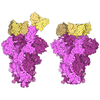
- Assembly
| Deposited unit | 
|
|---|---|
| 1 |
|
-Components
-Protein , 1 types, 1 molecules A
| #1: Protein | Mass: 75811.500 Da / Num. of mol.: 1 Source method: isolated from a genetically manipulated source Source: (gene. exp.) Severe acute respiratory syndrome coronavirusGene: S, 2 / Variant: Omicron / Production host:  Homo sapiens (human) / References: UniProt: P0DTC2 Homo sapiens (human) / References: UniProt: P0DTC2 |
|---|
-Antibody , 4 types, 4 molecules DEFG
| #2: Antibody | Mass: 49665.703 Da / Num. of mol.: 1 Source method: isolated from a genetically manipulated source Source: (gene. exp.) Mus musculus (house mouse) / Production host: Homo sapiens (human) |
|---|---|
| #3: Antibody | Mass: 23294.617 Da / Num. of mol.: 1 Source method: isolated from a genetically manipulated source Source: (gene. exp.) Mus musculus (house mouse) / Production host: Homo sapiens (human) |
| #4: Antibody | Mass: 49558.652 Da / Num. of mol.: 1 Source method: isolated from a genetically manipulated source Source: (gene. exp.) Mus musculus (house mouse) / Production host: Homo sapiens (human) |
| #5: Antibody | Mass: 23534.965 Da / Num. of mol.: 1 Source method: isolated from a genetically manipulated source Source: (gene. exp.) Mus musculus (house mouse) / Production host: Homo sapiens (human) |
-Sugars , 2 types, 2 molecules 
| #6: Polysaccharide | 2-acetamido-2-deoxy-beta-D-glucopyranose-(1-4)-[alpha-L-fucopyranose-(1-6)]2-acetamido-2-deoxy-beta- ...2-acetamido-2-deoxy-beta-D-glucopyranose-(1-4)-[alpha-L-fucopyranose-(1-6)]2-acetamido-2-deoxy-beta-D-glucopyranose Source method: isolated from a genetically manipulated source |
|---|---|
| #7: Sugar | ChemComp-NAG / 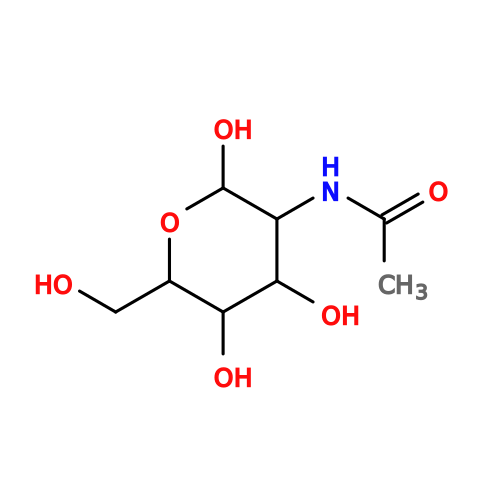 Type: D-saccharide, beta linking / Mass: 221.208 Da / Num. of mol.: 1 / Source method: obtained synthetically / Formula: C8H15NO6 Type: D-saccharide, beta linking / Mass: 221.208 Da / Num. of mol.: 1 / Source method: obtained synthetically / Formula: C8H15NO6 |
-Details
| Has ligand of interest | N |
|---|---|
| Has protein modification | Y |
-Experimental details
-Experiment
| Experiment | Method: ELECTRON MICROSCOPY |
|---|---|
| EM experiment | Aggregation state: PARTICLE / 3D reconstruction method: single particle reconstruction |
- Sample preparation
| Component | Name: S212 Fab with BA.5 RBD and SP1-77 complex / Type: COMPLEX / Entity ID: #1-#5 / Source: MULTIPLE SOURCES |
|---|---|
| Source (natural) | Organism: Mus musculus (house mouse) |
| Source (recombinant) | Organism: Homo sapiens (human) |
| Buffer solution | pH: 7.5 |
| Specimen | Embedding applied: NO / Shadowing applied: NO / Staining applied: NO / Vitrification applied: YES |
| Vitrification | Cryogen name: ETHANE |
- Electron microscopy imaging
| Experimental equipment |  Model: Titan Krios / Image courtesy: FEI Company |
|---|---|
| Microscopy | Model: TFS KRIOS |
| Electron gun | Electron source:  FIELD EMISSION GUN / Accelerating voltage: 300 kV / Illumination mode: FLOOD BEAM FIELD EMISSION GUN / Accelerating voltage: 300 kV / Illumination mode: FLOOD BEAM |
| Electron lens | Mode: BRIGHT FIELD / Nominal defocus max: 2200 nm / Nominal defocus min: 500 nm |
| Image recording | Electron dose: 54.09 e/Å2 / Film or detector model: GATAN K3 BIOQUANTUM (6k x 4k) |
- Processing
| EM software |
| ||||||||||||||||||||||||
|---|---|---|---|---|---|---|---|---|---|---|---|---|---|---|---|---|---|---|---|---|---|---|---|---|---|
| CTF correction | Type: PHASE FLIPPING AND AMPLITUDE CORRECTION | ||||||||||||||||||||||||
| Symmetry | Point symmetry: C1 (asymmetric) | ||||||||||||||||||||||||
| 3D reconstruction | Resolution: 2.68 Å / Resolution method: FSC 0.143 CUT-OFF / Num. of particles: 247380 / Symmetry type: POINT | ||||||||||||||||||||||||
| Refinement | Highest resolution: 2.68 Å Stereochemistry target values: REAL-SPACE (WEIGHTED MAP SUM AT ATOM CENTERS) | ||||||||||||||||||||||||
| Refine LS restraints |
|
