[English] 日本語
Yorodumi
- EMDB-73392: Cryo-EM structure of SARS-CoV-2 Omicron neutralizing antibody AB2... -

+
Open data


ID or keywords:

Loading...

-
Basic information

Entry
Database: EMDB / ID: EMD-73392
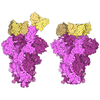
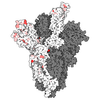
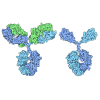
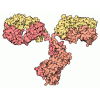
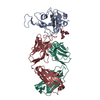
TitleCryo-EM structure of SARS-CoV-2 Omicron neutralizing antibody AB2-122 with BA.5 RBD and SP1-77 Fab complex
Map data
Sample
  • Complex: AB2-122 with BA.5 RBD and SP1-77 Fab complex
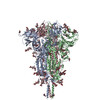
    • Protein or peptide: Spike glycoprotein
    • Protein or peptide: SP1-77 Fab heavy chain
    • Protein or peptide: SP1-77 Fab light chain
    • Protein or peptide: AB2-122 Fab heavy chain
    • Protein or peptide: AB2-122 Fab light chain
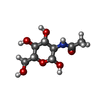
  • Ligand: 2-acetamido-2-deoxy-beta-D-glucopyranose
Keywordsantibody / fab / broadly neutralizing / vdj recombination / humanized mouse model / cdr3 diversity / SARS-COV-2 / ANTIVIRAL PROTEIN / VIRAL PROTEIN-IMMUNE SYSTEM complex
Function / homology
Function and homology information


symbiont-mediated disruption of host tissue / Maturation of spike protein / Translation of Structural Proteins / Virion Assembly and Release / host cell surface / host extracellular region / symbiont-mediated-mediated suppression of host tetherin activity / Induction of Cell-Cell Fusion / structural constituent of virion / positive regulation of viral entry into host cell ...symbiont-mediated disruption of host tissue / Maturation of spike protein / Translation of Structural Proteins / Virion Assembly and Release / host cell surface / host extracellular region / symbiont-mediated-mediated suppression of host tetherin activity / Induction of Cell-Cell Fusion / structural constituent of virion / positive regulation of viral entry into host cell / membrane fusion / host cell endoplasmic reticulum-Golgi intermediate compartment membrane / Attachment and Entry / entry receptor-mediated virion attachment to host cell / receptor-mediated virion attachment to host cell / host cell surface receptor binding / symbiont-mediated suppression of host innate immune response / endocytosis involved in viral entry into host cell / receptor ligand activity / fusion of virus membrane with host plasma membrane / fusion of virus membrane with host endosome membrane / viral envelope / symbiont entry into host cell / virion attachment to host cell / host cell plasma membrane / SARS-CoV-2 activates/modulates innate and adaptive immune responses / virion membrane / membrane / identical protein binding / plasma membrane
Similarity search - Function
Spike (S) protein S1 subunit, receptor-binding domain, SARS-CoV-2 / Spike (S) protein S1 subunit, N-terminal domain, SARS-CoV-like / Coronavirus spike glycoprotein S1, C-terminal / Coronavirus spike glycoprotein S1, C-terminal / Spike glycoprotein, N-terminal domain superfamily / Spike S1 subunit, receptor binding domain superfamily, betacoronavirus / Spike glycoprotein, betacoronavirus / Betacoronavirus spike (S) glycoprotein S1 subunit N-terminal (NTD) domain profile. / Spike glycoprotein S1, N-terminal domain, betacoronavirus-like / Betacoronavirus-like spike glycoprotein S1, N-terminal ...Spike (S) protein S1 subunit, receptor-binding domain, SARS-CoV-2 / Spike (S) protein S1 subunit, N-terminal domain, SARS-CoV-like / Coronavirus spike glycoprotein S1, C-terminal / Coronavirus spike glycoprotein S1, C-terminal / Spike glycoprotein, N-terminal domain superfamily / Spike S1 subunit, receptor binding domain superfamily, betacoronavirus / Spike glycoprotein, betacoronavirus / Betacoronavirus spike (S) glycoprotein S1 subunit N-terminal (NTD) domain profile. / Spike glycoprotein S1, N-terminal domain, betacoronavirus-like / Betacoronavirus-like spike glycoprotein S1, N-terminal / Betacoronavirus spike (S) glycoprotein S1 subunit C-terminal (CTD) domain profile. / Spike (S) protein S1 subunit, receptor-binding domain, betacoronavirus / Betacoronavirus spike glycoprotein S1, receptor binding / Spike glycoprotein S2 superfamily, coronavirus / Spike glycoprotein S2, coronavirus, heptad repeat 1 / Spike glycoprotein S2, coronavirus, heptad repeat 2 / Coronavirus spike (S) glycoprotein S2 subunit heptad repeat 1 (HR1) region profile. / Coronavirus spike (S) glycoprotein S2 subunit heptad repeat 2 (HR2) region profile. / Spike glycoprotein S2, coronavirus / Coronavirus spike glycoprotein S2
Similarity search - Domain/homology
Biological speciesMus musculus (house mouse) / Severe acute respiratory syndrome coronavirus
Methodsingle particle reconstruction / cryo EM / Resolution: 3.0 Å
AuthorsJonaid G / Batra H / Kibria G / Chen B / Alt FW
Funding support United States, 2 items
OrganizationGrant numberCountry
Howard Hughes Medical Institute (HHMI) United States
Massachusetts Consortium on Pathogen Readiness (MassCPR) United States
CitationJournal: Proc Natl Acad Sci U S A / Year: 2026
Title: Recurrent SARS-CoV-2 Omicron broadly neutralizing humanized antibodies in different single human V1-2-rearranging mouse models.
Authors: Himanshu Batra / Sai Luo / Kevin O Saunders / Jaclyn S Higgins / Fanchong Jian / Jun Zhang / Md Golam Kibria / G M Jonaid / Qingchen J Zhou / Amanda Eaton / Kenneth Cronin / Michael L ...Authors: Himanshu Batra / Sai Luo / Kevin O Saunders / Jaclyn S Higgins / Fanchong Jian / Jun Zhang / Md Golam Kibria / G M Jonaid / Qingchen J Zhou / Amanda Eaton / Kenneth Cronin / Michael L Mallory / Melissa Mattocks / Robert J Edwards / Robert Parks / Esther M Lee / Adam Yongxin Ye / Aimee Chapdelaine Williams / Geeyoun Jung / Katayoun Mansouri / S Munir Alam / David C Montefiori / Ming Tian / Ralph S Baric / Yunlong Cao / Barton F Haynes / Bing Chen / Frederick W Alt /
Abstract: During V(D)J recombination, antibody diversity is enhanced by nontemplated junctional modifications that generate immensely diverse heavy chain (HC) and light chain (LC) complementarity-determining 3 ...During V(D)J recombination, antibody diversity is enhanced by nontemplated junctional modifications that generate immensely diverse heavy chain (HC) and light chain (LC) complementarity-determining 3 antigen-contact regions (CDR3s). We previously developed a mouse model that generates diverse antibody repertoires by rearranging a single human V1-2 and Vκ1-33, associated with highly diverse CDR3s generated by V(D)J recombination with mouse Ds and/or Js. Immunization of this model with SARS-CoV-2 D614G spike elicited an antibody that potently neutralized SARS-CoV-2 variants through Omicron BA.2.754. Here, we report a related mouse model in which a single V1-2 rearranges to human D3-3 and J6, generating diverse HC-CDR3s much longer on average than those of our prior model. Omicron BA.4/.5 spike-ferritin nanoparticle-immunization of the new model elicited four highly related humanized antibodies that potently neutralize downstream Omicron subvariants. All four antibodies had 12 AA HC-CDR3s with two aromatic amino acids that engage an epitope comprising a hydrophobic patch opened-up by early Omicron lineage mutations and conserved in subsequent variants. Immunization of our prior, shorter CDR3-based model, elicited slightly less potent neutralizing antibodies that bound the same Omicron epitope, and were similar in all other aspects to those from the long, fully human CDR3 model. One tested antibody from each set reduced lung viral titers in a mouse-adapted BQ1.1 challenge. The antibodies we describe are related in their epitope recognition to recently described antibodies from Omicron-infected humans. These studies validate the utility of single human V- and Vκ-rearranging mice for discovering humanized antibodies that neutralize emerging pathogens.
History
DepositionOct 18, 2025-
Header (metadata) releaseJul 29, 2026-
Map releaseJul 29, 2026-
UpdateJul 29, 2026-
Current statusJul 29, 2026Processing site: RCSB / Status: Released

-
Structure visualization

Supplemental images

Downloads & links

-
Map

FileDownload / File: emd_73392.map.gz / Format: CCP4 / Size: 244.1 MB / Type: IMAGE STORED AS FLOATING POINT NUMBER (4 BYTES)
Projections & slices

Image control

Size
Brightness
Contrast
Others
AxesZ (Sec.)Y (Row.)X (Col.)
0.74 Å/pix.
x 400 pix.
= 294.4 Å
0.74 Å/pix.
x 400 pix.
= 294.4 Å
0.74 Å/pix.
x 400 pix.
= 294.4 Å

Surface

Projections

Slices (1/3)

Slices (1/2)

Slices (2/3)

Images are generated by Spider.

Voxel sizeX=Y=Z: 0.736 Å
Density
Contour LevelBy AUTHOR: 0.006
Minimum - Maximum-0.05303557 - 0.12581554
Average (Standard dev.)0.00012913762 (±0.0023294839)
SymmetrySpace group: 1
Details

EMDB XML:

Map geometry
Axis orderXYZ
Origin000
Dimensions400400400
Spacing400400400
CellA=B=C: 294.4 Å
α=β=γ: 90.0 °

-
Supplemental data

-
Mask #1

Fileemd_73392_msk_1.map
Projections & Slices
AxesZYX

Projections

Slices (1/2)
Density Histograms

-
Additional map: deepEMhancer sharpened map

Fileemd_73392_additional_1.map
AnnotationdeepEMhancer sharpened map
Projections & Slices
AxesZYX

Projections

Slices (1/2)
Density Histograms

-
Half map: #1

Fileemd_73392_half_map_1.map
Projections & Slices
AxesZYX

Projections

Slices (1/2)
Density Histograms

-
Half map: #2

Fileemd_73392_half_map_2.map
Projections & Slices
AxesZYX

Projections

Slices (1/2)
Density Histograms

-
Sample components

-
Entire : AB2-122 with BA.5 RBD and SP1-77 Fab complex

EntireName: AB2-122 with BA.5 RBD and SP1-77 Fab complex
Components
  • Complex: AB2-122 with BA.5 RBD and SP1-77 Fab complex
    • Protein or peptide: Spike glycoprotein
    • Protein or peptide: SP1-77 Fab heavy chain
    • Protein or peptide: SP1-77 Fab light chain
    • Protein or peptide: AB2-122 Fab heavy chain
    • Protein or peptide: AB2-122 Fab light chain
  • Ligand: 2-acetamido-2-deoxy-beta-D-glucopyranose

-
Supramolecule #1: AB2-122 with BA.5 RBD and SP1-77 Fab complex

SupramoleculeName: AB2-122 with BA.5 RBD and SP1-77 Fab complex / type: complex / ID: 1 / Parent: 0 / Macromolecule list: #1-#5
Source (natural)Organism: Mus musculus (house mouse)

-
Macromolecule #1: Spike glycoprotein

MacromoleculeName: Spike glycoprotein / type: protein_or_peptide / ID: 1 / Number of copies: 1 / Enantiomer: LEVO
Source (natural)Organism: Severe acute respiratory syndrome coronavirus
Molecular weightTheoretical: 75.8115 KDa
Recombinant expressionOrganism: Homo sapiens (human)
SequenceString: MFLLTTKRTM FVFLVLLPLV SSQCVNLITR TQSYTNSFTR GVYYPDKVFR SSVLHSTQDL FLPFFSNVTW FHAISGTNGT KRFDNPVLP FNDGVYFAST EKSNIIRGWI FGTTLDSKTQ SLLIVNNATN VVIKVCEFQF CNDPFLDVYH KNNKSWMESE F RVYSSANN ...String:
MFLLTTKRTM FVFLVLLPLV SSQCVNLITR TQSYTNSFTR GVYYPDKVFR SSVLHSTQDL FLPFFSNVTW FHAISGTNGT KRFDNPVLP FNDGVYFAST EKSNIIRGWI FGTTLDSKTQ SLLIVNNATN VVIKVCEFQF CNDPFLDVYH KNNKSWMESE F RVYSSANN CTFEYVSQPF LMDLEGKQGN FKNLREFVFK NIDGYFKIYS KHTPINLGRD LPQGFSALEP LVDLPIGINI TR FQTLLAL HRSYLTPGDS SSGWTAGAAA YYVGYLQPRT FLLKYNENGT ITDAVDCALD PLSETKCTLK SFTVEKGIYQ TSN FRVQPT ESIVRFPNIT NLCPFDEVFN ATRFASVYAW NRKRISNCVA DYSVLYNFAP FFAFKCYGVS PTKLNDLCFT NVYA DSFVI RGNEVSQIAP GQTGNIADYN YKLPDDFTGC VIAWNSNNLD SKVGGNYNYR YRLFRKSNLK PFERDISTEI YQAGN KPCN GVAGVNCYFP LQSYGFRPTY GVGHQPYRVV VLSFELLHAP ATVCGPKKST NLVKNKCVNF NFNGLTGTGV LTESNK KFL PFQQFGRDIA DTTDAVRDPQ TLEILDITPC SFGGVSVITP GTNTSNQVAV LYQGVNCTEV PVAIHADQLT PTWRVYS TG SNVFQTRAGC LIGAEYVNNS YECDIPIGAG ICAS

UniProtKB: Spike glycoprotein

-
Macromolecule #2: SP1-77 Fab heavy chain

MacromoleculeName: SP1-77 Fab heavy chain / type: protein_or_peptide / ID: 2 / Number of copies: 1 / Enantiomer: LEVO
Source (natural)Organism: Mus musculus (house mouse)
Molecular weightTheoretical: 49.665703 KDa
Recombinant expressionOrganism: Homo sapiens (human)
SequenceString: QVQLVQSGAE VKKPGASVKV SCKASGYTFT GTYIHWVRQA PGQGLEWMGW INPNSGGTNF AQIFQGRVTL TRDTSISTAY MDLNRLKSD DTAVYYCARD RVLYGRSFGW YFDVWGAGTT VTVSSASTKG PSVFPLAPCS RSTSESTAAL GCLVKDYFPE P VTVSWNSG ...String:
QVQLVQSGAE VKKPGASVKV SCKASGYTFT GTYIHWVRQA PGQGLEWMGW INPNSGGTNF AQIFQGRVTL TRDTSISTAY MDLNRLKSD DTAVYYCARD RVLYGRSFGW YFDVWGAGTT VTVSSASTKG PSVFPLAPCS RSTSESTAAL GCLVKDYFPE P VTVSWNSG ALTSGVHTFP AVLQSSGLYS LSSVVTVPSS SLGTKTYTCN VDHKPSNTKV DKRVESKYGP PCPSCPAPEF LG GPSVFLF PPKPKDTLMI SRTPEVTCVV VDVSQEDPEV QFNWYVDGVE VHNAKTKPRE EQFNSTYRVV SVLTVLHQDW LNG KEYKCK VSNKGLPSSI EKTISKAKGQ PREPQVYTLP PSQEEMTKNQ VSLTCLVKGF YPSDIAVEWE SNGQPENNYK TTPP VLDSD GSFFLYSRLT VDKSRWQEGN VFSCSVMHEA LHNHYTQKSL SLSLGK

-
Macromolecule #3: SP1-77 Fab light chain

MacromoleculeName: SP1-77 Fab light chain / type: protein_or_peptide / ID: 3 / Number of copies: 1 / Enantiomer: LEVO
Source (natural)Organism: Mus musculus (house mouse)
Molecular weightTheoretical: 23.294617 KDa
Recombinant expressionOrganism: Homo sapiens (human)
SequenceString: DIQMTQSPSS LSASVGDRVT ITCQASQDIS DYLNWYQQQP GKAPKLLIYD ASNLETGVPS RFSGSGSGTD FTFTISSLQP EDIGTYYCQ QYDNLPTFGG GTKLEIKRTV AAPSVFIFPP SDEQLKSGTA SVVCLLNNFY PREAKVQWKV DNALQSGNSQ E SVTEQDSK ...String:
DIQMTQSPSS LSASVGDRVT ITCQASQDIS DYLNWYQQQP GKAPKLLIYD ASNLETGVPS RFSGSGSGTD FTFTISSLQP EDIGTYYCQ QYDNLPTFGG GTKLEIKRTV AAPSVFIFPP SDEQLKSGTA SVVCLLNNFY PREAKVQWKV DNALQSGNSQ E SVTEQDSK DSTYSLSSTL TLSKADYEKH KVYACEVTHQ GLSSPVTKSF NRGEC

-
Macromolecule #4: AB2-122 Fab heavy chain

MacromoleculeName: AB2-122 Fab heavy chain / type: protein_or_peptide / ID: 4 / Number of copies: 1 / Enantiomer: LEVO
Source (natural)Organism: Mus musculus (house mouse)
Molecular weightTheoretical: 49.572801 KDa
Recombinant expressionOrganism: Homo sapiens (human)
SequenceString: QVQLVQSGAE VKKPGASVKV SCKASGYTFT GY(TYS)LYWVRQA PGQGLEWMGW INPKTGGTNY AQKFQGRVTM TRDTSI STA YMELNRLSSD DTAVYYCGRR DFWSHYMDVW GKGTTVTVSS ASTKGPSVFP LAPSSKSTSG GTAALGCLVK DYFPEPV TV SWNSGALTSG ...String:
QVQLVQSGAE VKKPGASVKV SCKASGYTFT GY(TYS)LYWVRQA PGQGLEWMGW INPKTGGTNY AQKFQGRVTM TRDTSI STA YMELNRLSSD DTAVYYCGRR DFWSHYMDVW GKGTTVTVSS ASTKGPSVFP LAPSSKSTSG GTAALGCLVK DYFPEPV TV SWNSGALTSG VHTFPAVLQS SGLYSLSSVV TVPSSSLGTQ TYICNVNHKP SNTKVDKKVE PKSCDKTHTC PPCPAPEL L GGPSVFLFPP KPKDTLMISR TPEVTCVVVD VSHEDPEVKF NWYVDGVEVH NAKTKPREEQ YNSTYRVVSV LTVLHQDWL NGKEYKCKVS NKALPAPIEK TISKAKGQPR EPQVYTLPPS RDELTKNQVS LTCLVKGFYP SDIAVEWESN GQPENNYKTT PPVLDSDGS FFLYSKLTVD KSRWQQGNVF SCSVMHEALH NHYTQKSLSL SPGK

-
Macromolecule #5: AB2-122 Fab light chain

MacromoleculeName: AB2-122 Fab light chain / type: protein_or_peptide / ID: 5 / Number of copies: 1 / Enantiomer: LEVO
Source (natural)Organism: Mus musculus (house mouse)
Molecular weightTheoretical: 23.514951 KDa
Recombinant expressionOrganism: Homo sapiens (human)
SequenceString: DIQMTQSPSS LSASVGDRVA ITCQASQDIY NNLNWYQQKP GKAPKLLIYD ASNLETGVPS RFSGSGSGTD FTFTISSLQP EDIATYFCQ QYDYLSWTFG GGTKLEIKRT VAAPSVFIFP PSDEQLKSGT ASVVCLLNNF YPREAKVQWK VDNALQSGNS Q ESVTEQDS ...String:
DIQMTQSPSS LSASVGDRVA ITCQASQDIY NNLNWYQQKP GKAPKLLIYD ASNLETGVPS RFSGSGSGTD FTFTISSLQP EDIATYFCQ QYDYLSWTFG GGTKLEIKRT VAAPSVFIFP PSDEQLKSGT ASVVCLLNNF YPREAKVQWK VDNALQSGNS Q ESVTEQDS KDSTYSLSST LTLSKADYEK HKVYACEVTH QGLSSPVTKS FNRGEC

-
Macromolecule #7: 2-acetamido-2-deoxy-beta-D-glucopyranose

MacromoleculeName: 2-acetamido-2-deoxy-beta-D-glucopyranose / type: ligand / ID: 7 / Number of copies: 1 / Formula: NAG
Molecular weightTheoretical: 221.208 Da
Chemical component information

ChemComp-NAG:
2-acetamido-2-deoxy-beta-D-glucopyranose

-
Experimental details

-
Structure determination

Methodcryo EM
Processingsingle particle reconstruction
Aggregation stateparticle

-
Sample preparation

BufferpH: 7.5
VitrificationCryogen name: ETHANE

-
Electron microscopy

MicroscopeTFS KRIOS
Image recordingFilm or detector model: GATAN K3 BIOQUANTUM (6k x 4k) / Average electron dose: 52.28 e/Å2
Electron beamAcceleration voltage: 300 kV / Electron source: FIELD EMISSION GUN
Electron opticsIllumination mode: FLOOD BEAM / Imaging mode: BRIGHT FIELD / Nominal defocus max: 2.2 µm / Nominal defocus min: 0.5 µm
Experimental equipment
Model: Titan Krios / Image courtesy: FEI Company

+
Image processing

CTF correctionType: PHASE FLIPPING AND AMPLITUDE CORRECTION
Startup model#0 - Type of model: PDB ENTRY
#0 - PDB model - PDB ID:

#1 - Type of model: PDB ENTRY
#1 - PDB model - PDB ID:
Final reconstructionApplied symmetry - Point group: C1 (asymmetric) / Resolution.type: BY AUTHOR / Resolution: 3.0 Å / Resolution method: FSC 0.143 CUT-OFF / Software - Name: cryoSPARC (ver. 4.7) / Number images used: 79684
Initial angle assignmentType: NOT APPLICABLE
Final angle assignmentType: NOT APPLICABLE
FSC plot (resolution estimation)

+
About Yorodumi

-
News

-
Feb 9, 2022. New format data for meta-information of EMDB entries

New format data for meta-information of EMDB entries

  • Version 3 of the EMDB header file is now the official format.
  • The previous official version 1.9 will be removed from the archive.

Related info.:EMDB header

External links:wwPDB to switch to version 3 of the EMDB data model

-
Aug 12, 2020. Covid-19 info

Covid-19 info

URL: https://pdbj.org/emnavi/covid19.php

New page: Covid-19 featured information page in EM Navigator.

Related info.:Covid-19 info / Mar 5, 2020. Novel coronavirus structure data

+
Mar 5, 2020. Novel coronavirus structure data

Novel coronavirus structure data

Related info.:Yorodumi Speices / Aug 12, 2020. Covid-19 info

External links:COVID-19 featured content - PDBj / Molecule of the Month (242):Coronavirus Proteases

+
Jan 31, 2019. EMDB accession codes are about to change! (news from PDBe EMDB page)

EMDB accession codes are about to change! (news from PDBe EMDB page)

  • The allocation of 4 digits for EMDB accession codes will soon come to an end. Whilst these codes will remain in use, new EMDB accession codes will include an additional digit and will expand incrementally as the available range of codes is exhausted. The current 4-digit format prefixed with “EMD-” (i.e. EMD-XXXX) will advance to a 5-digit format (i.e. EMD-XXXXX), and so on. It is currently estimated that the 4-digit codes will be depleted around Spring 2019, at which point the 5-digit format will come into force.
  • The EM Navigator/Yorodumi systems omit the EMD- prefix.

Related info.:Q: What is EMD? / ID/Accession-code notation in Yorodumi/EM Navigator

External links:EMDB Accession Codes are Changing Soon! / Contact to PDBj

+
Jul 12, 2017. Major update of PDB

Major update of PDB

  • wwPDB released updated PDB data conforming to the new PDBx/mmCIF dictionary.
  • This is a major update changing the version number from 4 to 5, and with Remediation, in which all the entries are updated.
  • In this update, many items about electron microscopy experimental information are reorganized (e.g. em_software).
  • Now, EM Navigator and Yorodumi are based on the updated data.

External links:wwPDB Remediation / Enriched Model Files Conforming to OneDep Data Standards Now Available in the PDB FTP Archive

-
Yorodumi

Thousand views of thousand structures

  • Yorodumi is a browser for structure data from EMDB, PDB, SASBDB, etc.
  • This page is also the successor to EM Navigator detail page, and also detail information page/front-end page for Omokage search.
  • The word "yorodu" (or yorozu) is an old Japanese word meaning "ten thousand". "mi" (miru) is to see.

Related info.:EMDB / PDB / SASBDB / Comparison of 3 databanks / Yorodumi Search / Aug 31, 2016. New EM Navigator & Yorodumi / Yorodumi Papers / Jmol/JSmol / Function and homology information / Changes in new EM Navigator and Yorodumi

Read more