 Movie
Movie Controller


+ Open data

- Basic information
| Entry | Database: PDB / ID: 9yoq | |||||||||||||||||||||
|---|---|---|---|---|---|---|---|---|---|---|---|---|---|---|---|---|---|---|---|---|---|---|
| Title | Core module of ctSAGA | |||||||||||||||||||||
 Components Components |
| |||||||||||||||||||||
 Keywords Keywords | TRANSCRIPTION / ctSAGA complex / Histone Acetyl Transferase (HAT) Module / Tra1 module and Core module | |||||||||||||||||||||
| Function / homology |  Function and homology information Function and homology informationRITS complex assembly / SLIK (SAGA-like) complex / regulatory ncRNA-mediated heterochromatin formation / SAGA complex / transcription factor TFIID complex / RNA polymerase II general transcription initiation factor activity / NuA4 histone acetyltransferase complex / RNA polymerase II preinitiation complex assembly / TBP-class protein binding / promoter-specific chromatin binding ...RITS complex assembly / SLIK (SAGA-like) complex / regulatory ncRNA-mediated heterochromatin formation / SAGA complex / transcription factor TFIID complex / RNA polymerase II general transcription initiation factor activity / NuA4 histone acetyltransferase complex / RNA polymerase II preinitiation complex assembly / TBP-class protein binding / promoter-specific chromatin binding / transcription initiation at RNA polymerase II promoter / transcription by RNA polymerase II / transcription coregulator activity / chromatin organization / transcription coactivator activity / DNA repair / protein heterodimerization activity / regulation of transcription by RNA polymerase II / regulation of DNA-templated transcription / DNA binding / nucleus Similarity search - Function | |||||||||||||||||||||
| Biological species |  Thermochaetoides thermophila (fungus) Thermochaetoides thermophila (fungus) | |||||||||||||||||||||
| Method | ELECTRON MICROSCOPY / single particle reconstruction / cryo EM / Resolution: 2.6 Å | |||||||||||||||||||||
 Authors Authors | Mattoo, R.U.H. / Chen, D.H. / Bushnell, D.A. / Tamir, S. / Kornberg, R.D. | |||||||||||||||||||||
| Funding support |  United States, 1items United States, 1items
| |||||||||||||||||||||
 Citation Citation | Journal: Mol Cell / Year: 2025 Title: Structure of the transcriptional co-activator SAGA complex, including the histone acetyltransferase module. Authors: Rayees U H Mattoo / Dong-Hua Chen / David A Bushnell / Sagi Tamir / Roger D Kornberg / Abstract: The Spt-Ada-Gcn5 acetyltransferase (SAGA) complex, a 1.8 MDa multi-subunit assembly comprising 19 subunits, is required for RNA polymerase II transcription in eukaryotes. The complex consists of four ...The Spt-Ada-Gcn5 acetyltransferase (SAGA) complex, a 1.8 MDa multi-subunit assembly comprising 19 subunits, is required for RNA polymerase II transcription in eukaryotes. The complex consists of four modules: transcription-associated protein 1 (Tra1), core, deubiquitination (DUB), and histone acetyltransferase (HAT). Although the structures of the Tra1, core, and DUB modules have been determined, the overall architecture of the HAT module remained elusive due to its inherent flexibility. To address this, we conducted cryo-electron microscopy (cryo-EM) analyses on SAGA purified from the thermophilic fungus Chaetomium thermophilum, yielding structures of Tra1 and core modules at 2.6 Å and three of the four HAT subunits at 3.7 Å. The structure of the HAT module was informative about the aspects of histone acetylation and the interface of HAT-core modules, contradicting earlier AlphaFold predictions. Our structure-guided genetic and biochemical analyses confirmed the roles of Ada1 and Spt7 in anchoring the HAT module within the SAGA complex. | |||||||||||||||||||||
| History |
|
- Structure visualization
| Structure viewer | Molecule: MolmilJmol/JSmol |
|---|
- Downloads & links
-Download
| PDBx/mmCIF format | 9yoq.cif.gz | 1.3 MB | Display | PDBx/mmCIF format |
|---|---|---|---|---|
| PDB format | pdb9yoq.ent.gz | 854.2 KB | Display | PDB format |
| PDBx/mmJSON format | 9yoq.json.gz | Tree view | PDBx/mmJSON format | |
| Others |  Other downloads Other downloads |
-Validation report
| Arichive directory | https://data.pdbj.org/pub/pdb/validation_reports/yo/9yoqftp://data.pdbj.org/pub/pdb/validation_reports/yo/9yoq | HTTPS FTP |
|---|
-Related structure data
| Related structure data |  73269MC  9ynuC  9ynvC  9ynwC  9yolC  9yzyC M: map data used to model this data C: citing same article ( |
|---|---|
| Similar structure data |


-Links
 PDBj
PDBj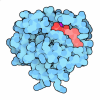
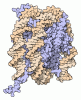
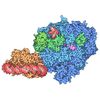
- Assembly
| Deposited unit | 
|
|---|---|
| 1 |
|
-Components
-Protein , 5 types, 5 molecules ABCQF
| #1: Protein | Mass: 444670.094 Da / Num. of mol.: 1 / Source method: isolated from a natural source / Source: (natural) Thermochaetoides thermophila (fungus) / References: UniProt: G0S842 |
|---|---|
| #2: Protein | Mass: 128449.367 Da / Num. of mol.: 1 / Source method: isolated from a natural source / Source: (natural) Thermochaetoides thermophila (fungus) / References: UniProt: G0RYM2 |
| #3: Protein | Mass: 48541.484 Da / Num. of mol.: 1 / Source method: isolated from a natural source / Source: (natural) Thermochaetoides thermophila (fungus) / References: UniProt: G0S660 |
| #10: Protein | Mass: 137082.672 Da / Num. of mol.: 1 / Source method: isolated from a natural source / Source: (natural) Thermochaetoides thermophila (fungus) / References: UniProt: G0S6A1 |
| #11: Protein | Mass: 28834.281 Da / Num. of mol.: 1 / Source method: isolated from a natural source / Source: (natural) Thermochaetoides thermophila (fungus) |
-Transcription initiation factor TFIID subunit ... , 4 types, 4 molecules DEGI
| #4: Protein | Mass: 83784.141 Da / Num. of mol.: 1 / Source method: isolated from a natural source / Source: (natural) Thermochaetoides thermophila (fungus) / References: UniProt: G0SH10 |
|---|---|
| #5: Protein | Mass: 52463.859 Da / Num. of mol.: 1 / Source method: isolated from a natural source / Source: (natural) Thermochaetoides thermophila (fungus) / References: UniProt: G0S770 |
| #6: Protein | Mass: 21417.871 Da / Num. of mol.: 1 / Source method: isolated from a natural source / Source: (natural) Thermochaetoides thermophila (fungus) / References: UniProt: G0RYR4 |
| #8: Protein | Mass: 83091.188 Da / Num. of mol.: 1 / Source method: isolated from a natural source / Source: (natural) Thermochaetoides thermophila (fungus) / References: UniProt: G0S2A1 |
-Putative transcriptional ... , 2 types, 2 molecules HK
| #7: Protein | Mass: 52133.355 Da / Num. of mol.: 1 / Source method: isolated from a natural source / Source: (natural) Thermochaetoides thermophila (fungus) / References: UniProt: G0SED0 |
|---|---|
| #9: Protein | Mass: 150297.500 Da / Num. of mol.: 1 / Source method: isolated from a natural source / Source: (natural) Thermochaetoides thermophila (fungus) |
-Details
| Has protein modification | N |
|---|
-Experimental details
-Experiment
| Experiment | Method: ELECTRON MICROSCOPY |
|---|---|
| EM experiment | Aggregation state: PARTICLE / 3D reconstruction method: single particle reconstruction |
- Sample preparation
| Component | Name: Core module of ctSAGA complex / Type: COMPLEX / Entity ID: all / Source: NATURAL |
|---|---|
| Molecular weight | Experimental value: NO |
| Source (natural) | Organism: Thermochaetoides thermophila (fungus) |
| Buffer solution | pH: 7.5 |
| Specimen | Embedding applied: YES / Shadowing applied: NO / Staining applied: NO / Vitrification applied: YES |
| EM embedding | Material: HEPES buffer |
| Vitrification | Cryogen name: ETHANE |
- Electron microscopy imaging
| Experimental equipment |  Model: Titan Krios / Image courtesy: FEI Company |
|---|---|
| Microscopy | Model: TFS KRIOS |
| Electron gun | Electron source:  FIELD EMISSION GUN / Accelerating voltage: 300 kV / Illumination mode: OTHER FIELD EMISSION GUN / Accelerating voltage: 300 kV / Illumination mode: OTHER |
| Electron lens | Mode: OTHER / Nominal defocus max: 2500 nm / Nominal defocus min: 1200 nm |
| Image recording | Electron dose: 68.9 e/Å2 / Film or detector model: GATAN K3 BIOQUANTUM (6k x 4k) |
- Processing
| EM software |
| ||||||||||||||||||||||||
|---|---|---|---|---|---|---|---|---|---|---|---|---|---|---|---|---|---|---|---|---|---|---|---|---|---|
| CTF correction | Type: NONE | ||||||||||||||||||||||||
| 3D reconstruction | Resolution: 2.6 Å / Resolution method: FSC 0.143 CUT-OFF / Num. of particles: 1734991 / Symmetry type: POINT | ||||||||||||||||||||||||
| Refinement | Cross valid method: NONE Stereochemistry target values: GeoStd + Monomer Library + CDL v1.2 | ||||||||||||||||||||||||
| Displacement parameters | Biso mean: 32.54 Å2 | ||||||||||||||||||||||||
| Refine LS restraints |
|
