 Movie
Movie Controller


+ Open data

- Basic information
| Entry | Database: PDB / ID: 9yi4 | |||||||||||||||||||||||||||
|---|---|---|---|---|---|---|---|---|---|---|---|---|---|---|---|---|---|---|---|---|---|---|---|---|---|---|---|---|
| Title | Octopus sensory receptor CRT1 bound to Progesterone | |||||||||||||||||||||||||||
 Components Components | Chemotactile receptor CRT1 | |||||||||||||||||||||||||||
 Keywords Keywords | MEMBRANE PROTEIN / complex | |||||||||||||||||||||||||||
| Function / homology |  Function and homology information Function and homology informationextracellular ligand-gated monoatomic ion channel activity / transmembrane signaling receptor activity / dendrite / membrane Similarity search - Function | |||||||||||||||||||||||||||
| Biological species |  Octopus bimaculoides (California two-spot octopus) Octopus bimaculoides (California two-spot octopus) | |||||||||||||||||||||||||||
| Method | ELECTRON MICROSCOPY / single particle reconstruction / cryo EM / Resolution: 2.8 Å | |||||||||||||||||||||||||||
 Authors Authors | Jiang, H. / Hibbs, R.E. | |||||||||||||||||||||||||||
| Funding support |  United States, 1items United States, 1items
| |||||||||||||||||||||||||||
 Citation Citation | Journal: Science / Year: 2026 Title: A sensory system for mating in octopus. Authors: Pablo S Villar / Hao Jiang / Tatiana Shugaeva / Emma L Berdan / Arpita Kulkarni / Makoto Hiroi / Giovanni Masucci / Sam Reiter / Erik Lindahl / Rebecca J Howard / Ryan E Hibbs / Nicholas W Bellono /   Abstract: Sensory systems for mate recognition maintain species boundaries and influence diversification. Thus, uncovering how molecules and receptors evolve to mediate this critical function is essential to ...Sensory systems for mate recognition maintain species boundaries and influence diversification. Thus, uncovering how molecules and receptors evolve to mediate this critical function is essential to understanding biodiversity. Male octopuses use a specialized arm called the hectocotylus to identify females and navigate their internal organs to reach the oviduct and deliver sperm. Here, we discovered that the hectocotylus is a dual sensory and mating organ that uses contact-dependent chemosensation of progesterone, a conserved ovarian hormone. We identified chemotactile receptors for progesterone and resolved the structural basis for their evolution from ancestral neurotransmitter receptors and subsequent expansion and tuning across cephalopods. These findings reveal principles by which sensory innovations shape reproductive behavior and suggest mechanisms for how sensory evolution contributes to the diversification of life. | |||||||||||||||||||||||||||
| History |
|
- Structure visualization
| Structure viewer | Molecule: MolmilJmol/JSmol |
|---|
- Downloads & links
-Download
| PDBx/mmCIF format | 9yi4.cif.gz | 587.2 KB | Display | PDBx/mmCIF format |
|---|---|---|---|---|
| PDB format | pdb9yi4.ent.gz | 495.7 KB | Display | PDB format |
| PDBx/mmJSON format | 9yi4.json.gz | Tree view | PDBx/mmJSON format | |
| Others |  Other downloads Other downloads |
-Validation report
| Arichive directory | https://data.pdbj.org/pub/pdb/validation_reports/yi/9yi4ftp://data.pdbj.org/pub/pdb/validation_reports/yi/9yi4 | HTTPS FTP |
|---|
-Related structure data
| Related structure data |  72977MC M: map data used to model this data C: citing same article ( |
|---|---|
| Similar structure data |
-Links
 PDBj
PDBj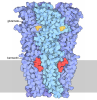
- Assembly
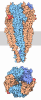
| Deposited unit | 
|
|---|---|
| 1 |
|
-Components
| #1: Protein | Mass: 47334.262 Da / Num. of mol.: 5 Source method: isolated from a genetically manipulated source Source: (gene. exp.) Octopus bimaculoides (California two-spot octopus)Gene: OCBIM_22006518mg / Production host:  Homo sapiens (human) / References: UniProt: A0A0L8FVQ9 Homo sapiens (human) / References: UniProt: A0A0L8FVQ9#2: Sugar | ChemComp-NAG / 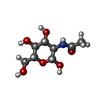 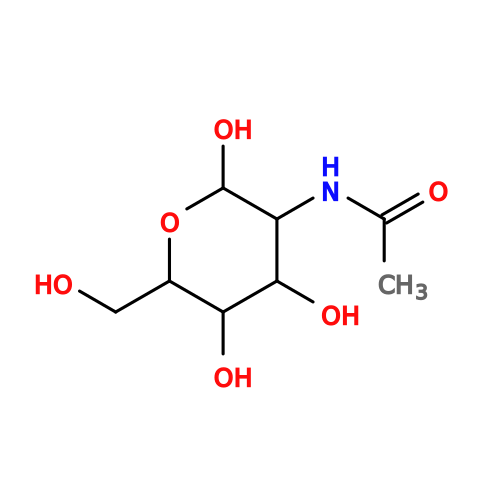 Type: D-saccharide, beta linking / Mass: 221.208 Da / Num. of mol.: 25 Type: D-saccharide, beta linking / Mass: 221.208 Da / Num. of mol.: 25Source method: isolated from a genetically manipulated source Formula: C8H15NO6 #3: Chemical | ChemComp-STR / 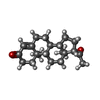 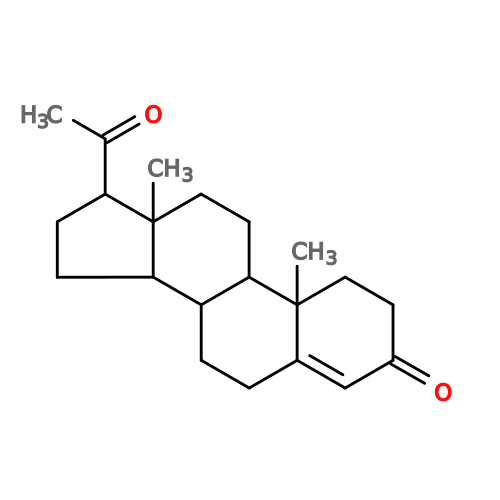 Mass: 314.462 Da / Num. of mol.: 5 / Source method: obtained synthetically / Formula: C21H30O2 / Feature type: SUBJECT OF INVESTIGATION Mass: 314.462 Da / Num. of mol.: 5 / Source method: obtained synthetically / Formula: C21H30O2 / Feature type: SUBJECT OF INVESTIGATIONHas ligand of interest | Y | Has protein modification | Y | |
|---|
-Experimental details
-Experiment
| Experiment | Method: ELECTRON MICROSCOPY |
|---|---|
| EM experiment | Aggregation state: PARTICLE / 3D reconstruction method: single particle reconstruction |
- Sample preparation
| Component | Name: octopus chemotactile receptor CRT1 bound to progesterone Type: COMPLEX / Entity ID: #1 / Source: RECOMBINANT |
|---|---|
| Source (natural) | Organism: Octopus bimaculoides (California two-spot octopus) |
| Source (recombinant) | Organism: Homo sapiens (human) |
| Buffer solution | pH: 8 |
| Specimen | Embedding applied: NO / Shadowing applied: NO / Staining applied: NO / Vitrification applied: YES |
| Vitrification | Cryogen name: ETHANE |
- Electron microscopy imaging
| Experimental equipment |  Model: Titan Krios / Image courtesy: FEI Company |
|---|---|
| Microscopy | Model: TFS KRIOS |
| Electron gun | Electron source:  FIELD EMISSION GUN / Accelerating voltage: 300 kV / Illumination mode: FLOOD BEAM FIELD EMISSION GUN / Accelerating voltage: 300 kV / Illumination mode: FLOOD BEAM |
| Electron lens | Mode: BRIGHT FIELD / Nominal defocus max: 2000 nm / Nominal defocus min: 800 nm |
| Image recording | Electron dose: 50 e/Å2 / Film or detector model: FEI FALCON IV (4k x 4k) |
- Processing
| EM software |
| ||||||||||||||||||||||||
|---|---|---|---|---|---|---|---|---|---|---|---|---|---|---|---|---|---|---|---|---|---|---|---|---|---|
| CTF correction | Type: PHASE FLIPPING AND AMPLITUDE CORRECTION | ||||||||||||||||||||||||
| 3D reconstruction | Resolution: 2.8 Å / Resolution method: FSC 0.143 CUT-OFF / Num. of particles: 241406 / Symmetry type: POINT | ||||||||||||||||||||||||
| Refinement | Highest resolution: 2.8 Å Stereochemistry target values: REAL-SPACE (WEIGHTED MAP SUM AT ATOM CENTERS) | ||||||||||||||||||||||||
| Refine LS restraints |
|
