 Movie
Movie Controller

[English] 日本語
 Yorodumi
- PDB-9ygz: Cryo-EM structure of active mutant human green cone opsin (E129Q)... -
+ Open data

- Basic information
| Entry | Database: PDB / ID: 9ygz | ||||||||||||||||||||||||
|---|---|---|---|---|---|---|---|---|---|---|---|---|---|---|---|---|---|---|---|---|---|---|---|---|---|
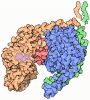
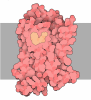
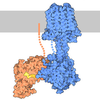
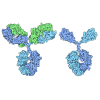
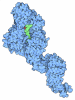
| Title | Cryo-EM structure of active mutant human green cone opsin (E129Q) in complex with chimeric G protein (miniGist) | ||||||||||||||||||||||||
 Components Components |
| ||||||||||||||||||||||||
 Keywords Keywords | SIGNALING PROTEIN / G protein-coupled receptor / cone opsin / MEMBRANE PROTEIN | ||||||||||||||||||||||||
| Function / homology |  Function and homology information Function and homology informationDefective visual phototransduction due to OPN1MW loss of function / cone photoreceptor disc membrane / The retinoid cycle in cones (daylight vision) / Opsins / absorption of visible light / G protein-coupled photoreceptor activity / cellular response to light stimulus / sensory perception of chemical stimulus / mu-type opioid receptor binding / corticotropin-releasing hormone receptor 1 binding ...Defective visual phototransduction due to OPN1MW loss of function / cone photoreceptor disc membrane / The retinoid cycle in cones (daylight vision) / Opsins / absorption of visible light / G protein-coupled photoreceptor activity / cellular response to light stimulus / sensory perception of chemical stimulus / mu-type opioid receptor binding / corticotropin-releasing hormone receptor 1 binding / beta-2 adrenergic receptor binding / host cell mitochondrial membrane / host cell lipid droplet / symbiont-mediated transformation of host cell / symbiont-mediated suppression of host TRAF-mediated signal transduction / positive regulation of cytokinesis / symbiont-mediated perturbation of host cell cycle G1/S transition checkpoint / photoreceptor activity / phototransduction / developmental growth / PKA activation in glucagon signalling / photoreceptor outer segment / D1 dopamine receptor binding / Hedgehog 'off' state / visual perception / insulin-like growth factor receptor binding / symbiont-mediated suppression of host JAK-STAT cascade via inhibition of STAT1 activity / symbiont-mediated suppression of host cytoplasmic pattern recognition receptor signaling pathway via inhibition of MAVS activity / ionotropic glutamate receptor binding / adenylate cyclase activator activity / bioluminescence / generation of precursor metabolites and energy / bone development / platelet aggregation / G-protein beta/gamma-subunit complex binding / adenylate cyclase-inhibiting G protein-coupled receptor signaling pathway / Olfactory Signaling Pathway / Activation of the phototransduction cascade / G protein-coupled acetylcholine receptor signaling pathway / G beta:gamma signalling through PLC beta / Presynaptic function of Kainate receptors / Thromboxane signalling through TP receptor / Activation of G protein gated Potassium channels / Inhibition of voltage gated Ca2+ channels via Gbeta/gamma subunits / G-protein activation / Glucagon signaling in metabolic regulation / G beta:gamma signalling through CDC42 / Prostacyclin signalling through prostacyclin receptor / Synthesis, secretion, and inactivation of Glucagon-like Peptide-1 (GLP-1) / ribonucleoside triphosphate phosphatase activity / photoreceptor disc membrane / G beta:gamma signalling through BTK / ADP signalling through P2Y purinoceptor 12 / Sensory perception of sweet, bitter, and umami (glutamate) taste / Glucagon-type ligand receptors / Adrenaline,noradrenaline inhibits insulin secretion / Vasopressin regulates renal water homeostasis via Aquaporins / G alpha (z) signalling events / Glucagon-like Peptide-1 (GLP1) regulates insulin secretion / ADP signalling through P2Y purinoceptor 1 / cellular response to catecholamine stimulus / G beta:gamma signalling through PI3Kgamma / ADORA2B mediated anti-inflammatory cytokines production / adenylate cyclase-activating dopamine receptor signaling pathway / cellular response to prostaglandin E stimulus / Cooperation of PDCL (PhLP1) and TRiC/CCT in G-protein beta folding / positive regulation of cold-induced thermogenesis / GPER1 signaling / heterotrimeric G-protein complex / Inactivation, recovery and regulation of the phototransduction cascade / G alpha (12/13) signalling events / G-protein beta-subunit binding / extracellular vesicle / Thrombin signalling through proteinase activated receptors (PARs) / viral nucleocapsid / adenylate cyclase-activating G protein-coupled receptor signaling pathway / signaling receptor complex adaptor activity / channel activity / GTPase binding / G protein activity / Ca2+ pathway / clathrin-dependent endocytosis of virus by host cell / monoatomic ion transmembrane transport / High laminar flow shear stress activates signaling by PIEZO1 and PECAM1:CDH5:KDR in endothelial cells / G alpha (i) signalling events / G alpha (s) signalling events / G alpha (q) signalling events / Hydrolases; Acting on acid anhydrides; Acting on GTP to facilitate cellular and subcellular movement / Ras protein signal transduction / RNA helicase activity / Extra-nuclear estrogen signaling / apical plasma membrane / host cell perinuclear region of cytoplasm / host cell endoplasmic reticulum membrane / symbiont-mediated suppression of host type I interferon-mediated signaling pathway / G protein-coupled receptor signaling pathway / ribonucleoprotein complex / serine-type endopeptidase activity / symbiont-mediated activation of host autophagy / lysosomal membrane Similarity search - Function | ||||||||||||||||||||||||
| Biological species |  Homo sapiens (human) Homo sapiens (human)  Mus musculus (house mouse) Mus musculus (house mouse) | ||||||||||||||||||||||||
| Method | ELECTRON MICROSCOPY / single particle reconstruction / cryo EM / Resolution: 3.04 Å | ||||||||||||||||||||||||
 Authors Authors | Yao, W. / Fay, J.F. / Farrens, D.L. | ||||||||||||||||||||||||
| Funding support |  United States, 1items United States, 1items
| ||||||||||||||||||||||||
 Citation Citation | Journal: Biophys J / Year: 2026 Title: Biophysical and structural analysis of human green cone opsin. Authors: Weekie Yao / Jonathan F Fay / David L Farrens / Abstract: We describe a straightforward method for purifying and optimizing human green cone opsin (GCO), which we then used for biophysical and structural studies of a GCO mutant, GCO. Our results show that ...We describe a straightforward method for purifying and optimizing human green cone opsin (GCO), which we then used for biophysical and structural studies of a GCO mutant, GCO. Our results show that in dark-state GCO, residue E129 enables long-wavelength light absorption, presumably by acting as the counterion for the protonated retinal Schiff base. Notably, the Schiff base pKa in dark-state GCO appears to be markedly lower (pKa ≈4) than in the rhodopsin equivalent, Rho (pKa ≈7), indicating distinct electrostatic environments at the retinal attachment site. Functional studies show that light-activated GCO decays more slowly and activates more G-protein than wild-type GCO (GCO). To identify the basis for these differences, we determined the structure of active GCO bound to a G-protein. We first developed a streamlined workflow to identify conditions that enhance GCO binding to G-proteins. This approach involved screening GCO binding to Gα-CT resin (beads bearing tethered Gα C-terminal peptides), followed by small-scale pull-down assays using 1D4 antibody beads to detect co-purification of GCO with a Venus-tagged mini-G-protein. Using the optimized conditions, we determined a 3.0-Å cryo-EM structure of the GCO-G-protein complex. Comparison with rhodopsin and our recent 3.0-Å structure of GCO reveals that the active-state architectures are largely similar, with several intriguing differences. Together, these results establish a generalizable, streamlined approach for biophysical and structural analysis of cone opsins and provide new mechanistic insight into the activation and signaling properties of GCO. | ||||||||||||||||||||||||
| History |
|
- Structure visualization
| Structure viewer | Molecule: MolmilJmol/JSmol |
|---|
- Downloads & links
-Download
| PDBx/mmCIF format | 9ygz.cif.gz | 245 KB | Display | PDBx/mmCIF format |
|---|---|---|---|---|
| PDB format | pdb9ygz.ent.gz | 186.4 KB | Display | PDB format |
| PDBx/mmJSON format | 9ygz.json.gz | Tree view | PDBx/mmJSON format | |
| Others |  Other downloads Other downloads |
-Validation report
| Arichive directory | https://data.pdbj.org/pub/pdb/validation_reports/yg/9ygzftp://data.pdbj.org/pub/pdb/validation_reports/yg/9ygz | HTTPS FTP |
|---|
-Related structure data
| Related structure data |  72946MC C: citing same article ( M: map data used to model this data |
|---|---|
| Similar structure data |

-Links
 PDBj
PDBj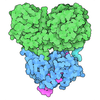
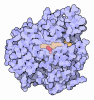
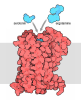

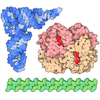
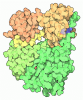
- Assembly
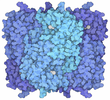
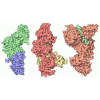
| Deposited unit | 
|
|---|---|
| 1 |
|
-Components
-Protein , 2 types, 2 molecules RA
| #1: Protein | Mass: 40784.414 Da / Num. of mol.: 1 / Mutation: E129Q Source method: isolated from a genetically manipulated source Source: (gene. exp.) Homo sapiens (human) / Gene: OPN1MW, GCP / Plasmid: pMT4 / Cell (production host): fibroblast / Cell line (production host): COS-1 / Production host: Chlorocebus aethiops (grivet monkey) / Tissue (production host): kidney / References: UniProt: P04001 |
|---|---|
| #5: Protein | Mass: 57380.715 Da / Num. of mol.: 1 Source method: isolated from a genetically manipulated source Source: (gene. exp.) Homo sapiens (human) / Plasmid: pcDNA3 / Gene: GNAS, GNAS1 / Cell (production host): fibroblast / Cell line (production host): COS-1 / Production host: Chlorocebus aethiops (grivet monkey) / Tissue (production host): kidneyReferences: UniProt: W8GG88, UniProt: Q5JWF2, Hydrolases; Acting on acid anhydrides; Acting on GTP to facilitate cellular and subcellular movement |
-Guanine nucleotide-binding protein ... , 2 types, 2 molecules BG
| #2: Protein | Mass: 38878.375 Da / Num. of mol.: 1 Source method: isolated from a genetically manipulated source Source: (gene. exp.) Homo sapiens (human) / Gene: GNB1 / Plasmid: pcDNA3 / Cell (production host): fibroblast / Cell line (production host): COS-1 / Production host: Chlorocebus aethiops (grivet monkey) / Tissue (production host): kidney / References: UniProt: P62873 |
|---|---|
| #3: Protein | Mass: 7861.143 Da / Num. of mol.: 1 Source method: isolated from a genetically manipulated source Source: (gene. exp.) Homo sapiens (human) / Gene: GNG2 / Plasmid: pcDNA3 / Cell (production host): fibroblast / Cell line (production host): COS-1 / Production host: Chlorocebus aethiops (grivet monkey) / Tissue (production host): kidney / References: UniProt: P59768 |
-Antibody / Non-polymers , 2 types, 2 molecules H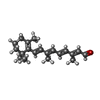
| #4: Antibody | Mass: 28674.902 Da / Num. of mol.: 1 Source method: isolated from a genetically manipulated source Source: (gene. exp.) Mus musculus (house mouse) / Cell line (production host): Sf9 / Production host:   Spodoptera frugiperda (fall armyworm) Spodoptera frugiperda (fall armyworm) |
|---|---|
| #6: Chemical | ChemComp-RET / 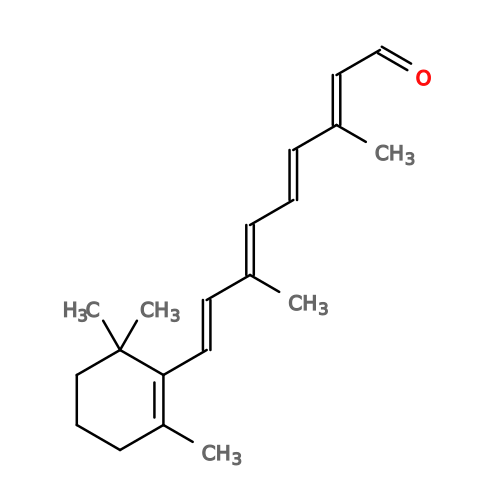 Mass: 284.436 Da / Num. of mol.: 1 / Source method: obtained synthetically / Formula: C20H28O / Feature type: SUBJECT OF INVESTIGATION Mass: 284.436 Da / Num. of mol.: 1 / Source method: obtained synthetically / Formula: C20H28O / Feature type: SUBJECT OF INVESTIGATION |
-Details
| Has ligand of interest | Y |
|---|---|
| Has protein modification | Y |
-Experimental details
-Experiment
| Experiment | Method: ELECTRON MICROSCOPY |
|---|---|
| EM experiment | Aggregation state: PARTICLE / 3D reconstruction method: single particle reconstruction |
- Sample preparation
| Component | Name: Cryo-EM structure of active mutant human green cone opsin (E129Q) in complex with chimeric G protein (miniGist) Type: COMPLEX / Entity ID: #1-#5 / Source: RECOMBINANT |
|---|---|
| Molecular weight | Experimental value: NO |
| Source (natural) | Organism: Homo sapiens (human) |
| Source (recombinant) | Organism: Chlorocebus aethiops (grivet monkey) / Cell: COS-1 / Plasmid: pcDNA3 |
| Buffer solution | pH: 7 |
| Buffer component | Conc.: 20 mM / Name: HEPES / Formula: C8H18N2O4S |
| Specimen | Embedding applied: NO / Shadowing applied: NO / Staining applied: NO / Vitrification applied: YES |
| Specimen support | Grid material: GOLD / Grid mesh size: 300 divisions/in. / Grid type: Quantifoil R1.2/1.3 |
| Vitrification | Instrument: FEI VITROBOT MARK IV / Cryogen name: ETHANE-PROPANE / Humidity: 100 % / Chamber temperature: 277 K |
- Electron microscopy imaging
| Microscopy | Model: TFS GLACIOS |
|---|---|
| Electron gun | Electron source:  FIELD EMISSION GUN / Accelerating voltage: 200 kV / Illumination mode: FLOOD BEAM FIELD EMISSION GUN / Accelerating voltage: 200 kV / Illumination mode: FLOOD BEAM |
| Electron lens | Mode: BRIGHT FIELD / Nominal defocus max: 2000 nm / Nominal defocus min: 100 nm |
| Image recording | Electron dose: 37.2 e/Å2 / Film or detector model: FEI FALCON IV (4k x 4k) / Num. of real images: 2001 |
- Processing
| EM software |
| |||||||||||||||||||||
|---|---|---|---|---|---|---|---|---|---|---|---|---|---|---|---|---|---|---|---|---|---|---|
| CTF correction | Type: PHASE FLIPPING AND AMPLITUDE CORRECTION | |||||||||||||||||||||
| 3D reconstruction | Resolution: 3.04 Å / Resolution method: FSC 0.143 CUT-OFF / Num. of particles: 891373 / Symmetry type: POINT | |||||||||||||||||||||
| Atomic model building | Source name: AlphaFold / Type: in silico model |
