 Movie
Movie Controller
 Structure viewers
 About Yorodumi Papers


+Search query
-Structure paper
| Title | Biophysical and structural analysis of human green cone opsin. |
|---|---|
| Journal, issue, pages | Biophys J, Vol. 125, Issue 10, Page 2448-2462, Year 2026 |
| Publish date | May 19, 2026 |
 Authors Authors | Weekie Yao / Jonathan F Fay / David L Farrens /  |
| PubMed Abstract | We describe a straightforward method for purifying and optimizing human green cone opsin (GCO), which we then used for biophysical and structural studies of a GCO mutant, GCO. Our results show that ...We describe a straightforward method for purifying and optimizing human green cone opsin (GCO), which we then used for biophysical and structural studies of a GCO mutant, GCO. Our results show that in dark-state GCO, residue E129 enables long-wavelength light absorption, presumably by acting as the counterion for the protonated retinal Schiff base. Notably, the Schiff base pKa in dark-state GCO appears to be markedly lower (pKa ≈4) than in the rhodopsin equivalent, Rho (pKa ≈7), indicating distinct electrostatic environments at the retinal attachment site. Functional studies show that light-activated GCO decays more slowly and activates more G-protein than wild-type GCO (GCO). To identify the basis for these differences, we determined the structure of active GCO bound to a G-protein. We first developed a streamlined workflow to identify conditions that enhance GCO binding to G-proteins. This approach involved screening GCO binding to Gα-CT resin (beads bearing tethered Gα C-terminal peptides), followed by small-scale pull-down assays using 1D4 antibody beads to detect co-purification of GCO with a Venus-tagged mini-G-protein. Using the optimized conditions, we determined a 3.0-Å cryo-EM structure of the GCO-G-protein complex. Comparison with rhodopsin and our recent 3.0-Å structure of GCO reveals that the active-state architectures are largely similar, with several intriguing differences. Together, these results establish a generalizable, streamlined approach for biophysical and structural analysis of cone opsins and provide new mechanistic insight into the activation and signaling properties of GCO. |
 External links External links | Biophys J / PubMed:41832604 / PubMed Central |
| Methods | EM (single particle) |
| Resolution | 3.04 - 3.16 Å |
| Structure data |  EMDB-72914: Local refinement of active human green opsin mutant E129Q in complex with chimeric G protein EMDB-72946, PDB-9ygz: |
| Chemicals | 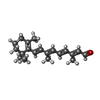 ChemComp-RET: |
| Source |
|
 Keywords Keywords | SIGNALING PROTEIN / G protein-coupled receptor / cone opsin / MEMBRANE PROTEIN |


 homo sapiens (human)
 mus musculus (house mouse)