 Movie
Movie Controller

[English] 日本語
 Yorodumi
- PDB-9y1q: Alternative NBD1-binding geometry in channel-formed, ATP-bound, V... -
+ Open data

- Basic information
| Entry | Database: PDB / ID: 9y1q | |||||||||
|---|---|---|---|---|---|---|---|---|---|---|
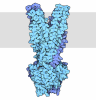
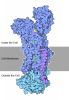
| Title | Alternative NBD1-binding geometry in channel-formed, ATP-bound, VX809-bound, T2a-nanobody-bound wild-type human CFTR (Composite map from PHENIX) | |||||||||
 Components Components |
| |||||||||
 Keywords Keywords | MEMBRANE PROTEIN / cystic fibrosis / CFTR / nanobody / protein folding | |||||||||
| Function / homology |  Function and homology information Function and homology informationSec61 translocon complex binding / channel-conductance-controlling ATPase / intracellularly ATP-gated chloride channel activity / positive regulation of enamel mineralization / RHO GTPases regulate CFTR trafficking / transepithelial water transport / intracellular pH elevation / amelogenesis / chloride channel inhibitor activity / multicellular organismal-level water homeostasis ...Sec61 translocon complex binding / channel-conductance-controlling ATPase / intracellularly ATP-gated chloride channel activity / positive regulation of enamel mineralization / RHO GTPases regulate CFTR trafficking / transepithelial water transport / intracellular pH elevation / amelogenesis / chloride channel inhibitor activity / multicellular organismal-level water homeostasis / water transport / chloride channel regulator activity / Golgi-associated vesicle membrane / bicarbonate transmembrane transporter activity / membrane hyperpolarization / bicarbonate transport / chloride transmembrane transporter activity / sperm capacitation / RHOQ GTPase cycle / chloride channel activity / ATPase-coupled transmembrane transporter activity / chloride channel complex / ABC-type transporter activity / 14-3-3 protein binding / cellular response to cAMP / response to endoplasmic reticulum stress / cellular response to forskolin / chloride transmembrane transport / Developmental Lineage of Pancreatic Ductal Cells / PDZ domain binding / clathrin-coated endocytic vesicle membrane / Late endosomal microautophagy / Defective CFTR causes cystic fibrosis / recycling endosome / ABC-family protein mediated transport / recycling endosome membrane / Chaperone Mediated Autophagy / transmembrane transport / Aggrephagy / Cargo recognition for clathrin-mediated endocytosis / Clathrin-mediated endocytosis / protein-folding chaperone binding / early endosome membrane / basolateral plasma membrane / early endosome / apical plasma membrane / endosome membrane / Ub-specific processing proteases / lysosomal membrane / endoplasmic reticulum membrane / enzyme binding / cell surface / ATP hydrolysis activity / protein-containing complex / ATP binding / membrane / identical protein binding / nucleus / plasma membrane / cytosol / cytoplasm Similarity search - Function | |||||||||
| Biological species |  Homo sapiens (human) Homo sapiens (human)  Lama glama (llama) Lama glama (llama) | |||||||||
| Method | ELECTRON MICROSCOPY / single particle reconstruction / cryo EM / Resolution: 3.86 Å | |||||||||
 Authors Authors | Hunt, J.F. / Paige, A.S. / Govaerts, C. | |||||||||
| Funding support |  United States, 1items United States, 1items
| |||||||||
 Citation Citation | Journal: To Be Published Title: Nanobody-Driven Stabilization Synergistically Rescues F508del-CFTR and Reveals an Alternative Active State of the Channel Authors: Hunt, F.J. / Paige, A.S. / Cohen, B.M. / Goldberg, P.M. / Wang, C. / Loughlin, B.J. / Kappes, J.C. / Yang, Z. / Jiang, F. / Govaerts, C. / Overtus, M. / Urbatsch, I.L. / Lukacs, G. | |||||||||
| History |
|
- Structure visualization
| Structure viewer | Molecule: MolmilJmol/JSmol |
|---|
- Downloads & links
-Download
| PDBx/mmCIF format | 9y1q.cif.gz | 466.7 KB | Display | PDBx/mmCIF format |
|---|---|---|---|---|
| PDB format | pdb9y1q.ent.gz | 373 KB | Display | PDB format |
| PDBx/mmJSON format | 9y1q.json.gz | Tree view | PDBx/mmJSON format | |
| Others |  Other downloads Other downloads |
-Validation report
| Arichive directory | https://data.pdbj.org/pub/pdb/validation_reports/y1/9y1qftp://data.pdbj.org/pub/pdb/validation_reports/y1/9y1q | HTTPS FTP |
|---|
-Related structure data
| Related structure data |  72403MC C: citing same article ( M: map data used to model this data |
|---|---|
| Similar structure data | |
| Experimental dataset #1 | Data reference: 10.6019/EMPIAR-12127 / Data set type: raw EM image data |


-Links
 PDBj
PDBj
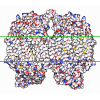
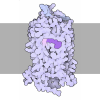
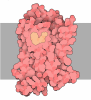
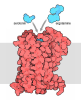
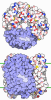
- Assembly
| Deposited unit | 
|
|---|---|
| 1 |
|
-Components
-Protein / Antibody / Protein/peptide , 3 types, 3 molecules ABC
| #1: Protein | Mass: 172734.984 Da / Num. of mol.: 1 Source method: isolated from a genetically manipulated source Source: (gene. exp.) Homo sapiens (human) / Gene: CFTR, ABCC7 / Cell (production host): CHO / Production host:  Cricetulus griseus (Chinese hamster) Cricetulus griseus (Chinese hamster)References: UniProt: P13569, channel-conductance-controlling ATPase |
|---|---|
| #2: Antibody | Mass: 15820.306 Da / Num. of mol.: 1 Source method: isolated from a genetically manipulated source Source: (gene. exp.) Lama glama (llama) / Production host:   Escherichia coli (E. coli) Escherichia coli (E. coli) |
| #3: Protein/peptide | Mass: 1464.797 Da / Num. of mol.: 1 Source method: isolated from a genetically manipulated source Source: (gene. exp.) Homo sapiens (human) / Cell (production host): CHO / Production host: Cricetulus griseus (Chinese hamster) |
-Non-polymers , 15 types, 32 molecules 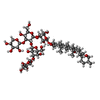
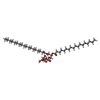
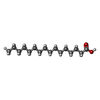


| #4: Chemical | ChemComp-AJP / 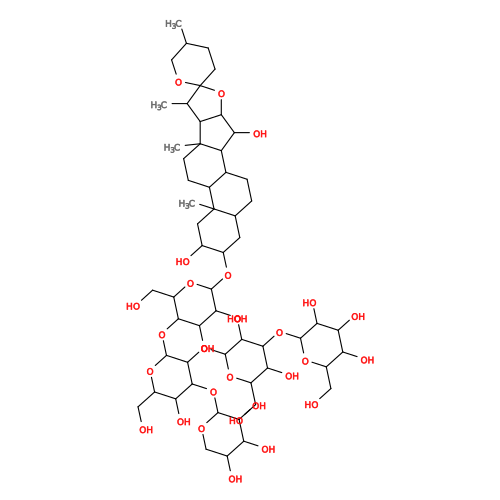 Mass: 1229.312 Da / Num. of mol.: 1 / Source method: obtained synthetically / Formula: C56H92O29 / Comment: detergent*YM Mass: 1229.312 Da / Num. of mol.: 1 / Source method: obtained synthetically / Formula: C56H92O29 / Comment: detergent*YM | ||||||||||||||||||||||||||
|---|---|---|---|---|---|---|---|---|---|---|---|---|---|---|---|---|---|---|---|---|---|---|---|---|---|---|---|
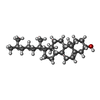
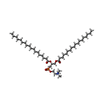
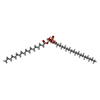
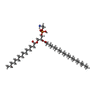
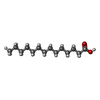
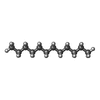
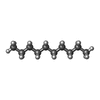
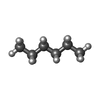
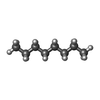
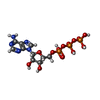
| #5: Chemical | ChemComp-CLR / 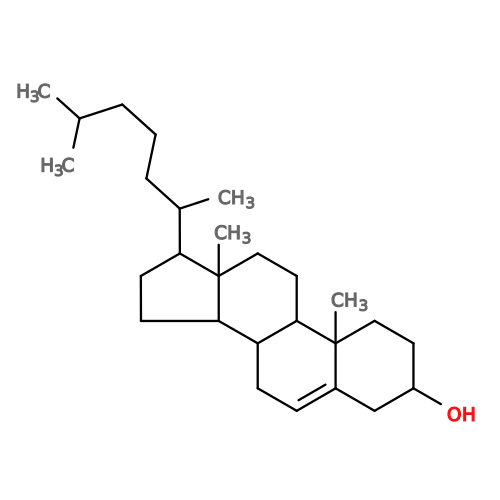 Mass: 386.654 Da / Num. of mol.: 4 / Source method: obtained synthetically / Formula: C27H46O Mass: 386.654 Da / Num. of mol.: 4 / Source method: obtained synthetically / Formula: C27H46O#6: Chemical | 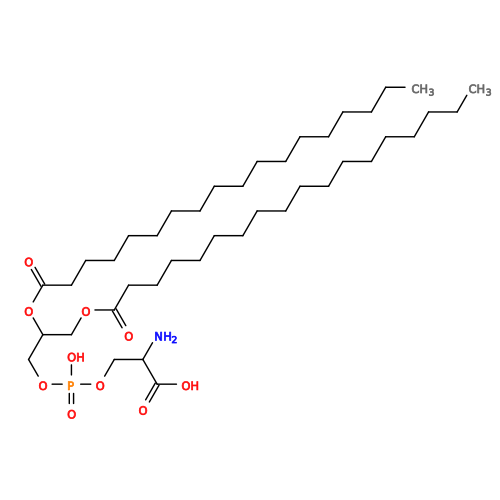 Mass: 792.075 Da / Num. of mol.: 2 / Source method: obtained synthetically / Formula: C42H82NO10P Mass: 792.075 Da / Num. of mol.: 2 / Source method: obtained synthetically / Formula: C42H82NO10P#7: Chemical | 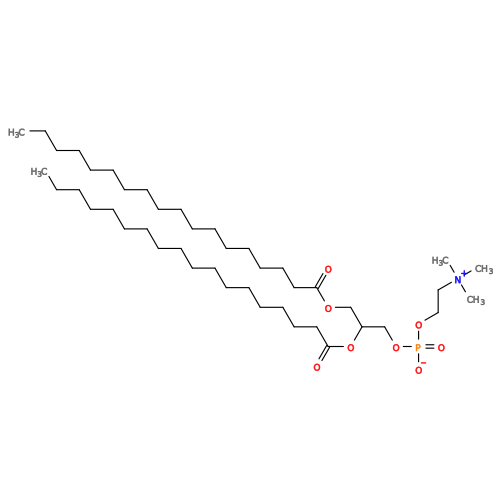 Mass: 790.145 Da / Num. of mol.: 2 / Source method: obtained synthetically / Formula: C44H88NO8P / Comment: phospholipid*YM Mass: 790.145 Da / Num. of mol.: 2 / Source method: obtained synthetically / Formula: C44H88NO8P / Comment: phospholipid*YM#8: Chemical |  Mass: 704.998 Da / Num. of mol.: 3 / Source method: obtained synthetically / Formula: C39H77O8P Mass: 704.998 Da / Num. of mol.: 3 / Source method: obtained synthetically / Formula: C39H77O8P#9: Chemical | 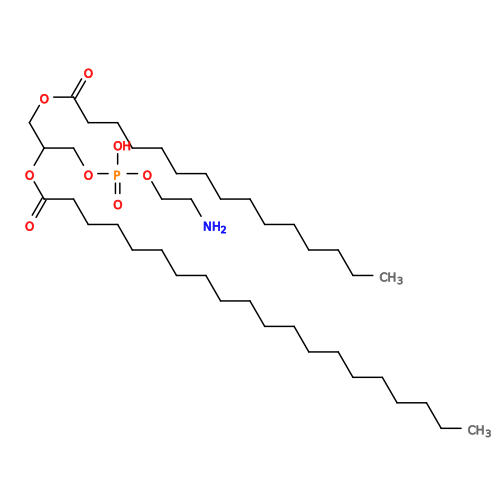 Mass: 734.039 Da / Num. of mol.: 2 / Source method: obtained synthetically / Formula: C40H80NO8P / Comment: phospholipid*YM Mass: 734.039 Da / Num. of mol.: 2 / Source method: obtained synthetically / Formula: C40H80NO8P / Comment: phospholipid*YM#10: Chemical | ChemComp-PLM / 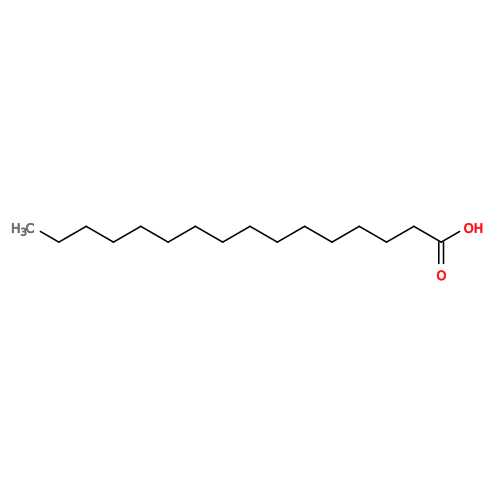 Mass: 256.424 Da / Num. of mol.: 4 / Source method: obtained synthetically / Formula: C16H32O2 Mass: 256.424 Da / Num. of mol.: 4 / Source method: obtained synthetically / Formula: C16H32O2#11: Chemical | ChemComp-MYR / | 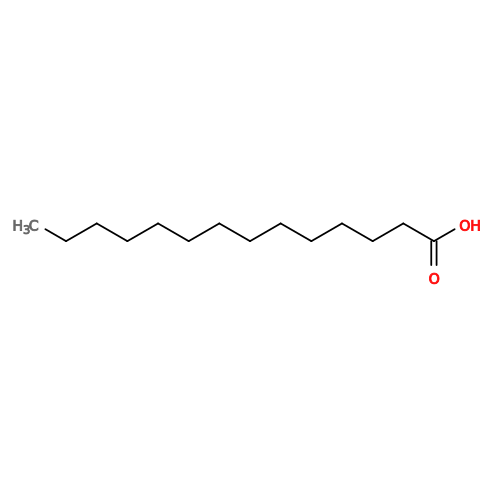 Mass: 228.371 Da / Num. of mol.: 1 / Source method: obtained synthetically / Formula: C14H28O2 Mass: 228.371 Da / Num. of mol.: 1 / Source method: obtained synthetically / Formula: C14H28O2#12: Chemical | 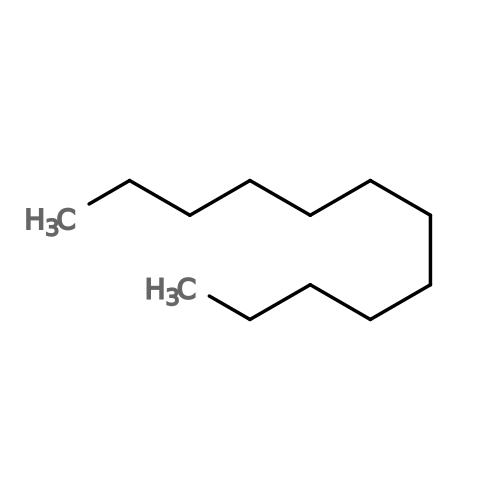 Mass: 170.335 Da / Num. of mol.: 3 / Source method: obtained synthetically / Formula: C12H26 Mass: 170.335 Da / Num. of mol.: 3 / Source method: obtained synthetically / Formula: C12H26#13: Chemical | ChemComp-D10 / | 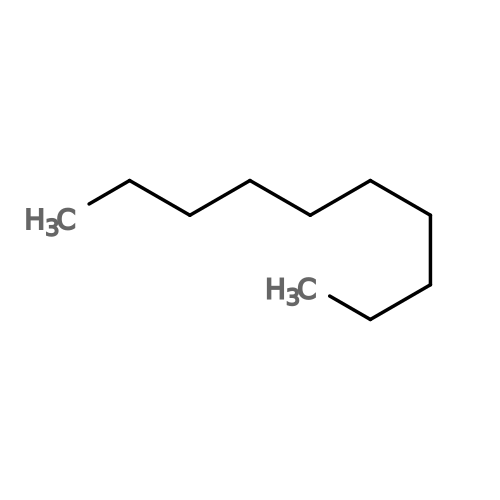 Mass: 142.282 Da / Num. of mol.: 1 / Source method: obtained synthetically / Formula: C10H22 Mass: 142.282 Da / Num. of mol.: 1 / Source method: obtained synthetically / Formula: C10H22#14: Chemical | 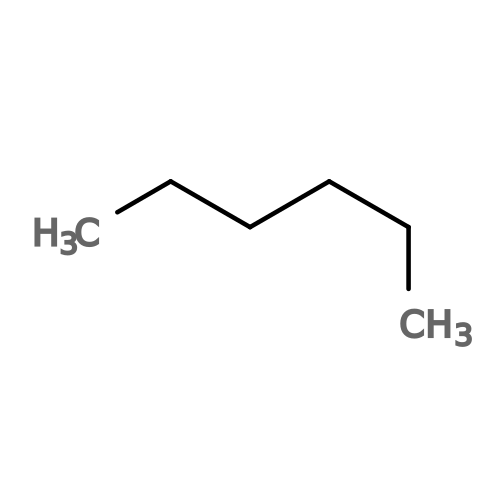 Mass: 86.175 Da / Num. of mol.: 3 / Source method: obtained synthetically / Formula: C6H14 Mass: 86.175 Da / Num. of mol.: 3 / Source method: obtained synthetically / Formula: C6H14#15: Chemical | ChemComp-OCT / | 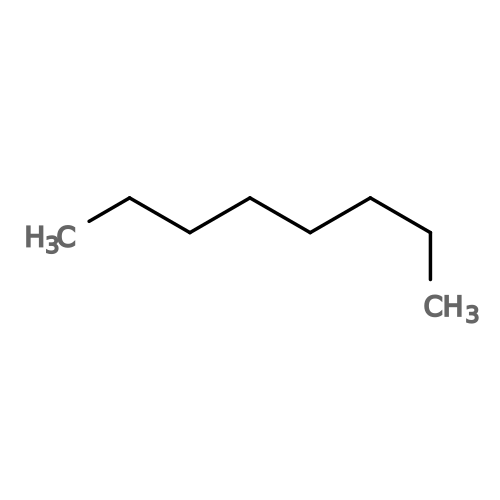 Mass: 114.229 Da / Num. of mol.: 1 / Source method: obtained synthetically / Formula: C8H18 Mass: 114.229 Da / Num. of mol.: 1 / Source method: obtained synthetically / Formula: C8H18#16: Chemical | 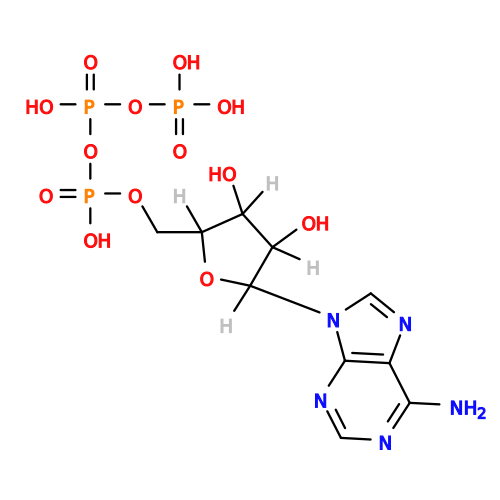 Mass: 507.181 Da / Num. of mol.: 2 / Source method: obtained synthetically / Formula: C10H16N5O13P3 / Comment: ATP, energy-carrying molecule*YM Mass: 507.181 Da / Num. of mol.: 2 / Source method: obtained synthetically / Formula: C10H16N5O13P3 / Comment: ATP, energy-carrying molecule*YM#17: Chemical |  Mass: 24.305 Da / Num. of mol.: 2 / Source method: obtained synthetically / Formula: Mg Mass: 24.305 Da / Num. of mol.: 2 / Source method: obtained synthetically / Formula: Mg#18: Chemical | ChemComp-VX8 / | 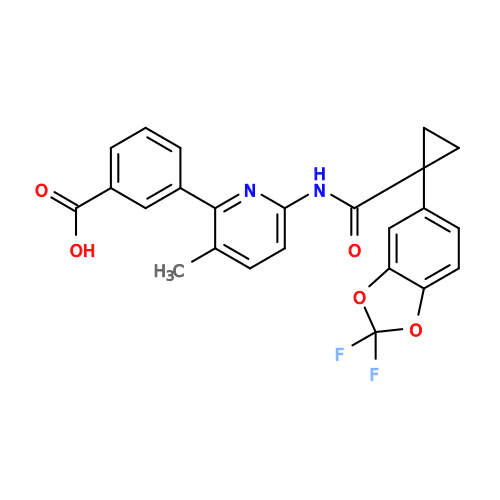 Mass: 452.407 Da / Num. of mol.: 1 / Source method: obtained synthetically / Formula: C24H18F2N2O5 Mass: 452.407 Da / Num. of mol.: 1 / Source method: obtained synthetically / Formula: C24H18F2N2O5 |
-Details
| Has ligand of interest | N |
|---|---|
| Has protein modification | Y |
-Experimental details
-Experiment
| Experiment | Method: ELECTRON MICROSCOPY |
|---|---|
| EM experiment | Aggregation state: PARTICLE / 3D reconstruction method: single particle reconstruction |
- Sample preparation
| Component |
| ||||||||||||||||||||||||||||||
|---|---|---|---|---|---|---|---|---|---|---|---|---|---|---|---|---|---|---|---|---|---|---|---|---|---|---|---|---|---|---|---|
| Molecular weight |
| ||||||||||||||||||||||||||||||
| Source (natural) |
| ||||||||||||||||||||||||||||||
| Source (recombinant) |
| ||||||||||||||||||||||||||||||
| Buffer solution | pH: 7.5 | ||||||||||||||||||||||||||||||
| Buffer component |
| ||||||||||||||||||||||||||||||
| Specimen | Conc.: 1.5 mg/ml / Embedding applied: NO / Shadowing applied: NO / Staining applied: NO / Vitrification applied: YES | ||||||||||||||||||||||||||||||
| Specimen support | Details: The grid was treated in a Solarus Plasma Cleaner 950 (Gatan Inc., USA) for 25 sec with O2/H2 flow-rates of 27.5/6.4 sccm and 15 W cleaning power. Grid material: GOLD / Grid mesh size: 300 divisions/in. / Grid type: Quantifoil R0.6/1 | ||||||||||||||||||||||||||||||
| Vitrification | Instrument: FEI VITROBOT MARK IV / Cryogen name: ETHANE / Humidity: 100 % / Chamber temperature: 277 K |
- Electron microscopy imaging
| Experimental equipment |  Model: Titan Krios / Image courtesy: FEI Company |
|---|---|
| Microscopy | Model: TFS KRIOS |
| Electron gun | Electron source:  FIELD EMISSION GUN / Accelerating voltage: 300 kV / Illumination mode: FLOOD BEAM FIELD EMISSION GUN / Accelerating voltage: 300 kV / Illumination mode: FLOOD BEAM |
| Electron lens | Mode: BRIGHT FIELD / Nominal magnification: 105000 X / Nominal defocus max: 2900 nm / Nominal defocus min: 200 nm / Cs: 2.7 mm / C2 aperture diameter: 100 µm / Alignment procedure: COMA FREE |
| Specimen holder | Cryogen: NITROGEN / Specimen holder model: FEI TITAN KRIOS AUTOGRID HOLDER / Temperature (max): 90 K / Temperature (min): 85 K |
| Image recording | Average exposure time: 2.5 sec. / Electron dose: 58 e/Å2 / Film or detector model: GATAN K3 BIOQUANTUM (6k x 4k) / Num. of grids imaged: 1 / Num. of real images: 11110 Details: Movies comprised 40 frames collected in 2.5 seconds. |
| EM imaging optics | Energyfilter name: GIF Quantum ER / Energyfilter slit width: 20 eV |
| Image scans | Sampling size: 5 µm / Width: 5760 / Height: 4092 |
- Processing
| EM software |
| ||||||||||||||||||||||||||||||||||||||||
|---|---|---|---|---|---|---|---|---|---|---|---|---|---|---|---|---|---|---|---|---|---|---|---|---|---|---|---|---|---|---|---|---|---|---|---|---|---|---|---|---|---|
| CTF correction | Type: PHASE FLIPPING AND AMPLITUDE CORRECTION | ||||||||||||||||||||||||||||||||||||||||
| Particle selection | Num. of particles selected: 2635244 | ||||||||||||||||||||||||||||||||||||||||
| 3D reconstruction | Resolution: 3.86 Å / Resolution method: FSC 0.143 CUT-OFF / Num. of particles: 36856 / Algorithm: BACK PROJECTION / Num. of class averages: 1 / Symmetry type: POINT | ||||||||||||||||||||||||||||||||||||||||
| Atomic model building | Details: Real space refinement in PHENIX using default parameters with separate grouped ADPs for side chain and backbone atoms. REMARK Because of the relatively low resolution and the anisotropy of ...Details: Real space refinement in PHENIX using default parameters with separate grouped ADPs for side chain and backbone atoms. REMARK Because of the relatively low resolution and the anisotropy of the map corresponding to this model, it was built primarily by transferring coordinates from higher resolution structures with equivalent conformations. The model for NBD2, the transmembrane region, and the bound lipids came from a 2.98 A structure of an "NBD1less" conformation of human CFTR that has no significant density for NBD1. The model for NBD1 and T2a came from a 3.04 A structure of the standard "VShaped" conformation of human CFTR (without the internal chloride channel formed) that has the T2a nanobody bound to NBD1. The relevant portions of those two models were aligned with the density in ChimeraX and then combined with a model for the C peptide that was built directly into this map. The C peptide, which has not been assigned to a specific CFTR sequence, likely derives from either the Regulatory Insertion spanning residues 403-436 or the R Region spanning residues 638-840. No manual rebuilding was performed on the model, although a small number of protein segments and two ligands showing stereochemical strains or clashes in an initial refinement in PHENIX were subject to real space refinement in COOT. Occupancy refinement was performed on the two backbone segments that have alternative conformations in the NBD1less model (541-548 and 919-922) and also on residues 1012-1034 in CFTR and the entirety of the T2a nanobody. | ||||||||||||||||||||||||||||||||||||||||
| Refinement | Highest resolution: 3.86 Å Stereochemistry target values: REAL-SPACE (WEIGHTED MAP SUM AT ATOM CENTERS) | ||||||||||||||||||||||||||||||||||||||||
| Refine LS restraints |
|
