[English] 日本語
Yorodumi
- EMDB-72403: Alternative NBD1-binding geometry in channel-formed, ATP-bound, V... -

+
Open data


ID or keywords:

Loading...

-
Basic information

Entry
Database: EMDB / ID: EMD-72403
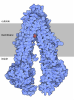
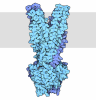
TitleAlternative NBD1-binding geometry in channel-formed, ATP-bound, VX809-bound, T2a-nanobody-bound wild-type human CFTR (Composite map from PHENIX)
Map data
Sample
  • Complex: Wild-type human CFTR solubilized in digitonin and cholesterol-hemisuccinate plus T2a nanobody in the presence of 2 mM MgATP
    • Organelle or cellular component: Wild type human Cystic Fibrosis Transmembrane Conductance Regulator (hCFTR)
      • Organelle or cellular component: T2a nanobody
        • Protein or peptide: x 1 types
      • Protein or peptide: x 1 types
    • Protein or peptide: x 1 types
  • Ligand: x 15 types
Keywordscystic fibrosis / CFTR / nanobody / protein folding / MEMBRANE PROTEIN
Function / homology
Function and homology information


Sec61 translocon complex binding / channel-conductance-controlling ATPase / intracellularly ATP-gated chloride channel activity / positive regulation of enamel mineralization / RHO GTPases regulate CFTR trafficking / transepithelial water transport / intracellular pH elevation / amelogenesis / chloride channel inhibitor activity / multicellular organismal-level water homeostasis ...Sec61 translocon complex binding / channel-conductance-controlling ATPase / intracellularly ATP-gated chloride channel activity / positive regulation of enamel mineralization / RHO GTPases regulate CFTR trafficking / transepithelial water transport / intracellular pH elevation / amelogenesis / chloride channel inhibitor activity / multicellular organismal-level water homeostasis / water transport / chloride channel regulator activity / Golgi-associated vesicle membrane / bicarbonate transmembrane transporter activity / membrane hyperpolarization / bicarbonate transport / chloride transmembrane transporter activity / sperm capacitation / RHOQ GTPase cycle / chloride channel activity / ATPase-coupled transmembrane transporter activity / chloride channel complex / ABC-type transporter activity / 14-3-3 protein binding / cellular response to cAMP / response to endoplasmic reticulum stress / cellular response to forskolin / chloride transmembrane transport / Developmental Lineage of Pancreatic Ductal Cells / PDZ domain binding / clathrin-coated endocytic vesicle membrane / Late endosomal microautophagy / Defective CFTR causes cystic fibrosis / recycling endosome / ABC-family protein mediated transport / recycling endosome membrane / Chaperone Mediated Autophagy / transmembrane transport / Aggrephagy / Cargo recognition for clathrin-mediated endocytosis / Clathrin-mediated endocytosis / protein-folding chaperone binding / early endosome membrane / basolateral plasma membrane / early endosome / apical plasma membrane / endosome membrane / Ub-specific processing proteases / lysosomal membrane / endoplasmic reticulum membrane / enzyme binding / cell surface / ATP hydrolysis activity / protein-containing complex / ATP binding / membrane / identical protein binding / nucleus / plasma membrane / cytosol / cytoplasm
Similarity search - Function
: / CFTR regulator domain / Cystic fibrosis TM conductance regulator (CFTR), regulator domain / Cystic fibrosis transmembrane conductance regulator / : / ABC transporter transmembrane region / ABC transporter type 1, transmembrane domain / ABC transporter integral membrane type-1 fused domain profile. / ABC transporter type 1, transmembrane domain superfamily / ABC transporter-like, conserved site ...: / CFTR regulator domain / Cystic fibrosis TM conductance regulator (CFTR), regulator domain / Cystic fibrosis transmembrane conductance regulator / : / ABC transporter transmembrane region / ABC transporter type 1, transmembrane domain / ABC transporter integral membrane type-1 fused domain profile. / ABC transporter type 1, transmembrane domain superfamily / ABC transporter-like, conserved site / ABC transporters family signature. / ABC transporter / ABC transporter-like, ATP-binding domain / ATP-binding cassette, ABC transporter-type domain profile. / ATPases associated with a variety of cellular activities / AAA+ ATPase domain / P-loop containing nucleoside triphosphate hydrolase
Similarity search - Domain/homology
Cystic fibrosis transmembrane conductance regulator
Similarity search - Component
Biological speciesHomo sapiens (human) / Lama glama (llama)
Methodsingle particle reconstruction / cryo EM / Resolution: 3.86 Å
AuthorsHunt JF / Paige AS / Govaerts C / Goldberg PM / Wang C / Loughlin BJ / Kappes JC / Yang Z / Jiang F / Overtus M / Rich Z
Funding support United States, 1 items
OrganizationGrant numberCountry
Cystic Fibrosis FoundationHUNT13XX0, HUNT18G0, HUNT20G0, 004400G222-Hunt, 007997G224-Hunt, FRANK16XX0, FRANK18G0 United States
CitationJournal: To Be Published
Title: Nanobody-Driven Stabilization Synergistically Rescues F508del-CFTR and Reveals an Alternative Active State of the Channel
Authors: Hunt FJ / Paige AS / Cohen BM / Goldberg PM / Wang C / Loughlin BJ / Kappes JC / Yang Z / Jiang F / Govaerts C / Overtus M / Urbatsch IL / Lukacs G
History
DepositionAug 30, 2025-
Header (metadata) releaseSep 9, 2026-
Map releaseSep 9, 2026-
UpdateSep 9, 2026-
Current statusSep 9, 2026Processing site: RCSB / Status: Released

-
Structure visualization

Supplemental images

Downloads & links

-
Map

FileDownload / File: emd_72403.map.gz / Format: CCP4 / Size: 125 MB / Type: IMAGE STORED AS FLOATING POINT NUMBER (4 BYTES)
Projections & slices

Image control

Size
Brightness
Contrast
Others
AxesZ (Sec.)Y (Row.)X (Col.)
0.83 Å/pix.
x 320 pix.
= 265.6 Å
0.83 Å/pix.
x 320 pix.
= 265.6 Å
0.83 Å/pix.
x 320 pix.
= 265.6 Å

Surface

Projections

Slices (1/3)

Slices (1/2)

Slices (2/3)

Images are generated by Spider.

Voxel sizeX=Y=Z: 0.83 Å
Density
Contour LevelBy AUTHOR: 9.5
Minimum - Maximum-27.015620999999999 - 48.351469999999999
Average (Standard dev.)0.00020139494 (±0.956961)
SymmetrySpace group: 1
Details

EMDB XML:

Map geometry
Axis orderXYZ
Origin000
Dimensions320320320
Spacing320320320
CellA=B=C: 265.6 Å
α=β=γ: 90.0 °

-
Supplemental data

-
Half map: #1

Fileemd_72403_half_map_1.map
Projections & Slices
AxesZYX

Projections

Slices (1/2)
Density Histograms

-
Half map: #2

Fileemd_72403_half_map_2.map
Projections & Slices
AxesZYX

Projections

Slices (1/2)
Density Histograms

-
Sample components

+
Entire : Wild-type human CFTR solubilized in digitonin and cholesterol-hem...

EntireName: Wild-type human CFTR solubilized in digitonin and cholesterol-hemisuccinate plus T2a nanobody in the presence of 2 mM MgATP
Components
  • Complex: Wild-type human CFTR solubilized in digitonin and cholesterol-hemisuccinate plus T2a nanobody in the presence of 2 mM MgATP
    • Organelle or cellular component: Wild type human Cystic Fibrosis Transmembrane Conductance Regulator (hCFTR)
      • Organelle or cellular component: T2a nanobody
        • Protein or peptide: T2a nanobody
      • Protein or peptide: Cystic fibrosis transmembrane conductance regulator
    • Protein or peptide: UNK-UNK-UNK-UNK-UNK-UNK-UNK-UNK-UNK-UNK-UNK-UNK-UNK-UNK-UNK-UNK-UNK
  • Ligand: Digitonin
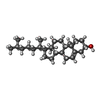
  • Ligand: CHOLESTEROL
  • Ligand: O-[(R)-{[(2R)-2,3-bis(octadecanoyloxy)propyl]oxy}(hydroxy)phosphoryl]-L-serine
  • Ligand: 1,2-DIACYL-SN-GLYCERO-3-PHOSPHOCHOLINE
  • Ligand: 1,2-DIACYL-GLYCEROL-3-SN-PHOSPHATE
  • Ligand: PHOSPHATIDYLETHANOLAMINE
  • Ligand: PALMITIC ACID
  • Ligand: MYRISTIC ACID
  • Ligand: DODECANE
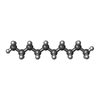
  • Ligand: DECANE
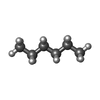
  • Ligand: HEXANE
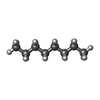
  • Ligand: N-OCTANE
  • Ligand: ADENOSINE-5'-TRIPHOSPHATE
  • Ligand: MAGNESIUM ION
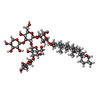
  • Ligand: Lumacaftor

+
Supramolecule #1: Wild-type human CFTR solubilized in digitonin and cholesterol-hem...

SupramoleculeName: Wild-type human CFTR solubilized in digitonin and cholesterol-hemisuccinate plus T2a nanobody in the presence of 2 mM MgATP
type: complex / ID: 1 / Parent: 0 / Macromolecule list: #1-#3
Source (natural)Organism: Homo sapiens (human)
Molecular weightTheoretical: 172.5 KDa

+
Supramolecule #2: Wild type human Cystic Fibrosis Transmembrane Conductance Regulat...

SupramoleculeName: Wild type human Cystic Fibrosis Transmembrane Conductance Regulator (hCFTR)
type: organelle_or_cellular_component / ID: 2 / Parent: 1 / Macromolecule list: #1
Source (natural)Organism: Homo sapiens (human)

+
Supramolecule #3: T2a nanobody

SupramoleculeName: T2a nanobody / type: organelle_or_cellular_component / ID: 3 / Parent: 2 / Macromolecule list: #2
Source (natural)Organism: Lama glama (llama)

+
Macromolecule #1: Cystic fibrosis transmembrane conductance regulator

MacromoleculeName: Cystic fibrosis transmembrane conductance regulator / type: protein_or_peptide / ID: 1 / Number of copies: 1 / Enantiomer: LEVO / EC number: channel-conductance-controlling ATPase
Source (natural)Organism: Homo sapiens (human)
Molecular weightTheoretical: 172.734984 KDa
Recombinant expressionOrganism: Cricetulus griseus (Chinese hamster)
SequenceString: MQRSPLEKAS VVSKLFFSWT RPILRKGYRQ RLELSDIYQI PSVDSADNLS EKLEREWDRE LASKKNPKLI NALRRCFFWR FMFYGIFLY LGEVTKAVQP LLLGRIIASY DPDNKEERSI AIYLGIGLCL LFIVRTLLLH PAIFGLHHIG MQMRIAMFSL I YKKTLKLS ...String:
MQRSPLEKAS VVSKLFFSWT RPILRKGYRQ RLELSDIYQI PSVDSADNLS EKLEREWDRE LASKKNPKLI NALRRCFFWR FMFYGIFLY LGEVTKAVQP LLLGRIIASY DPDNKEERSI AIYLGIGLCL LFIVRTLLLH PAIFGLHHIG MQMRIAMFSL I YKKTLKLS SRVLDKISIG QLVSLLSNNL NKFDEGLALA HFVWIAPLQV ALLMGLIWEL LQASAFCGLG FLIVLALFQA GL GRMMMKY RDQRAGKISE RLVITSEMIE NIQSVKAYCW EEAMEKMIEN LRQTELKLTR KAAYVRYFNS SAFFFSGFFV VFL SVLPYA LIKGIILRKI FTTISFCIVL RMAVTRQFPW AVQTWYDSLG AINKIQDFLQ KQEYKTLEYN LTTTEVVMEN VTAF WEEGF GELFEKAKQN NNNRKTSNGD DSLFFSNFSL LGTPVLKDIN FKIERGQLLA VAGSTGAGKT SLLMMIMGEL EPSEG KIKH SGRISFCSQF SWIMPGTIKE NIIFGVSYDE YRYRSVIKAC QLEEDISKFA EKDNIVLGEG GITLSGGQRA RISLAR AVY KDADLYLLDS PFGYLDVLTE KEIFESCVCK LMANKTRILV TSKMEHLKKA DKILILHEGS SYFYGTFSEL QNLQPDF SS KLMGCDSFDQ FSAERRNSIL TETLHRFSLE GDAPVSWTET KKQSFKQTGE FGEKRKNSIL NPINSIRKFS IVQKTPLQ M NGIEEDSDEP LERRLSLVPD SEQGEAILPR ISVISTGPTL QARRRQSVLN LMTHSVNQGQ NIHRKTTAST RKVSLAPQA NLTELDIYSR RLSQETGLEI SEEINEEDLK ECFFDDMESI PAVTTWNTYL RYITVHKSLI FVLIWCLVIF LAEVAASLVV LWLLGNTPL QDKGNSTHSR NNSYAVIITS TSSYYVFYIY VGVADTLLAM GFFRGLPLVH TLITVSKILH HKMLHSVLQA P MSTLNTLK AGGILNRFSK DIAILDDLLP LTIFDFIQLL LIVIGAIAVV AVLQPYIFVA TVPVIVAFIM LRAYFLQTSQ QL KQLESEG RSPIFTHLVT SLKGLWTLRA FGRQPYFETL FHKALNLHTA NWFLYLSTLR WFQMRIEMIF VIFFIAVTFI SIL TTGEGE GRVGIILTLA MNIMSTLQWA VNSSIDVDSL MRSVSRVFKF IDMPTEGKPT KSTKPYKNGQ LSKVMIIENS HVKK DDIWP SGGQMTVKDL TAKYTEGGNA ILENISFSIS PGQRVGLLGR TGSGKSTLLS AFLRLLNTEG EIQIDGVSWD SITLQ QWRK AFGVIPQKVF IFSGTFRKNL DPYEQWSDQE IWKVADEVGL RSVIEQFPGK LDFVLVDGGC VLSHGHKQLM CLARSV LSK AKILLLDEPS AHLDPVTYQI IRRTLKQAFA DCTVILCEHR IEAMLECQQF LVIEENKVRQ YDSIQKLLNE RSLFRQA IS PSDRVKLFPH RNSSKCKSKP QIAALKEETE EEVQDTRLLE ENLYFQGGGG SGGSWSHPQF EKAAAGGGSG GGSWSHPQ F EK

UniProtKB: Cystic fibrosis transmembrane conductance regulator

+
Macromolecule #2: T2a nanobody

MacromoleculeName: T2a nanobody / type: protein_or_peptide / ID: 2 / Number of copies: 1 / Enantiomer: LEVO
Source (natural)Organism: Lama glama (llama)
Molecular weightTheoretical: 15.820306 KDa
Recombinant expressionOrganism: Escherichia coli (E. coli)
SequenceString:
QVQLQESGGG LVQAGGSLRL SCAASGSIFR IDAMGWYRQA PGKQRELVAH STSGGSTDYA DSVKGRFTIS RDNAKNTVYL QMNSLKPED TAVYYCNADV RTRWYASNNY WGQGTQVTVS SAAAHHHHHH GAAEQKLISE EDLNGAA

+
Macromolecule #3: UNK-UNK-UNK-UNK-UNK-UNK-UNK-UNK-UNK-UNK-UNK-UNK-UNK-UNK-UNK-UNK-UNK

MacromoleculeName: UNK-UNK-UNK-UNK-UNK-UNK-UNK-UNK-UNK-UNK-UNK-UNK-UNK-UNK-UNK-UNK-UNK
type: protein_or_peptide / ID: 3 / Number of copies: 1 / Enantiomer: LEVO
Source (natural)Organism: Homo sapiens (human)
Molecular weightTheoretical: 1.464797 KDa
Recombinant expressionOrganism: Cricetulus griseus (Chinese hamster)
SequenceString:
(UNK)(UNK)(UNK)(UNK)(UNK)(UNK)(UNK)(UNK)(UNK)(UNK) (UNK)(UNK)(UNK)(UNK)(UNK)(UNK) (UNK)

+
Macromolecule #4: Digitonin

MacromoleculeName: Digitonin / type: ligand / ID: 4 / Number of copies: 1 / Formula: AJP
Molecular weightTheoretical: 1.229312 KDa
Chemical component information

ChemComp-AJP:
Digitonin / detergent*YM

+
Macromolecule #5: CHOLESTEROL

MacromoleculeName: CHOLESTEROL / type: ligand / ID: 5 / Number of copies: 4 / Formula: CLR
Molecular weightTheoretical: 386.654 Da
Chemical component information

ChemComp-CLR:
CHOLESTEROL

+
Macromolecule #6: O-[(R)-{[(2R)-2,3-bis(octadecanoyloxy)propyl]oxy}(hydroxy)phospho...
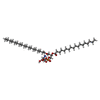
MacromoleculeName: O-[(R)-{[(2R)-2,3-bis(octadecanoyloxy)propyl]oxy}(hydroxy)phosphoryl]-L-serine
type: ligand / ID: 6 / Number of copies: 2 / Formula: P5S
Molecular weightTheoretical: 792.075 Da
Chemical component information

ChemComp-P5S:
O-[(R)-{[(2R)-2,3-bis(octadecanoyloxy)propyl]oxy}(hydroxy)phosphoryl]-L-serine

+
Macromolecule #7: 1,2-DIACYL-SN-GLYCERO-3-PHOSPHOCHOLINE
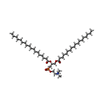
MacromoleculeName: 1,2-DIACYL-SN-GLYCERO-3-PHOSPHOCHOLINE / type: ligand / ID: 7 / Number of copies: 2 / Formula: PC1
Molecular weightTheoretical: 790.145 Da
Chemical component information

ChemComp-PC1:
1,2-DIACYL-SN-GLYCERO-3-PHOSPHOCHOLINE / phospholipid*YM

+
Macromolecule #8: 1,2-DIACYL-GLYCEROL-3-SN-PHOSPHATE
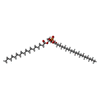
MacromoleculeName: 1,2-DIACYL-GLYCEROL-3-SN-PHOSPHATE / type: ligand / ID: 8 / Number of copies: 3 / Formula: 3PH
Molecular weightTheoretical: 704.998 Da
Chemical component information

ChemComp-3PH:
1,2-DIACYL-GLYCEROL-3-SN-PHOSPHATE

+
Macromolecule #9: PHOSPHATIDYLETHANOLAMINE
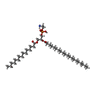
MacromoleculeName: PHOSPHATIDYLETHANOLAMINE / type: ligand / ID: 9 / Number of copies: 2 / Formula: PTY
Molecular weightTheoretical: 734.039 Da
Chemical component information

ChemComp-PTY:
PHOSPHATIDYLETHANOLAMINE / phospholipid*YM

+
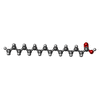
Macromolecule #10: PALMITIC ACID

MacromoleculeName: PALMITIC ACID / type: ligand / ID: 10 / Number of copies: 4 / Formula: PLM
Molecular weightTheoretical: 256.424 Da
Chemical component information

ChemComp-PLM:
PALMITIC ACID

+
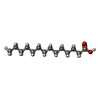
Macromolecule #11: MYRISTIC ACID

MacromoleculeName: MYRISTIC ACID / type: ligand / ID: 11 / Number of copies: 1 / Formula: MYR
Molecular weightTheoretical: 228.371 Da
Chemical component information

ChemComp-MYR:
MYRISTIC ACID

+
Macromolecule #12: DODECANE

MacromoleculeName: DODECANE / type: ligand / ID: 12 / Number of copies: 3 / Formula: D12
Molecular weightTheoretical: 170.335 Da
Chemical component information

ChemComp-D12:
DODECANE

+
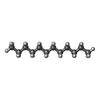
Macromolecule #13: DECANE

MacromoleculeName: DECANE / type: ligand / ID: 13 / Number of copies: 1 / Formula: D10
Molecular weightTheoretical: 142.282 Da
Chemical component information

ChemComp-D10:
DECANE

+
Macromolecule #14: HEXANE

MacromoleculeName: HEXANE / type: ligand / ID: 14 / Number of copies: 3 / Formula: HEX
Molecular weightTheoretical: 86.175 Da
Chemical component information

ChemComp-HEX:
HEXANE

+
Macromolecule #15: N-OCTANE

MacromoleculeName: N-OCTANE / type: ligand / ID: 15 / Number of copies: 1 / Formula: OCT
Molecular weightTheoretical: 114.229 Da
Chemical component information

ChemComp-OCT:
N-OCTANE

+
Macromolecule #16: ADENOSINE-5'-TRIPHOSPHATE
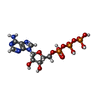
MacromoleculeName: ADENOSINE-5'-TRIPHOSPHATE / type: ligand / ID: 16 / Number of copies: 2 / Formula: ATP
Molecular weightTheoretical: 507.181 Da
Chemical component information

ChemComp-ATP:
ADENOSINE-5'-TRIPHOSPHATE / ATP, energy-carrying molecule*YM

+
Macromolecule #17: MAGNESIUM ION

MacromoleculeName: MAGNESIUM ION / type: ligand / ID: 17 / Number of copies: 2 / Formula: MG
Molecular weightTheoretical: 24.305 Da

+
Macromolecule #18: Lumacaftor

MacromoleculeName: Lumacaftor / type: ligand / ID: 18 / Number of copies: 1 / Formula: VX8
Molecular weightTheoretical: 452.407 Da
Chemical component information

ChemComp-VX8:
Lumacaftor

-
Experimental details

-
Structure determination

Methodcryo EM
Processingsingle particle reconstruction
Aggregation stateparticle

-
Sample preparation

Concentration1.5 mg/mL
BufferpH: 7.5
Component:
ConcentrationFormulaName
200.0 mMNaClSodium Chloride
3.0 mMMgCl2Magnesium Chloride
50.0 mMC4H11NO3Tris buffer
0.06 % (w/v)C56H92O29Digitonin
2.0 mMC10H16N5O13P3ATP
GridModel: Quantifoil R0.6/1 / Material: GOLD / Mesh: 300 / Support film - Material: GOLD / Support film - topology: HOLEY / Support film - Film thickness: 50 / Pretreatment - Type: PLASMA CLEANING / Pretreatment - Time: 25 sec. / Pretreatment - Atmosphere: OTHER
Details: The grid was treated in a Solarus Plasma Cleaner 950 (Gatan Inc., USA) for 25 sec with O2/H2 flow-rates of 27.5/6.4 sccm and 15 W cleaning power.
VitrificationCryogen name: ETHANE / Chamber humidity: 100 % / Chamber temperature: 277 K / Instrument: FEI VITROBOT MARK IV

-
Electron microscopy

MicroscopeTFS KRIOS
TemperatureMin: 85.0 K / Max: 90.0 K
Specialist opticsEnergy filter - Name: GIF Quantum ER / Energy filter - Slit width: 20 eV
Image recordingFilm or detector model: GATAN K3 BIOQUANTUM (6k x 4k) / Digitization - Dimensions - Width: 5760 pixel / Digitization - Dimensions - Height: 4092 pixel / Number grids imaged: 1 / Number real images: 11110 / Average exposure time: 2.5 sec. / Average electron dose: 58.0 e/Å2
Details: Movies comprised 40 frames collected in 2.5 seconds.
Electron beamAcceleration voltage: 300 kV / Electron source: FIELD EMISSION GUN
Electron opticsC2 aperture diameter: 100.0 µm / Illumination mode: FLOOD BEAM / Imaging mode: BRIGHT FIELD / Cs: 2.7 mm / Nominal defocus max: 2.9 µm / Nominal defocus min: 0.2 µm / Nominal magnification: 105000
Sample stageSpecimen holder model: FEI TITAN KRIOS AUTOGRID HOLDER / Cooling holder cryogen: NITROGEN
Experimental equipment
Model: Titan Krios / Image courtesy: FEI Company

+
Image processing

Particle selectionNumber selected: 2635244
CTF correctionSoftware - Name: cryoSPARC (ver. 4.3.1) / Software - details: Patch CTF correction / Type: PHASE FLIPPING AND AMPLITUDE CORRECTION
Startup modelType of model: NONE
Final reconstructionNumber classes used: 1 / Algorithm: BACK PROJECTION / Resolution.type: BY AUTHOR / Resolution: 3.86 Å / Resolution method: FSC 0.143 CUT-OFF / Software - Name: cryoSPARC (ver. 4.7.0) / Number images used: 36856
Initial angle assignmentType: MAXIMUM LIKELIHOOD / Software - Name: cryoSPARC (ver. 4.3.1)
Final angle assignmentType: MAXIMUM LIKELIHOOD / Software - Name: cryoSPARC (ver. 4.3.1)
Final 3D classificationNumber classes: 5 / Avg.num./class: 73709 / Software - Name: cryoSPARC (ver. 4.7.0)
Details: 373422 particles assigned to 16 protein classes at the end of iterative heteroclassifications including 6 decoy volumes.
FSC plot (resolution estimation)

-
Atomic model buiding 1

DetailsReal space refinement in PHENIX using default parameters with separate grouped ADPs for side chain and backbone atoms. REMARK Because of the relatively low resolution and the anisotropy of the map corresponding to this model, it was built primarily by transferring coordinates from higher resolution structures with equivalent conformations. The model for NBD2, the transmembrane region, and the bound lipids came from a 2.98 A structure of an "NBD1less" conformation of human CFTR that has no significant density for NBD1. The model for NBD1 and T2a came from a 3.04 A structure of the standard "VShaped" conformation of human CFTR (without the internal chloride channel formed) that has the T2a nanobody bound to NBD1. The relevant portions of those two models were aligned with the density in ChimeraX and then combined with a model for the C peptide that was built directly into this map. The C peptide, which has not been assigned to a specific CFTR sequence, likely derives from either the Regulatory Insertion spanning residues 403-436 or the R Region spanning residues 638-840. No manual rebuilding was performed on the model, although a small number of protein segments and two ligands showing stereochemical strains or clashes in an initial refinement in PHENIX were subject to real space refinement in COOT. Occupancy refinement was performed on the two backbone segments that have alternative conformations in the NBD1less model (541-548 and 919-922) and also on residues 1012-1034 in CFTR and the entirety of the T2a nanobody.
Output model

PDB-9y1q:
Alternative NBD1-binding geometry in channel-formed, ATP-bound, VX809-bound, T2a-nanobody-bound wild-type human CFTR (Composite map from PHENIX)

+
About Yorodumi

-
News

-
Feb 9, 2022. New format data for meta-information of EMDB entries

New format data for meta-information of EMDB entries

  • Version 3 of the EMDB header file is now the official format.
  • The previous official version 1.9 will be removed from the archive.

Related info.:EMDB header

External links:wwPDB to switch to version 3 of the EMDB data model

-
Aug 12, 2020. Covid-19 info

Covid-19 info

URL: https://pdbj.org/emnavi/covid19.php

New page: Covid-19 featured information page in EM Navigator.

Related info.:Covid-19 info / Mar 5, 2020. Novel coronavirus structure data

+
Mar 5, 2020. Novel coronavirus structure data

Novel coronavirus structure data

Related info.:Yorodumi Speices / Aug 12, 2020. Covid-19 info

External links:COVID-19 featured content - PDBj / Molecule of the Month (242):Coronavirus Proteases

+
Jan 31, 2019. EMDB accession codes are about to change! (news from PDBe EMDB page)

EMDB accession codes are about to change! (news from PDBe EMDB page)

  • The allocation of 4 digits for EMDB accession codes will soon come to an end. Whilst these codes will remain in use, new EMDB accession codes will include an additional digit and will expand incrementally as the available range of codes is exhausted. The current 4-digit format prefixed with “EMD-” (i.e. EMD-XXXX) will advance to a 5-digit format (i.e. EMD-XXXXX), and so on. It is currently estimated that the 4-digit codes will be depleted around Spring 2019, at which point the 5-digit format will come into force.
  • The EM Navigator/Yorodumi systems omit the EMD- prefix.

Related info.:Q: What is EMD? / ID/Accession-code notation in Yorodumi/EM Navigator

External links:EMDB Accession Codes are Changing Soon! / Contact to PDBj

+
Jul 12, 2017. Major update of PDB

Major update of PDB

  • wwPDB released updated PDB data conforming to the new PDBx/mmCIF dictionary.
  • This is a major update changing the version number from 4 to 5, and with Remediation, in which all the entries are updated.
  • In this update, many items about electron microscopy experimental information are reorganized (e.g. em_software).
  • Now, EM Navigator and Yorodumi are based on the updated data.

External links:wwPDB Remediation / Enriched Model Files Conforming to OneDep Data Standards Now Available in the PDB FTP Archive

-
Yorodumi

Thousand views of thousand structures

  • Yorodumi is a browser for structure data from EMDB, PDB, SASBDB, etc.
  • This page is also the successor to EM Navigator detail page, and also detail information page/front-end page for Omokage search.
  • The word "yorodu" (or yorozu) is an old Japanese word meaning "ten thousand". "mi" (miru) is to see.

Related info.:EMDB / PDB / SASBDB / Comparison of 3 databanks / Yorodumi Search / Aug 31, 2016. New EM Navigator & Yorodumi / Yorodumi Papers / Jmol/JSmol / Function and homology information / Changes in new EM Navigator and Yorodumi

Read more