 Movie
Movie Controller

[English] 日本語
 Yorodumi
- PDB-9x0y: Pseudomonas aeruginosa (PAO1) Outer membrane PilQ (Secretin) with... -
+ Open data

- Basic information
| Entry | Database: PDB / ID: 9x0y | |||||||||||||||||||||||||||
|---|---|---|---|---|---|---|---|---|---|---|---|---|---|---|---|---|---|---|---|---|---|---|---|---|---|---|---|---|
| Title | Pseudomonas aeruginosa (PAO1) Outer membrane PilQ (Secretin) with SlkA in C14 symmetry | |||||||||||||||||||||||||||
 Components Components |
| |||||||||||||||||||||||||||
 Keywords Keywords | TRANSPORT PROTEIN / type IV pili / secretin / plug / outer membrane / permeability barrier / antibiotics / drug resistance | |||||||||||||||||||||||||||
| Function / homology |  Function and homology information Function and homology information | |||||||||||||||||||||||||||
| Biological species |  Pseudomonas aeruginosa PAO1 (bacteria) Pseudomonas aeruginosa PAO1 (bacteria) | |||||||||||||||||||||||||||
| Method | ELECTRON MICROSCOPY / single particle reconstruction / cryo EM / Resolution: 2.68 Å | |||||||||||||||||||||||||||
 Authors Authors | Kwon, O. / Lee, Y. / Ryu, B. / Yoo, Y. / Chung, J. / Cho, H. | |||||||||||||||||||||||||||
| Funding support |  Korea, Republic Of, 5items Korea, Republic Of, 5items
| |||||||||||||||||||||||||||
 Citation Citation | Journal: Nat Commun / Year: 2026 Title: Secretin-interacting plug proteins prevent antibiotic influx during type IV pilus assembly in Pseudomonas aeruginosa. Authors: Oh Hyun Kwon / Yeseul Lee / Bumhan Ryu / Joel W Sher / Sohee Park / Frédéric Lauber / Bi-O Kim / Youngki Yoo / Seung-Hyun Cho / Donghui Choe / You-Hee Cho / Jean-François Collet / Melanie ...Authors: Oh Hyun Kwon / Yeseul Lee / Bumhan Ryu / Joel W Sher / Sohee Park / Frédéric Lauber / Bi-O Kim / Youngki Yoo / Seung-Hyun Cho / Donghui Choe / You-Hee Cho / Jean-François Collet / Melanie D Ohi / Thomas G Bernhardt / Jeong Min Chung / Hongbaek Cho /   Abstract: Type IV pili (T4P) are important virulence factors that mediate host attachment and other pathogenic functions. In Gram-negative bacteria, T4P are assembled from pilin subunits at the inner membrane ...Type IV pili (T4P) are important virulence factors that mediate host attachment and other pathogenic functions. In Gram-negative bacteria, T4P are assembled from pilin subunits at the inner membrane (IM) and extend through the outer membrane (OM) via secretin channels. Although essential for T4P function, secretin complexes can impair the OM permeability barrier, potentially allowing entry of toxic compounds. The mechanisms that prevent such influx remain poorly understood. Here, we identify SlkA and SlkB (PA5122 and PA5123) as periplasmic proteins that interact with the T4P secretin channel and block antibiotic influx. Our data indicate that these proteins function as physical plugs sealing the channel until the IM complex docks and pilus assembly begins. These findings demonstrate that Slk proteins and the IM complex function redundantly to maintain OM barrier integrity, and that their interaction with the secretin channel represents a promising target for antibiotic potentiation. | |||||||||||||||||||||||||||
| History |
|
- Structure visualization
| Structure viewer | Molecule: MolmilJmol/JSmol |
|---|
- Downloads & links
-Download
| PDBx/mmCIF format | 9x0y.cif.gz | 1 MB | Display | PDBx/mmCIF format |
|---|---|---|---|---|
| PDB format | pdb9x0y.ent.gz | Display | PDB format | |
| PDBx/mmJSON format | 9x0y.json.gz | Tree view | PDBx/mmJSON format | |
| Others |  Other downloads Other downloads |
-Validation report
| Arichive directory | https://data.pdbj.org/pub/pdb/validation_reports/x0/9x0yftp://data.pdbj.org/pub/pdb/validation_reports/x0/9x0y | HTTPS FTP |
|---|
-Related structure data
| Related structure data |  66449MC  9x0wC  9x0xC M: map data used to model this data C: citing same article ( |
|---|---|
| Similar structure data |


-Links
 PDBj
PDBj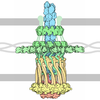
- Assembly
| Deposited unit | 
|
|---|---|
| 1 |
|
-Components
| #1: Protein | Mass: 77463.703 Da / Num. of mol.: 14 Source method: isolated from a genetically manipulated source Source: (gene. exp.) Pseudomonas aeruginosa PAO1 (bacteria) / Gene: pilQ, PA5040 / Production host: Pseudomonas aeruginosa PAO1 (bacteria) / References: UniProt: P34750#2: Protein | Mass: 11599.263 Da / Num. of mol.: 14 Source method: isolated from a genetically manipulated source Source: (gene. exp.) Pseudomonas aeruginosa PAO1 (bacteria) / Gene: PA0359 / Production host: Pseudomonas aeruginosa PAO1 (bacteria) / References: UniProt: Q9I6D5#3: Chemical | ChemComp-PTY /  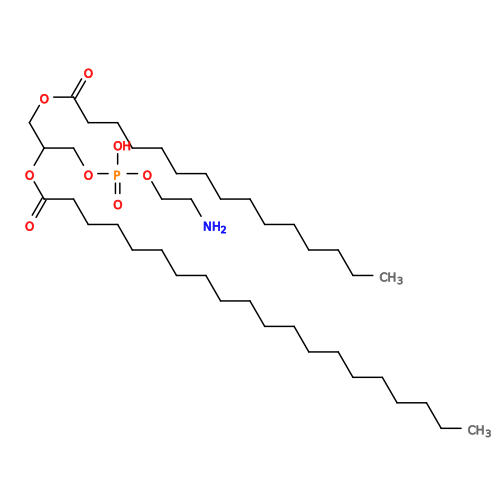 Mass: 734.039 Da / Num. of mol.: 14 / Source method: obtained synthetically / Formula: C40H80NO8P / Comment: phospholipid*YM Mass: 734.039 Da / Num. of mol.: 14 / Source method: obtained synthetically / Formula: C40H80NO8P / Comment: phospholipid*YMHas ligand of interest | N | Has protein modification | Y | |
|---|
-Experimental details
-Experiment
| Experiment | Method: ELECTRON MICROSCOPY |
|---|---|
| EM experiment | Aggregation state: PARTICLE / 3D reconstruction method: single particle reconstruction |
- Sample preparation
| Component | Name: Pseudomonas aeruginosa (PAO1) Outer membrane PilQ (Secretin) with SlkA Type: COMPLEX / Entity ID: #1-#2 / Source: RECOMBINANT |
|---|---|
| Source (natural) | Organism: Pseudomonas aeruginosa PAO1 (bacteria) |
| Source (recombinant) | Organism: Pseudomonas aeruginosa PAO1 (bacteria) |
| Buffer solution | pH: 8 |
| Specimen | Embedding applied: NO / Shadowing applied: NO / Staining applied: NO / Vitrification applied: YES |
| Vitrification | Cryogen name: ETHANE |
- Electron microscopy imaging
| Experimental equipment |  Model: Titan Krios / Image courtesy: FEI Company |
|---|---|
| Microscopy | Model: TFS KRIOS |
| Electron gun | Electron source:  FIELD EMISSION GUN / Accelerating voltage: 300 kV / Illumination mode: FLOOD BEAM FIELD EMISSION GUN / Accelerating voltage: 300 kV / Illumination mode: FLOOD BEAM |
| Electron lens | Mode: BRIGHT FIELD / Nominal defocus max: 1800 nm / Nominal defocus min: 700 nm / Cs: 2.7 mm / C2 aperture diameter: 70 µm |
| Image recording | Electron dose: 53.1 e/Å2 / Film or detector model: GATAN K3 BIOQUANTUM (6k x 4k) |
- Processing
| EM software |
| ||||||||||||||||||||||||||||
|---|---|---|---|---|---|---|---|---|---|---|---|---|---|---|---|---|---|---|---|---|---|---|---|---|---|---|---|---|---|
| CTF correction | Type: PHASE FLIPPING AND AMPLITUDE CORRECTION | ||||||||||||||||||||||||||||
| 3D reconstruction | Resolution: 2.68 Å / Resolution method: FSC 0.143 CUT-OFF / Num. of particles: 63311 / Symmetry type: POINT | ||||||||||||||||||||||||||||
| Atomic model building | Protocol: AB INITIO MODEL | ||||||||||||||||||||||||||||
| Atomic model building | Details: ModelAngelo / Source name: Other / Type: in silico model | ||||||||||||||||||||||||||||
| Refinement | Cross valid method: NONE |
