Type IV pilus secretin PilQ / : / AMIN domain / AMIN domain / Secretin and TonB N terminus short domain / Secretin/TonB, short N-terminal domain / Secretin and TonB N terminus short domain / GspD/PilQ family / Bacterial type II secretion system protein D signature. / Type II secretion system protein GspD, conserved site ...Type IV pilus secretin PilQ / : / AMIN domain / AMIN domain / Secretin and TonB N terminus short domain / Secretin/TonB, short N-terminal domain / Secretin and TonB N terminus short domain / GspD/PilQ family / Bacterial type II secretion system protein D signature. / Type II secretion system protein GspD, conserved site / NolW-like / NolW-like superfamily / Bacterial type II/III secretion system short domain / Type II/III secretion system / Bacterial type II and III secretion system protein Similarity search - Domain/homology
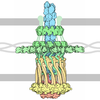
Journal: Nat Commun / Year: 2026 Title: Secretin-interacting plug proteins prevent antibiotic influx during type IV pilus assembly in Pseudomonas aeruginosa. Authors: Oh Hyun Kwon / Yeseul Lee / Bumhan Ryu / Joel W Sher / Sohee Park / Frédéric Lauber / Bi-O Kim / Youngki Yoo / Seung-Hyun Cho / Donghui Choe / You-Hee Cho / Jean-François Collet / Melanie ...Authors: Oh Hyun Kwon / Yeseul Lee / Bumhan Ryu / Joel W Sher / Sohee Park / Frédéric Lauber / Bi-O Kim / Youngki Yoo / Seung-Hyun Cho / Donghui Choe / You-Hee Cho / Jean-François Collet / Melanie D Ohi / Thomas G Bernhardt / Jeong Min Chung / Hongbaek Cho / Abstract: Type IV pili (T4P) are important virulence factors that mediate host attachment and other pathogenic functions. In Gram-negative bacteria, T4P are assembled from pilin subunits at the inner membrane ...Type IV pili (T4P) are important virulence factors that mediate host attachment and other pathogenic functions. In Gram-negative bacteria, T4P are assembled from pilin subunits at the inner membrane (IM) and extend through the outer membrane (OM) via secretin channels. Although essential for T4P function, secretin complexes can impair the OM permeability barrier, potentially allowing entry of toxic compounds. The mechanisms that prevent such influx remain poorly understood. Here, we identify SlkA and SlkB (PA5122 and PA5123) as periplasmic proteins that interact with the T4P secretin channel and block antibiotic influx. Our data indicate that these proteins function as physical plugs sealing the channel until the IM complex docks and pilus assembly begins. These findings demonstrate that Slk proteins and the IM complex function redundantly to maintain OM barrier integrity, and that their interaction with the secretin channel represents a promising target for antibiotic potentiation.
In the structure databanks used in Yorodumi, some data are registered as the other names, "COVID-19 virus" and "2019-nCoV". Here are the details of the virus and the list of structure data.
Jan 31, 2019. EMDB accession codes are about to change! (news from PDBe EMDB page)
EMDB accession codes are about to change! (news from PDBe EMDB page)
The allocation of 4 digits for EMDB accession codes will soon come to an end. Whilst these codes will remain in use, new EMDB accession codes will include an additional digit and will expand incrementally as the available range of codes is exhausted. The current 4-digit format prefixed with “EMD-” (i.e. EMD-XXXX) will advance to a 5-digit format (i.e. EMD-XXXXX), and so on. It is currently estimated that the 4-digit codes will be depleted around Spring 2019, at which point the 5-digit format will come into force.
The EM Navigator/Yorodumi systems omit the EMD- prefix.
Related info.:Q: What is EMD? / ID/Accession-code notation in Yorodumi/EM Navigator
Yorodumi is a browser for structure data from EMDB, PDB, SASBDB, etc.
This page is also the successor to EM Navigator detail page, and also detail information page/front-end page for Omokage search.
The word "yorodu" (or yorozu) is an old Japanese word meaning "ten thousand". "mi" (miru) is to see.
Related info.:EMDB / PDB / SASBDB / Comparison of 3 databanks / Yorodumi Search / Aug 31, 2016. New EM Navigator & Yorodumi / Yorodumi Papers / Jmol/JSmol / Function and homology information / Changes in new EM Navigator and Yorodumi
 Movie
Movie Controller

 Yorodumi
 Open data
 Basic information
 Map data
 Sample
 Keywords
 Function and homology information
 Pseudomonas aeruginosa PAO1 (bacteria)
 Authors
 Korea, Republic Of, 5 items
  Citation

 Structure visualization
 Downloads & links
 emd_66447.png
 https://data.pdbj.org/pub/emdb/structures/EMD-66447


 Z (Sec.)
 Y (Row.)
 X (Col.)


 Sample components
 Processing
 Electron microscopy
 FIELD EMISSION GUN

