 Movie
Movie Controller


+ Open data

- Basic information
| Entry | Database: PDB / ID: 9vu9 | |||||||||||||||||||||
|---|---|---|---|---|---|---|---|---|---|---|---|---|---|---|---|---|---|---|---|---|---|---|
| Title | channel D complex with 4 | |||||||||||||||||||||
 Components Components |
| |||||||||||||||||||||
 Keywords Keywords | MEMBRANE PROTEIN / channel D complex with 4 | |||||||||||||||||||||
| Function / homology |  Function and homology information Function and homology informationsmall conductance calcium-activated potassium channel activity / Acetylcholine inhibits contraction of outer hair cells / membrane repolarization during atrial cardiac muscle cell action potential / Ca2+ activated K+ channels / calcium-activated potassium channel activity / regulation of potassium ion transmembrane transport / inward rectifier potassium channel activity / CaM pathway / Cam-PDE 1 activation / Sodium/Calcium exchangers ...small conductance calcium-activated potassium channel activity / Acetylcholine inhibits contraction of outer hair cells / membrane repolarization during atrial cardiac muscle cell action potential / Ca2+ activated K+ channels / calcium-activated potassium channel activity / regulation of potassium ion transmembrane transport / inward rectifier potassium channel activity / CaM pathway / Cam-PDE 1 activation / Sodium/Calcium exchangers / Calmodulin induced events / Reduction of cytosolic Ca++ levels / Activation of Ca-permeable Kainate Receptor / CREB1 phosphorylation through the activation of CaMKII/CaMKK/CaMKIV cascasde / Loss of phosphorylation of MECP2 at T308 / CREB1 phosphorylation through the activation of Adenylate Cyclase / PKA activation / CaMK IV-mediated phosphorylation of CREB / CASP4 inflammasome assembly / Glycogen breakdown (glycogenolysis) / negative regulation of ryanodine-sensitive calcium-release channel activity / Activation of RAC1 downstream of NMDARs / organelle localization by membrane tethering / CLEC7A (Dectin-1) induces NFAT activation / : / negative regulation of high voltage-gated calcium channel activity / autophagosome membrane docking / negative regulation of calcium ion export across plasma membrane / regulation of cardiac muscle cell action potential / presynaptic endocytosis / Synthesis of IP3 and IP4 in the cytosol / Phase 0 - rapid depolarisation / Negative regulation of NMDA receptor-mediated neuronal transmission / Unblocking of NMDA receptors, glutamate binding and activation / calcineurin-mediated signaling / RHO GTPases activate PAKs / alpha-actinin binding / regulation of cell communication by electrical coupling involved in cardiac conduction / Uptake and function of anthrax toxins / Ion transport by P-type ATPases / protein phosphatase activator activity / Long-term potentiation / Calcineurin activates NFAT / regulation of ryanodine-sensitive calcium-release channel activity / DARPP-32 events / Regulation of MECP2 expression and activity / Smooth Muscle Contraction / potassium ion transport / detection of calcium ion / regulation of cardiac muscle contraction / cellular response to interferon-beta / RHO GTPases activate IQGAPs / presynaptic cytosol / calcium channel inhibitor activity / catalytic complex / eNOS activation / regulation of release of sequestered calcium ion into cytosol by sarcoplasmic reticulum / Tetrahydrobiopterin (BH4) synthesis, recycling, salvage and regulation / Activation of AMPK downstream of NMDARs / regulation of heart rate / Ion homeostasis / Protein methylation / regulation of cardiac muscle contraction by regulation of the release of sequestered calcium ion / titin binding / voltage-gated potassium channel complex / FCERI mediated Ca+2 mobilization / calcium channel complex / substantia nigra development / potassium ion transmembrane transport / FCGR3A-mediated IL10 synthesis / sperm midpiece / protein serine/threonine kinase activator activity / Antigen activates B Cell Receptor (BCR) leading to generation of second messengers / calyx of Held / positive regulation of receptor signaling pathway via JAK-STAT / Ras activation upon Ca2+ influx through NMDA receptor / adenylate cyclase activator activity / regulation of cytokinesis / VEGFR2 mediated cell proliferation / spindle microtubule / VEGFR2 mediated vascular permeability / sarcomere / calcium channel regulator activity / Translocation of SLC2A4 (GLUT4) to the plasma membrane / Transcriptional activation of mitochondrial biogenesis / long-term synaptic potentiation / cellular response to type II interferon / Enterobacterial factors antagonize host defense / response to calcium ion / RAF activation / Z disc / Stimuli-sensing channels / calcium-dependent protein binding / Signaling by RAF1 mutants / Signaling by moderate kinase activity BRAF mutants / Paradoxical activation of RAF signaling by kinase inactive BRAF / Signaling downstream of RAS mutants / RAS processing / Signaling by BRAF and RAF1 fusions / Platelet degranulation Similarity search - Function | |||||||||||||||||||||
| Biological species |  Homo sapiens (human) Homo sapiens (human) | |||||||||||||||||||||
| Method | ELECTRON MICROSCOPY / single particle reconstruction / cryo EM / Resolution: 3.34 Å | |||||||||||||||||||||
 Authors Authors | Jiang, D.H. / Ma, B. | |||||||||||||||||||||
| Funding support |  China, 1items China, 1items
| |||||||||||||||||||||
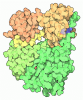
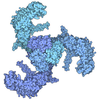
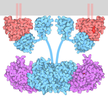
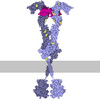
 Citation Citation | Journal: Nat Commun / Year: 2026 Title: Structural mechanisms for inhibition and activation of human small-conductance Ca-activated potassium channel SK2. Authors: Bao Ma / Di Wu / En Cao / Cheng Chi / Zhihao Wang / Zhanyi Xia / Long-Hua Sun / Bingxing Pan / Daohua Jiang / Wenhua Zhang / Abstract: The small-conductance calcium-activated potassium (SK1-3 or K2) channels regulate the intrinsic excitability and firing frequency of excitable cells. SK channels are modulated by a variety of ...The small-conductance calcium-activated potassium (SK1-3 or K2) channels regulate the intrinsic excitability and firing frequency of excitable cells. SK channels are modulated by a variety of distinct modulators; however, the underlying mechanisms remain elusive. Here, we present four cryoelectron microscopy structures of the human SK2-calmodulin complex bound with apamin, UCL1684, AP30663, and CAD-1883, elucidating their distinct binding sites and regulatory mechanisms. Apamin and UCL1684 compete for a similar binding site above the selectivity filter, which is formed by the distinct S3-S4 linker of SK2. CAD-1883 glues the N-lobe of calmodulin and the S4-S5 linker of SK2, reinforcing the open state. In contrast, AP30663 resides in the central cavity of SK2, blocking ion conductance. This study reveals multiple modulation sites in SK2 and the molecular mechanisms for the inhibition and potentiation of SK channels, which could advance rational drug design targeting SK2 channel for the treatment of cardiovascular and neurological disorders. | |||||||||||||||||||||
| History |
|
- Structure visualization
| Structure viewer | Molecule: MolmilJmol/JSmol |
|---|
- Downloads & links
-Download
| PDBx/mmCIF format | 9vu9.cif.gz | 318.2 KB | Display | PDBx/mmCIF format |
|---|---|---|---|---|
| PDB format | pdb9vu9.ent.gz | Display | PDB format | |
| PDBx/mmJSON format | 9vu9.json.gz | Tree view | PDBx/mmJSON format | |
| Others |  Other downloads Other downloads |
-Validation report
| Arichive directory | https://data.pdbj.org/pub/pdb/validation_reports/vu/9vu9ftp://data.pdbj.org/pub/pdb/validation_reports/vu/9vu9 | HTTPS FTP |
|---|
-Related structure data
| Related structure data |  65356MC  9vuaC  9vubC  9vucC M: map data used to model this data C: citing same article ( |
|---|---|
| Similar structure data |


-Links
 PDBj
PDBj

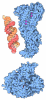
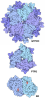
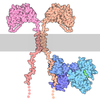
- Assembly
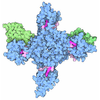
| Deposited unit | 
|
|---|---|
| 1 |
|
-Components
| #1: Protein | Mass: 16852.545 Da / Num. of mol.: 3 Source method: isolated from a genetically manipulated source Source: (gene. exp.) Homo sapiens (human) / Gene: CALM1, CALM, CAM, CAM1 / Production host: Homo sapiens (human) / References: UniProt: P0DP23#2: Protein | Mass: 63841.598 Da / Num. of mol.: 4 Source method: isolated from a genetically manipulated source Source: (gene. exp.) Homo sapiens (human) / Gene: KCNN2 / Production host: Homo sapiens (human) / References: UniProt: Q9H2S1#3: Chemical | ChemComp-A1ETX / ( | Mass: 401.385 Da / Num. of mol.: 1 / Source method: obtained synthetically / Formula: C20H18F3N5O / Feature type: SUBJECT OF INVESTIGATION #4: Chemical | ChemComp-K /   Mass: 39.098 Da / Num. of mol.: 4 / Source method: obtained synthetically / Formula: K / Feature type: SUBJECT OF INVESTIGATION Mass: 39.098 Da / Num. of mol.: 4 / Source method: obtained synthetically / Formula: K / Feature type: SUBJECT OF INVESTIGATIONHas ligand of interest | Y | Has protein modification | Y | |
|---|
-Experimental details
-Experiment
| Experiment | Method: ELECTRON MICROSCOPY |
|---|---|
| EM experiment | Aggregation state: PARTICLE / 3D reconstruction method: single particle reconstruction |
- Sample preparation
| Component | Name: channel D in complex 4 / Type: COMPLEX / Entity ID: #1-#2 / Source: RECOMBINANT |
|---|---|
| Source (natural) | Organism: Homo sapiens (human) |
| Source (recombinant) | Organism: Homo sapiens (human) |
| Buffer solution | pH: 7.5 |
| Specimen | Embedding applied: NO / Shadowing applied: NO / Staining applied: NO / Vitrification applied: YES |
| Vitrification | Cryogen name: ETHANE |
- Electron microscopy imaging
| Experimental equipment |  Model: Titan Krios / Image courtesy: FEI Company |
|---|---|
| Microscopy | Model: TFS KRIOS |
| Electron gun | Electron source:  FIELD EMISSION GUN / Accelerating voltage: 300 kV / Illumination mode: FLOOD BEAM FIELD EMISSION GUN / Accelerating voltage: 300 kV / Illumination mode: FLOOD BEAM |
| Electron lens | Mode: BRIGHT FIELD / Nominal defocus max: 2000 nm / Nominal defocus min: 1000 nm |
| Image recording | Electron dose: 60 e/Å2 / Film or detector model: GATAN K3 BIOQUANTUM (6k x 4k) |
- Processing
| EM software |
| ||||||||||||
|---|---|---|---|---|---|---|---|---|---|---|---|---|---|
| CTF correction | Type: PHASE FLIPPING AND AMPLITUDE CORRECTION | ||||||||||||
| 3D reconstruction | Resolution: 3.34 Å / Resolution method: FSC 0.143 CUT-OFF / Num. of particles: 62486 / Symmetry type: POINT | ||||||||||||
| Refinement | Highest resolution: 3.34 Å Stereochemistry target values: REAL-SPACE (WEIGHTED MAP SUM AT ATOM CENTERS) |
