 Movie
Movie Controller


+ Open data

- Basic information
| Entry |  | |||||||||
|---|---|---|---|---|---|---|---|---|---|---|
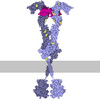
| Title | channel A complex with 1 | |||||||||
 Map data Map data | ||||||||||
 Sample Sample |
| |||||||||
 Keywords Keywords | channel A complex with 1 / MEMBRANE PROTEIN | |||||||||
| Function / homology |  Function and homology information Function and homology informationinward rectifier potassium channel inhibitor activity / negative regulation of potassium ion transmembrane transporter activity / negative regulation of inward rectifier potassium channel activity / venom-mediated perturbation of biological process / small conductance calcium-activated potassium channel activity / negative regulation of potassium ion transmembrane transport / Acetylcholine inhibits contraction of outer hair cells / membrane repolarization during atrial cardiac muscle cell action potential / Ca2+ activated K+ channels / calcium-activated potassium channel activity ...inward rectifier potassium channel inhibitor activity / negative regulation of potassium ion transmembrane transporter activity / negative regulation of inward rectifier potassium channel activity / venom-mediated perturbation of biological process / small conductance calcium-activated potassium channel activity / negative regulation of potassium ion transmembrane transport / Acetylcholine inhibits contraction of outer hair cells / membrane repolarization during atrial cardiac muscle cell action potential / Ca2+ activated K+ channels / calcium-activated potassium channel activity / regulation of potassium ion transmembrane transport / inward rectifier potassium channel activity / potassium channel inhibitor activity / CaM pathway / Cam-PDE 1 activation / Sodium/Calcium exchangers / Calmodulin induced events / Reduction of cytosolic Ca++ levels / Activation of Ca-permeable Kainate Receptor / CREB1 phosphorylation through the activation of CaMKII/CaMKK/CaMKIV cascasde / Loss of phosphorylation of MECP2 at T308 / CREB1 phosphorylation through the activation of Adenylate Cyclase / PKA activation / CaMK IV-mediated phosphorylation of CREB / CASP4 inflammasome assembly / Glycogen breakdown (glycogenolysis) / negative regulation of ryanodine-sensitive calcium-release channel activity / Activation of RAC1 downstream of NMDARs / organelle localization by membrane tethering / CLEC7A (Dectin-1) induces NFAT activation / : / negative regulation of high voltage-gated calcium channel activity / autophagosome membrane docking / negative regulation of calcium ion export across plasma membrane / regulation of cardiac muscle cell action potential / presynaptic endocytosis / Synthesis of IP3 and IP4 in the cytosol / Phase 0 - rapid depolarisation / Negative regulation of NMDA receptor-mediated neuronal transmission / Unblocking of NMDA receptors, glutamate binding and activation / calcineurin-mediated signaling / RHO GTPases activate PAKs / regulation of cell communication by electrical coupling involved in cardiac conduction / alpha-actinin binding / Uptake and function of anthrax toxins / Ion transport by P-type ATPases / Long-term potentiation / protein phosphatase activator activity / Calcineurin activates NFAT / regulation of ryanodine-sensitive calcium-release channel activity / DARPP-32 events / Regulation of MECP2 expression and activity / Smooth Muscle Contraction / potassium ion transport / detection of calcium ion / regulation of cardiac muscle contraction / cellular response to interferon-beta / toxin activity / presynaptic cytosol / RHO GTPases activate IQGAPs / calcium channel inhibitor activity / catalytic complex / eNOS activation / regulation of release of sequestered calcium ion into cytosol by sarcoplasmic reticulum / Tetrahydrobiopterin (BH4) synthesis, recycling, salvage and regulation / Activation of AMPK downstream of NMDARs / regulation of heart rate / Ion homeostasis / Protein methylation / titin binding / regulation of cardiac muscle contraction by regulation of the release of sequestered calcium ion / potassium ion transmembrane transport / voltage-gated potassium channel complex / FCERI mediated Ca+2 mobilization / calcium channel complex / substantia nigra development / FCGR3A-mediated IL10 synthesis / sperm midpiece / protein serine/threonine kinase activator activity / Antigen activates B Cell Receptor (BCR) leading to generation of second messengers / calyx of Held / positive regulation of receptor signaling pathway via JAK-STAT / Ras activation upon Ca2+ influx through NMDA receptor / adenylate cyclase activator activity / regulation of cytokinesis / VEGFR2 mediated cell proliferation / spindle microtubule / VEGFR2 mediated vascular permeability / sarcomere / calcium channel regulator activity / Translocation of SLC2A4 (GLUT4) to the plasma membrane / Transcriptional activation of mitochondrial biogenesis / cellular response to type II interferon / long-term synaptic potentiation / Enterobacterial factors antagonize host defense / response to calcium ion / RAF activation / Z disc / Stimuli-sensing channels / calcium-dependent protein binding Similarity search - Function | |||||||||
| Biological species |  Homo sapiens (human) / Homo sapiens (human) /   Apis mellifera (honey bee) Apis mellifera (honey bee) | |||||||||
| Method | single particle reconstruction / cryo EM / Resolution: 3.23 Å | |||||||||
 Authors Authors | Jiang DH / Ma B | |||||||||
| Funding support |  China, 1 items China, 1 items
| |||||||||
 Citation Citation | Journal: Nat Commun / Year: 2026 Title: Structural mechanisms for inhibition and activation of human small-conductance Ca-activated potassium channel SK2. Authors: Bao Ma / Di Wu / En Cao / Cheng Chi / Zhihao Wang / Zhanyi Xia / Long-Hua Sun / Bingxing Pan / Daohua Jiang / Wenhua Zhang / Abstract: The small-conductance calcium-activated potassium (SK1-3 or K2) channels regulate the intrinsic excitability and firing frequency of excitable cells. SK channels are modulated by a variety of ...The small-conductance calcium-activated potassium (SK1-3 or K2) channels regulate the intrinsic excitability and firing frequency of excitable cells. SK channels are modulated by a variety of distinct modulators; however, the underlying mechanisms remain elusive. Here, we present four cryoelectron microscopy structures of the human SK2-calmodulin complex bound with apamin, UCL1684, AP30663, and CAD-1883, elucidating their distinct binding sites and regulatory mechanisms. Apamin and UCL1684 compete for a similar binding site above the selectivity filter, which is formed by the distinct S3-S4 linker of SK2. CAD-1883 glues the N-lobe of calmodulin and the S4-S5 linker of SK2, reinforcing the open state. In contrast, AP30663 resides in the central cavity of SK2, blocking ion conductance. This study reveals multiple modulation sites in SK2 and the molecular mechanisms for the inhibition and potentiation of SK channels, which could advance rational drug design targeting SK2 channel for the treatment of cardiovascular and neurological disorders. | |||||||||
| History |
|
- Structure visualization
| Supplemental images |
|---|

- Downloads & links
-EMDB archive
| Map data | emd_65357.map.gz | 118 MB | EMDB map data format | |
|---|---|---|---|---|
| Header (meta data) | emd-65357-v30.xmlemd-65357.xml | 18.3 KB 18.3 KB | Display Display | EMDB header |
| Images |  emd_65357.png emd_65357.png | 59.7 KB | ||
| Filedesc metadata | emd-65357.cif.gz | 6.2 KB | ||
| Others | emd_65357_half_map_1.map.gzemd_65357_half_map_2.map.gz | 116.1 MB 116.1 MB | ||
| Archive directory |  https://data.pdbj.org/pub/emdb/structures/EMD-65357ftp://data.pdbj.org/pub/emdb/structures/EMD-65357 https://data.pdbj.org/pub/emdb/structures/EMD-65357ftp://data.pdbj.org/pub/emdb/structures/EMD-65357 | HTTPS FTP |
-Related structure data
| Related structure data |  9vuaMC  9vu9C  9vubC  9vucC M: atomic model generated by this map C: citing same article ( |
|---|---|
| Similar structure data |


-Links
| EMDB pages | EMDB (EBI/PDBe) / EMDataResource |
|---|---|
| Related items in Molecule of the Month |
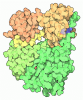
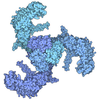
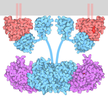
-Map
| File | Download / File: emd_65357.map.gz / Format: CCP4 / Size: 125 MB / Type: IMAGE STORED AS FLOATING POINT NUMBER (4 BYTES) | ||||||||||||||||||||||||||||||||||||
|---|---|---|---|---|---|---|---|---|---|---|---|---|---|---|---|---|---|---|---|---|---|---|---|---|---|---|---|---|---|---|---|---|---|---|---|---|---|
| Projections & slices | Image control
Images are generated by Spider. | ||||||||||||||||||||||||||||||||||||
| Voxel size | X=Y=Z: 0.85 Å | ||||||||||||||||||||||||||||||||||||
| Density |
| ||||||||||||||||||||||||||||||||||||
| Symmetry | Space group: 1 | ||||||||||||||||||||||||||||||||||||
| Details | EMDB XML:
|
 Z (Sec.)
 Y (Row.)
 X (Col.)


-Supplemental data
-Half map: #2
| File | emd_65357_half_map_1.map | ||||||||||||
|---|---|---|---|---|---|---|---|---|---|---|---|---|---|
| Projections & Slices |
| ||||||||||||
| Density Histograms |


-Half map: #1
| File | emd_65357_half_map_2.map | ||||||||||||
|---|---|---|---|---|---|---|---|---|---|---|---|---|---|
| Projections & Slices |
| ||||||||||||
| Density Histograms |


- Sample components
-Entire : channel A in complex 1
| Entire | Name: channel A in complex 1 |
|---|---|
| Components |
|
-Supramolecule #1: channel A in complex 1
| Supramolecule | Name: channel A in complex 1 / type: complex / ID: 1 / Parent: 0 / Macromolecule list: #1-#3 |
|---|---|
| Source (natural) | Organism: Homo sapiens (human) |
-Macromolecule #1: Calmodulin-1
| Macromolecule | Name: Calmodulin-1 / type: protein_or_peptide / ID: 1 / Number of copies: 3 / Enantiomer: LEVO |
|---|---|
| Source (natural) | Organism: Homo sapiens (human) |
| Molecular weight | Theoretical: 16.852545 KDa |
| Recombinant expression | Organism: Homo sapiens (human) |
| Sequence | String: MADQLTEEQI AEFKEAFSLF DKDGDGTITT KELGTVMRSL GQNPTEAELQ DMINEVDADG NGTIDFPEFL TMMARKMKDT DSEEEIREA FRVFDKDGNG YISAAELRHV MTNLGEKLTD EEVDEMIREA DIDGDGQVNY EEFVQMMTAK UniProtKB: Calmodulin-1 |
-Macromolecule #2: Small conductance calcium-activated potassium channel protein 2
| Macromolecule | Name: Small conductance calcium-activated potassium channel protein 2 type: protein_or_peptide / ID: 2 / Number of copies: 4 / Enantiomer: LEVO |
|---|---|
| Source (natural) | Organism: Homo sapiens (human) |
| Molecular weight | Theoretical: 63.841598 KDa |
| Recombinant expression | Organism: Homo sapiens (human) |
| Sequence | String: MSSCRYNGGV MRPLSNLSAS RRNLHEMDSE AQPLQPPASV GGGGGASSPS AAAAAAAAVS SSAPEIVVSK PEHNNSNNLA LYGTGGGGS TGGGGGGGGS GHGSSSGTKS SKKKNQNIGY KLGHRRALFE KRKRLSDYAL IFGMFGIVVM VIETELSWGA Y DKASLYSL ...String: MSSCRYNGGV MRPLSNLSAS RRNLHEMDSE AQPLQPPASV GGGGGASSPS AAAAAAAAVS SSAPEIVVSK PEHNNSNNLA LYGTGGGGS TGGGGGGGGS GHGSSSGTKS SKKKNQNIGY KLGHRRALFE KRKRLSDYAL IFGMFGIVVM VIETELSWGA Y DKASLYSL ALKCLISLST IILLGLIIVY HAREIQLFMV DNGADDWRIA MTYERIFFIC LEILVCAIHP IPGNYTFTWT AR LAFSYAP STTTADVDII LSIPMFLRLY LIARVMLLHS KLFTDASSRS IGALNKINFN TRFVMKTLMT ICPGTVLLVF SIS LWIIAA WTVRACERYH DQQDVTSNFL GAMWLISITF LSIGYGDMVP NTYCGKGVCL LTGIMGAGCT ALVVAVVARK LELT KAEKH VHNFMMDTQL TKRVKNAAAN VLRETWLIYK NTKLVKKIDH AKVRKHQRKF LQAIHQLRSV KMEQRKLNDQ ANTLV DLAK TQNIMYDMIS DLNERSEDFE KRIVTLETKL ETLIGSIHAL PGLISQTIRQ QQRDFIEAQM ESYDKHVTYN AERSRS SSR RRRSSSTAPP TSSESS UniProtKB: Small conductance calcium-activated potassium channel protein 2 |
-Macromolecule #3: Apamin
| Macromolecule | Name: Apamin / type: protein_or_peptide / ID: 3 / Number of copies: 1 / Enantiomer: LEVO |
|---|---|
| Source (natural) | Organism: Apis mellifera (honey bee) |
| Molecular weight | Theoretical: 2.036385 KDa |
| Recombinant expression | Organism: Apis mellifera (honey bee) |
| Sequence | String: CNCKAPETAL CARRCQQH UniProtKB: Apamin |
-Macromolecule #4: POTASSIUM ION
| Macromolecule | Name: POTASSIUM ION / type: ligand / ID: 4 / Number of copies: 4 / Formula: K |
|---|---|
| Molecular weight | Theoretical: 39.098 Da |
-Macromolecule #5: (2S)-3-(hexadecanoyloxy)-2-[(9Z)-octadec-9-enoyloxy]propyl 2-(tri...
| Macromolecule | Name: (2S)-3-(hexadecanoyloxy)-2-[(9Z)-octadec-9-enoyloxy]propyl 2-(trimethylammonio)ethyl phosphate type: ligand / ID: 5 / Number of copies: 4 / Formula: POV |
|---|---|
| Molecular weight | Theoretical: 760.076 Da |
| Chemical component information | 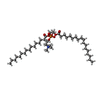 ChemComp-POV: |
-Experimental details
-Structure determination
| Method | cryo EM |
|---|---|
 Processing Processing | single particle reconstruction |
| Aggregation state | particle |
-Sample preparation
| Buffer | pH: 7.5 |
|---|---|
| Vitrification | Cryogen name: ETHANE |
- Electron microscopy
| Microscope | TFS KRIOS |
|---|---|
| Image recording | Film or detector model: GATAN K3 BIOQUANTUM (6k x 4k) / Average electron dose: 60.0 e/Å2 |
| Electron beam | Acceleration voltage: 300 kV / Electron source:  FIELD EMISSION GUN FIELD EMISSION GUN |
| Electron optics | Illumination mode: FLOOD BEAM / Imaging mode: BRIGHT FIELD / Nominal defocus max: 2.0 µm / Nominal defocus min: 1.0 µm |
| Experimental equipment |  Model: Titan Krios / Image courtesy: FEI Company |
