 Movie
Movie Controller


+ Open data

- Basic information
| Entry | Database: PDB / ID: 9unq | ||||||||||||||||||
|---|---|---|---|---|---|---|---|---|---|---|---|---|---|---|---|---|---|---|---|
| Title | native NMDA receptor-GluN1/N2A/2B in inactive state | ||||||||||||||||||
 Components Components | (Glutamate receptor ionotropic, NMDA ...) x 3 | ||||||||||||||||||
 Keywords Keywords | MEMBRANE PROTEIN/IMMUNE SYSTEM / native / NMDA receptor / ion channel / excitatory neurotransmitter / MEMBRANE PROTEIN-IMMUNE SYSTEM complex | ||||||||||||||||||
| Function / homology |  Function and homology information Function and homology informationAssembly and cell surface presentation of NMDA receptors / EPHB-mediated forward signaling / Synaptic adhesion-like molecules / Unblocking of NMDA receptors, glutamate binding and activation / neurotransmitter receptor transport, plasma membrane to endosome / directional locomotion / receptor recycling / RAF/MAP kinase cascade / sensory organ development / sensitization ...Assembly and cell surface presentation of NMDA receptors / EPHB-mediated forward signaling / Synaptic adhesion-like molecules / Unblocking of NMDA receptors, glutamate binding and activation / neurotransmitter receptor transport, plasma membrane to endosome / directional locomotion / receptor recycling / RAF/MAP kinase cascade / sensory organ development / sensitization / pons maturation / regulation of cAMP/PKA signal transduction / fear response / positive regulation of Schwann cell migration / regulation of cell communication / protein localization to postsynaptic membrane / conditioned taste aversion / sleep / serotonin metabolic process / suckling behavior / olfactory learning / dendritic branch / regulation of ARF protein signal transduction / locomotion / apical dendrite / transmitter-gated monoatomic ion channel activity / interleukin-1 receptor binding / regulation of respiratory gaseous exchange / dendritic spine organization / propylene metabolic process / response to glycine / positive regulation of inhibitory postsynaptic potential / heterocyclic compound binding / regulation of NMDA receptor activity / negative regulation of dendritic spine maintenance / neuromuscular process / neurotransmitter receptor complex / NMDA glutamate receptor activity / regulation of monoatomic cation transmembrane transport / cellular response to zinc ion / NMDA selective glutamate receptor complex / glutamate binding / regulation of axonogenesis / behavioral fear response / ligand-gated sodium channel activity / startle response / monoatomic ion channel complex / positive regulation of glutamate secretion / voltage-gated monoatomic cation channel activity / transport vesicle membrane / response to morphine / calcium ion transmembrane import into cytosol / dopamine metabolic process / regulation of synapse assembly / positive regulation of reactive oxygen species biosynthetic process / male mating behavior / protein heterotetramerization / regulation of dendrite morphogenesis / small molecule binding / behavioral response to pain / receptor clustering / glycine binding / glutamate receptor signaling pathway / response to lithium ion / positive regulation of calcium ion transport into cytosol / parallel fiber to Purkinje cell synapse / social behavior / regulation of neuronal synaptic plasticity / associative learning / regulation of postsynaptic membrane potential / regulation of MAPK cascade / extracellularly glutamate-gated ion channel activity / action potential / modulation of excitatory postsynaptic potential / detection of mechanical stimulus involved in sensory perception of pain / positive regulation of dendritic spine maintenance / monoatomic cation transmembrane transport / positive regulation of protein targeting to membrane / glutamate receptor binding / monoatomic cation transport / positive regulation of synaptic transmission / ligand-gated monoatomic ion channel activity / prepulse inhibition / neurogenesis / phosphatase binding / long-term memory / adult locomotory behavior / regulation of long-term neuronal synaptic plasticity / calcium ion homeostasis / postsynaptic density, intracellular component / monoatomic cation channel activity / sensory perception of pain / glutamate-gated receptor activity / regulation of long-term synaptic depression / response to amphetamine / positive regulation of synaptic transmission, glutamatergic / in utero embryonic development / glutamate-gated calcium ion channel activity / presynaptic active zone membrane / visual learning Similarity search - Function | ||||||||||||||||||
| Biological species |   Mus musculus (house mouse) Mus musculus (house mouse) | ||||||||||||||||||
| Method | ELECTRON MICROSCOPY / single particle reconstruction / cryo EM / Resolution: 3.2 Å | ||||||||||||||||||
 Authors Authors | Yu, J. / Xu, R.S. / Ge, J.P. | ||||||||||||||||||
| Funding support |  China, 1items China, 1items
| ||||||||||||||||||
 Citation Citation | Journal: Nature / Year: 2026 Title: Conformational diversity and fully opening mechanism of native NMDA receptor. Authors: Ruisheng Xu / Qiqi Jiang / Hongwei Xu / Lu Zhang / Xiangzi Hu / Zizhuo Lu / Huaqin Deng / Haolin Xiong / Sensen Zhang / Zhongwen Chen / Yifan Ge / Zhengjiang Zhu / Yaoyang Zhang / Yelin Chen ...Authors: Ruisheng Xu / Qiqi Jiang / Hongwei Xu / Lu Zhang / Xiangzi Hu / Zizhuo Lu / Huaqin Deng / Haolin Xiong / Sensen Zhang / Zhongwen Chen / Yifan Ge / Zhengjiang Zhu / Yaoyang Zhang / Yelin Chen / Jingpeng Ge / Jie Yu / Abstract: N-methyl-D-aspartate receptors (NMDARs) are glutamate-gated ion channels that mediate excitatory neurotransmission throughout the brain. As obligate heterotetramers, their activation requires the ...N-methyl-D-aspartate receptors (NMDARs) are glutamate-gated ion channels that mediate excitatory neurotransmission throughout the brain. As obligate heterotetramers, their activation requires the binding of both glycine and glutamate. Although recent structural studies have provided insights into endogenous receptors from select brain regions, most previous work has relied on recombinant receptors and engineered constructs, which limits our understanding of native NMDARs across the whole brain. Here we identify and resolve ten distinct native NMDAR assemblies from the whole-brain tissue of female C57BL/6 mice using immunoaffinity purification, single-molecule total internal reflection fluorescence microscopy and cryo-electron microscopy. Analyses of the GluN1-GluN2A(S1), GluN1-GluN2A(S2), GluN1-GluN2A(S3), GluN1-GluN2B, GluN1-GluN2A-GluN2B(S1), GluN1-GluN2A-GluN2B(S2), GluN1-GluN2A-GluNX(S1), GluN1-GluN2A-GluNX(S2), GluN1-GluN2B-GluNX and GluN1-GluNX structures reveal that GluN2A is the most prevalent subunit across assemblies. Moreover, the substantial conformational flexibility observed in the GluN2A amino-terminal domain may explain its fast kinetics and dominant role in gating. Dynamic movements of S-ketamine were also captured at the channel vestibule, as was pore dilation in both the GluN1 and GluN2B subunits of a native GluN1-GluN2B receptor. The latter observation represents a previously unknown fully open state of NMDAR. Our large collection of heterogeneous NMDAR structures from whole brain reveals previously unrecognized properties of conformational diversity and channel dilation. | ||||||||||||||||||
| History |
|
- Structure visualization
| Structure viewer | Molecule: MolmilJmol/JSmol |
|---|
- Downloads & links
-Download
| PDBx/mmCIF format | 9unq.cif.gz | 607.1 KB | Display | PDBx/mmCIF format |
|---|---|---|---|---|
| PDB format | pdb9unq.ent.gz | 478.1 KB | Display | PDB format |
| PDBx/mmJSON format | 9unq.json.gz | Tree view | PDBx/mmJSON format | |
| Others |  Other downloads Other downloads |
-Validation report
| Arichive directory | https://data.pdbj.org/pub/pdb/validation_reports/un/9unqftp://data.pdbj.org/pub/pdb/validation_reports/un/9unq | HTTPS FTP |
|---|
-Related structure data
| Related structure data |  64360MC  9un2C  9un3C  9unjC  9unkC  9unmC  9unnC  9unoC  9unpC  9unrC C: citing same article ( M: map data used to model this data |
|---|---|
| Similar structure data |


-Links
 PDBj
PDBj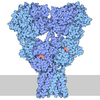
- Assembly
| Deposited unit | 
|
|---|---|
| 1 |
|
-Components
-Glutamate receptor ionotropic, NMDA ... , 3 types, 4 molecules ACBD
| #1: Protein | Mass: 92083.203 Da / Num. of mol.: 2 / Source method: isolated from a natural source / Source: (natural) Mus musculus (house mouse) / References: UniProt: P35438#2: Protein | | Mass: 90708.734 Da / Num. of mol.: 1 / Source method: isolated from a natural source / Source: (natural) Mus musculus (house mouse) / References: UniProt: P35436#3: Protein | | Mass: 90925.859 Da / Num. of mol.: 1 / Source method: isolated from a natural source / Source: (natural) Mus musculus (house mouse) / References: UniProt: Q01097 |
|---|
-Sugars , 1 types, 20 molecules 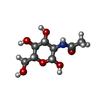
| #4: Sugar | ChemComp-NAG / 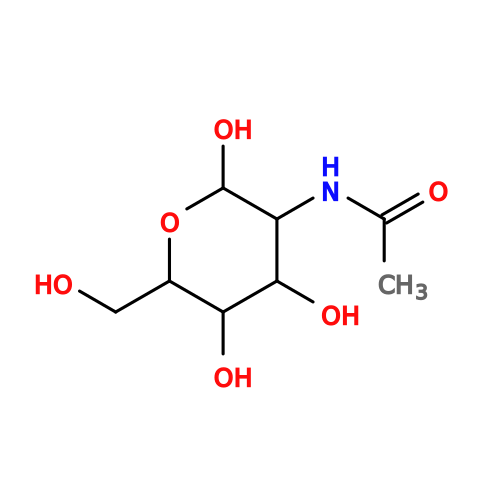 Type: D-saccharide, beta linking / Mass: 221.208 Da / Num. of mol.: 20 / Source method: obtained synthetically / Formula: C8H15NO6 Type: D-saccharide, beta linking / Mass: 221.208 Da / Num. of mol.: 20 / Source method: obtained synthetically / Formula: C8H15NO6 |
|---|
-Non-polymers , 2 types, 4 molecules 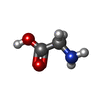
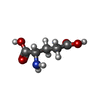
| #5: Chemical | 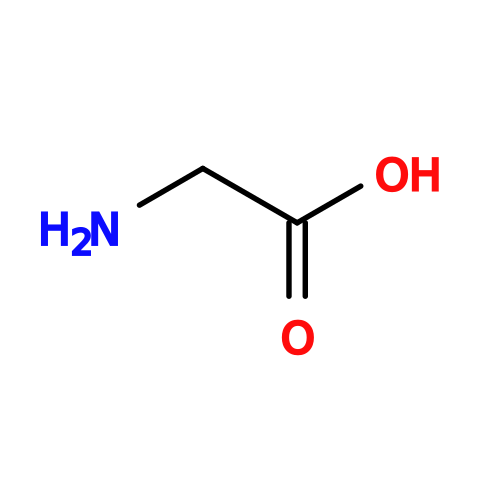 Type: peptide linking / Mass: 75.067 Da / Num. of mol.: 2 / Source method: obtained synthetically / Formula: C2H5NO2 Type: peptide linking / Mass: 75.067 Da / Num. of mol.: 2 / Source method: obtained synthetically / Formula: C2H5NO2#6: Chemical | 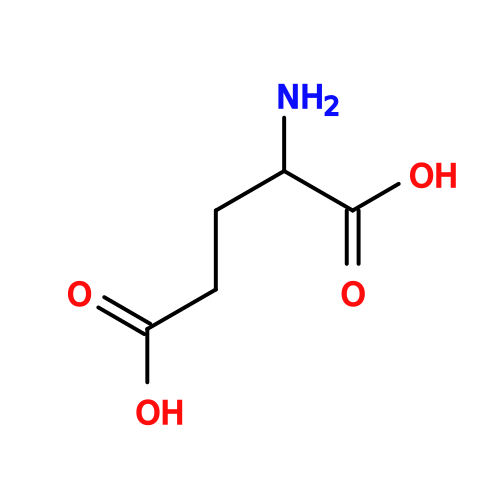 Type: L-peptide linking / Mass: 147.129 Da / Num. of mol.: 2 / Source method: obtained synthetically / Formula: C5H9NO4 Type: L-peptide linking / Mass: 147.129 Da / Num. of mol.: 2 / Source method: obtained synthetically / Formula: C5H9NO4 |
|---|
-Details
| Has ligand of interest | N |
|---|---|
| Has protein modification | Y |
-Experimental details
-Experiment
| Experiment | Method: ELECTRON MICROSCOPY |
|---|---|
| EM experiment | Aggregation state: PARTICLE / 3D reconstruction method: single particle reconstruction |
- Sample preparation
| Component | Name: native NMDA receptor-GluN1/N2A/2B in inactive state / Type: COMPLEX / Entity ID: #1-#3 / Source: NATURAL |
|---|---|
| Source (natural) | Organism:  Homo sapiens (human) Homo sapiens (human) |
| Source (recombinant) | Organism: Homo sapiens (human) / Strain: Human Embryonic Kidney Cells 293 |
| Buffer solution | pH: 8 |
| Specimen | Embedding applied: NO / Shadowing applied: NO / Staining applied: NO / Vitrification applied: YES |
| Vitrification | Cryogen name: ETHANE |
- Electron microscopy imaging
| Experimental equipment |  Model: Titan Krios / Image courtesy: FEI Company |
|---|---|
| Microscopy | Model: TFS KRIOS |
| Electron gun | Electron source:  FIELD EMISSION GUN / Accelerating voltage: 300 kV / Illumination mode: FLOOD BEAM FIELD EMISSION GUN / Accelerating voltage: 300 kV / Illumination mode: FLOOD BEAM |
| Electron lens | Mode: BRIGHT FIELD / Nominal defocus max: 2200 nm / Nominal defocus min: 1000 nm |
| Image recording | Electron dose: 50 e/Å2 / Film or detector model: GATAN K3 (6k x 4k) |
- Processing
| EM software |
| ||||||||||||||||||||||||
|---|---|---|---|---|---|---|---|---|---|---|---|---|---|---|---|---|---|---|---|---|---|---|---|---|---|
| CTF correction | Type: PHASE FLIPPING AND AMPLITUDE CORRECTION | ||||||||||||||||||||||||
| 3D reconstruction | Resolution: 3.2 Å / Resolution method: FSC 0.143 CUT-OFF / Num. of particles: 585019 / Symmetry type: POINT | ||||||||||||||||||||||||
| Refinement | Highest resolution: 3.2 Å Stereochemistry target values: REAL-SPACE (WEIGHTED MAP SUM AT ATOM CENTERS) | ||||||||||||||||||||||||
| Refine LS restraints |
|
