 Movie
Movie Controller

[English] 日本語
 Yorodumi
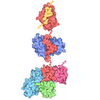
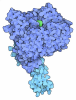
- PDB-9t92: cryo-EM structure of autophosphorylated mTOR complex 2, overall r... -
+ Open data

- Basic information
| Entry | Database: PDB / ID: 9t92 | ||||||||||||||||||
|---|---|---|---|---|---|---|---|---|---|---|---|---|---|---|---|---|---|---|---|
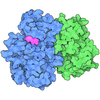
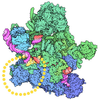
| Title | cryo-EM structure of autophosphorylated mTOR complex 2, overall refinement | ||||||||||||||||||
 Components Components |
| ||||||||||||||||||
 Keywords Keywords | TRANSFERASE / Kinase / Complex / Signaling protein | ||||||||||||||||||
| Function / homology |  Function and homology information Function and homology informationcardiac cell development / positive regulation of SCF-dependent proteasomal ubiquitin-dependent catabolic process / RNA polymerase III type 2 promoter sequence-specific DNA binding / T-helper 1 cell lineage commitment / RNA polymerase III type 1 promoter sequence-specific DNA binding / positive regulation of cytoplasmic translational initiation / regulation of locomotor rhythm / positive regulation of pentose-phosphate shunt / positive regulation of wound healing, spreading of epidermal cells / regulation of phosphatidylinositol 3-kinase/protein kinase B signal transduction ...cardiac cell development / positive regulation of SCF-dependent proteasomal ubiquitin-dependent catabolic process / RNA polymerase III type 2 promoter sequence-specific DNA binding / T-helper 1 cell lineage commitment / RNA polymerase III type 1 promoter sequence-specific DNA binding / positive regulation of cytoplasmic translational initiation / regulation of locomotor rhythm / positive regulation of pentose-phosphate shunt / positive regulation of wound healing, spreading of epidermal cells / regulation of phosphatidylinositol 3-kinase/protein kinase B signal transduction / TORC2 complex / cellular response to leucine starvation / TFIIIC-class transcription factor complex binding / regulation of lysosome organization / TORC1 complex / regulation of cellular response to oxidative stress / negative regulation of lysosome organization / regulation of osteoclast differentiation / RNA polymerase III type 3 promoter sequence-specific DNA binding / positive regulation of keratinocyte migration / positive regulation of transcription of nucleolar large rRNA by RNA polymerase I / negative regulation of Ras protein signal transduction / Energy dependent regulation of mTOR by LKB1-AMPK / cellular response to nutrient / cellular response to L-leucine / regulation of autophagosome assembly / phosphatidic acid binding / Amino acids regulate mTORC1 / embryo development ending in birth or egg hatching / Dengue virus modulates apoptosis / cellular response to methionine / phosphatidylinositol-3,4-bisphosphate binding / TORC2 signaling / TORC1 signaling / cellular response to osmotic stress / MTOR signalling / inositol hexakisphosphate binding / anoikis / negative regulation of protein localization to nucleus / positive regulation of ubiquitin-dependent protein catabolic process / regulation of cell size / phosphatidylinositol-3,5-bisphosphate binding / lipid biosynthetic process / negative regulation of macroautophagy / Macroautophagy / Constitutive Signaling by AKT1 E17K in Cancer / behavioral response to pain / positive regulation of transcription by RNA polymerase III / positive regulation of protein kinase activity / phosphatidylinositol-3,4,5-trisphosphate binding / response to amino acid / neuronal action potential / TOR signaling / mTORC1-mediated signalling / HSF1-dependent transactivation / positive regulation of translational initiation / CD28 dependent PI3K/Akt signaling / positive regulation of TOR signaling / enzyme-substrate adaptor activity / positive regulation of lipid biosynthetic process / positive regulation of epithelial to mesenchymal transition / T cell costimulation / vascular endothelial cell response to laminar fluid shear stress / cellular response to nutrient levels / regulation of cellular response to heat / 'de novo' pyrimidine nucleobase biosynthetic process / regulation of macroautophagy / cytoskeleton organization / positive regulation of endothelial cell proliferation / negative regulation of insulin receptor signaling pathway / phagocytic vesicle / phosphatidylinositol-4,5-bisphosphate binding / endomembrane system / substantia nigra development / positive regulation of glycolytic process / protein serine/threonine kinase activator activity / negative regulation of autophagy / cellular response to amino acid starvation / regulation of actin cytoskeleton organization / cellular response to amino acid stimulus / cellular response to starvation / Regulation of PTEN gene transcription / regulation of signal transduction by p53 class mediator / phosphatidylinositol 3-kinase/protein kinase B signal transduction / VEGFR2 mediated vascular permeability / non-specific protein-tyrosine kinase / TP53 Regulates Metabolic Genes / regulation of cell growth / non-membrane spanning protein tyrosine kinase activity / positive regulation of translation / phosphoprotein binding / response to nutrient levels / PML body / regulation of circadian rhythm / small GTPase binding / actin cytoskeleton organization / cellular response to insulin stimulus / Regulation of TP53 Degradation / late endosome / PIP3 activates AKT signaling Similarity search - Function | ||||||||||||||||||
| Biological species |  Homo sapiens (human) Homo sapiens (human) | ||||||||||||||||||
| Method | ELECTRON MICROSCOPY / single particle reconstruction / cryo EM / Resolution: 3.1 Å | ||||||||||||||||||
 Authors Authors | Hay, I.M. / Anandapadamanaban, M. / Williams, R.L. | ||||||||||||||||||
| Funding support |  United Kingdom, 2items United Kingdom, 2items
| ||||||||||||||||||
 Citation Citation | Journal: Biorxiv / Year: 2026 Title: Structural basis for a phosphoinositide-driven mTORC2-AKT positive feedback loop Authors: Hay, I.M. / Bourguet, M. / Ahsan, B. / Perisic, O. / Anandapadamanaban, M. / Williams, R.L. | ||||||||||||||||||
| History |
|
- Structure visualization
| Structure viewer | Molecule: MolmilJmol/JSmol |
|---|
- Downloads & links
-Download
| PDBx/mmCIF format | 9t92.cif.gz | 1.3 MB | Display | PDBx/mmCIF format |
|---|---|---|---|---|
| PDB format | pdb9t92.ent.gz | 1.1 MB | Display | PDB format |
| PDBx/mmJSON format | 9t92.json.gz | Tree view | PDBx/mmJSON format | |
| Others |  Other downloads Other downloads |
-Validation report
| Arichive directory | https://data.pdbj.org/pub/pdb/validation_reports/t9/9t92ftp://data.pdbj.org/pub/pdb/validation_reports/t9/9t92 | HTTPS FTP |
|---|
-Related structure data
| Related structure data |  55714MC  9t7jC  9t93C  9t94C  9tdsC  9tdtC  9tpwC  55643 55644 55649 M: map data used to model this data C: citing same article ( |
|---|---|
| Similar structure data |


-Links
 PDBj
PDBj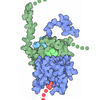
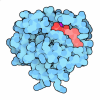
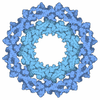
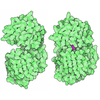
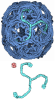
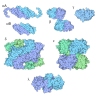
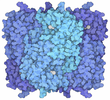
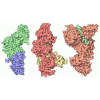
- Assembly
| Deposited unit | 
|
|---|---|
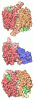
| 1 |
|
-Components
-Protein , 2 types, 4 molecules ABEF
| #1: Protein | Mass: 293557.656 Da / Num. of mol.: 2 Source method: isolated from a genetically manipulated source Source: (gene. exp.) Homo sapiens (human) / Gene: MTOR, FRAP, FRAP1, FRAP2, RAFT1, RAPT1 / Production host: Homo sapiens (human)References: UniProt: P42345, non-specific serine/threonine protein kinase, non-specific protein-tyrosine kinase #3: Protein | Mass: 195552.031 Da / Num. of mol.: 2 Source method: isolated from a genetically manipulated source Source: (gene. exp.) Homo sapiens (human) / Gene: RICTOR, KIAA1999 / Production host: Homo sapiens (human) / References: UniProt: Q6R327 |
|---|
-Target of rapamycin complex ... , 2 types, 4 molecules CDGH
| #2: Protein | Mass: 35910.090 Da / Num. of mol.: 2 Source method: isolated from a genetically manipulated source Source: (gene. exp.) Homo sapiens (human) / Gene: MLST8, GBL, LST8 / Production host: Homo sapiens (human) / References: UniProt: Q9BVC4#4: Protein | Mass: 59181.559 Da / Num. of mol.: 2 Source method: isolated from a genetically manipulated source Source: (gene. exp.) Homo sapiens (human) / Gene: MAPKAP1, MIP1, SIN1 / Production host: Homo sapiens (human) / References: UniProt: Q9BPZ7 |
|---|
-Non-polymers , 2 types, 4 molecules 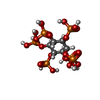

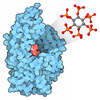
| #5: Chemical | 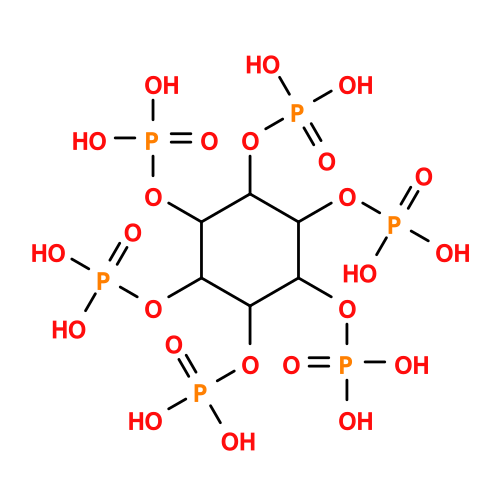 Mass: 660.035 Da / Num. of mol.: 2 / Source method: obtained synthetically / Formula: C6H18O24P6 Mass: 660.035 Da / Num. of mol.: 2 / Source method: obtained synthetically / Formula: C6H18O24P6#6: Chemical |  Mass: 65.409 Da / Num. of mol.: 2 / Source method: obtained synthetically / Formula: Zn Mass: 65.409 Da / Num. of mol.: 2 / Source method: obtained synthetically / Formula: Zn |
|---|
-Details
| Has ligand of interest | Y |
|---|---|
| Has protein modification | Y |
-Experimental details
-Experiment
| Experiment | Method: ELECTRON MICROSCOPY |
|---|---|
| EM experiment | Aggregation state: PARTICLE / 3D reconstruction method: single particle reconstruction |
- Sample preparation
| Component | Name: mTOR complex 2, autophosphorylated / Type: COMPLEX / Details: mTOR complex 2 autophosphorylated in vitro. / Entity ID: #1-#4 / Source: RECOMBINANT | ||||||||||||||||
|---|---|---|---|---|---|---|---|---|---|---|---|---|---|---|---|---|---|
| Molecular weight | Value: 0.58 MDa / Experimental value: NO | ||||||||||||||||
| Source (natural) | Organism: Homo sapiens (human) | ||||||||||||||||
| Source (recombinant) | Organism: Homo sapiens (human) | ||||||||||||||||
| Buffer solution | pH: 7.5 | ||||||||||||||||
| Buffer component |
| ||||||||||||||||
| Specimen | Conc.: 0.9 mg/ml / Embedding applied: NO / Shadowing applied: NO / Staining applied: NO / Vitrification applied: YES | ||||||||||||||||
| Vitrification | Instrument: FEI VITROBOT MARK IV / Cryogen name: ETHANE / Humidity: 100 % / Chamber temperature: 287 K |
- Electron microscopy imaging
| Experimental equipment |  Model: Titan Krios / Image courtesy: FEI Company |
|---|---|
| Microscopy | Model: TFS KRIOS |
| Electron gun | Electron source:  FIELD EMISSION GUN / Accelerating voltage: 300 kV / Illumination mode: FLOOD BEAM FIELD EMISSION GUN / Accelerating voltage: 300 kV / Illumination mode: FLOOD BEAM |
| Electron lens | Mode: BRIGHT FIELD / Nominal magnification: 130000 X / Nominal defocus max: 2800 nm / Nominal defocus min: 1000 nm / Cs: 2.7 mm |
| Specimen holder | Cryogen: NITROGEN / Specimen holder model: FEI TITAN KRIOS AUTOGRID HOLDER |
| Image recording | Electron dose: 50 e/Å2 / Film or detector model: TFS FALCON 4i (4k x 4k) |
| EM imaging optics | Energyfilter name: TFS Selectris X / Energyfilter slit width: 10 eV |
- Processing
| EM software |
| ||||||||||||||||||||||||||||||||||||
|---|---|---|---|---|---|---|---|---|---|---|---|---|---|---|---|---|---|---|---|---|---|---|---|---|---|---|---|---|---|---|---|---|---|---|---|---|---|
| CTF correction | Type: PHASE FLIPPING AND AMPLITUDE CORRECTION | ||||||||||||||||||||||||||||||||||||
| 3D reconstruction | Resolution: 3.1 Å / Resolution method: FSC 0.143 CUT-OFF / Num. of particles: 143361 / Symmetry type: POINT |
