 Movie
Movie Controller


+ Open data

- Basic information
| Entry | Database: PDB / ID: 9sri | |||||||||||||||||||||||||||
|---|---|---|---|---|---|---|---|---|---|---|---|---|---|---|---|---|---|---|---|---|---|---|---|---|---|---|---|---|
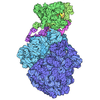
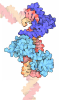
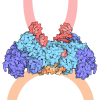
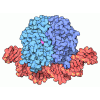
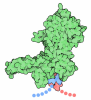
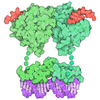
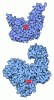
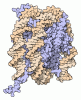
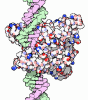
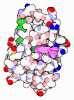
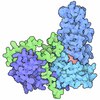
| Title | Human DNA polymerase epsilon bound to DNA blunt end | |||||||||||||||||||||||||||
 Components Components |
| |||||||||||||||||||||||||||
 Keywords Keywords | DNA BINDING PROTEIN / POLE1 / DNA / polymerase / epsilon / PCNA / leading strand / replication / replisome | |||||||||||||||||||||||||||
| Function / homology |  Function and homology information Function and homology informationDNA replication initiation / epsilon DNA polymerase complex / dinucleotide insertion or deletion binding / PCNA-p21 complex / mitotic telomere maintenance via semi-conservative replication / purine-specific mismatch base pair DNA N-glycosylase activity / nucleotide-excision repair, DNA gap filling / replisome / nuclear lamina / Polymerase switching ...DNA replication initiation / epsilon DNA polymerase complex / dinucleotide insertion or deletion binding / PCNA-p21 complex / mitotic telomere maintenance via semi-conservative replication / purine-specific mismatch base pair DNA N-glycosylase activity / nucleotide-excision repair, DNA gap filling / replisome / nuclear lamina / Polymerase switching / Processive synthesis on the lagging strand / DNA replication proofreading / PCNA complex / single-stranded DNA 3'-5' DNA exonuclease activity / Removal of the Flap Intermediate / Telomere C-strand (Lagging Strand) Synthesis / MutLalpha complex binding / Mismatch repair (MMR) directed by MSH2:MSH3 (MutSbeta) / Mismatch repair (MMR) directed by MSH2:MSH6 (MutSalpha) / Transcription of E2F targets under negative control by DREAM complex / Polymerase switching on the C-strand of the telomere / mitotic DNA replication / response to L-glutamate / Processive synthesis on the C-strand of the telomere / Removal of the Flap Intermediate from the C-strand / embryonic organ development / Hydrolases; Acting on ester bonds; Exodeoxyribonucleases producing 5'-phosphomonoesters / response to dexamethasone / histone acetyltransferase binding / DNA synthesis involved in DNA repair / leading strand elongation / DNA polymerase processivity factor activity / G1/S-Specific Transcription / SUMOylation of DNA replication proteins / nuclear replication fork / PCNA-Dependent Long Patch Base Excision Repair / DNA repair-dependent chromatin remodeling / response to cadmium ion / Activation of the pre-replicative complex / cyclin-dependent protein kinase holoenzyme complex / estrous cycle / base-excision repair, gap-filling / mismatch repair / epithelial cell differentiation / DNA polymerase binding / liver regeneration / TP53 Regulates Transcription of Genes Involved in G2 Cell Cycle Arrest / replication fork / positive regulation of DNA replication / positive regulation of DNA repair / translesion synthesis / replication fork processing / nuclear estrogen receptor binding / Translesion synthesis by REV1 / Translesion synthesis by POLK / Translesion synthesis by POLI / Gap-filling DNA repair synthesis and ligation in GG-NER / G1/S transition of mitotic cell cycle / Termination of translesion DNA synthesis / Translesion Synthesis by POLH / receptor tyrosine kinase binding / Recognition of DNA damage by PCNA-containing replication complex / DNA-templated DNA replication / cellular response to hydrogen peroxide / HDR through Homologous Recombination (HRR) / Dual Incision in GG-NER / heart development / cellular response to UV / Dual incision in TC-NER / Gap-filling DNA repair synthesis and ligation in TC-NER / response to estradiol / mitotic cell cycle / E3 ubiquitin ligases ubiquitinate target proteins / 4 iron, 4 sulfur cluster binding / DNA-directed DNA polymerase / chromatin organization / damaged DNA binding / DNA-directed DNA polymerase activity / DNA replication / chromosome, telomeric region / nucleotide binding / centrosome / chromatin binding / protein-containing complex binding / chromatin / enzyme binding / DNA binding / extracellular exosome / nucleoplasm / zinc ion binding / identical protein binding / nucleus / plasma membrane Similarity search - Function | |||||||||||||||||||||||||||
| Biological species |  Homo sapiens (human) Homo sapiens (human)synthetic construct (others) | |||||||||||||||||||||||||||
| Method | ELECTRON MICROSCOPY / single particle reconstruction / cryo EM / Resolution: 3.3 Å | |||||||||||||||||||||||||||
 Authors Authors | Roske, J.J. / Yeeles, J.T.P. | |||||||||||||||||||||||||||
| Funding support |  United Kingdom, 1items United Kingdom, 1items
| |||||||||||||||||||||||||||
 Citation Citation | Journal: Proc Natl Acad Sci U S A / Year: 2026 Title: Cryo-EM maps of human DNA polymerase ε should be reevaluated in light of its unexpected behavior in vitro. Authors: Johann J Roske / Joseph T P Yeeles / | |||||||||||||||||||||||||||
| History |
|
- Structure visualization
| Structure viewer | Molecule: MolmilJmol/JSmol |
|---|
- Downloads & links
-Download
| PDBx/mmCIF format | 9sri.cif.gz | 379.4 KB | Display | PDBx/mmCIF format |
|---|---|---|---|---|
| PDB format | pdb9sri.ent.gz | 294.5 KB | Display | PDB format |
| PDBx/mmJSON format | 9sri.json.gz | Tree view | PDBx/mmJSON format | |
| Others |  Other downloads Other downloads |
-Validation report
| Arichive directory | https://data.pdbj.org/pub/pdb/validation_reports/sr/9sriftp://data.pdbj.org/pub/pdb/validation_reports/sr/9sri | HTTPS FTP |
|---|
-Related structure data
| Related structure data |  55141MC M: map data used to model this data C: citing same article ( |
|---|---|
| Similar structure data |

-Links
 PDBj
PDBj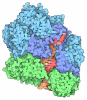

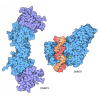
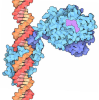

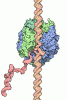
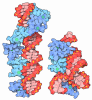



- Assembly
| Deposited unit | 
|
|---|---|
| 1 |
|
-Components
| #1: Protein | Mass: 138137.562 Da / Num. of mol.: 1 Source method: isolated from a genetically manipulated source Source: (gene. exp.) Homo sapiens (human) / Gene: POLE, POLE1 / Production host:  Trichoplusia ni (cabbage looper) Trichoplusia ni (cabbage looper)References: UniProt: Q07864, DNA-directed DNA polymerase, Hydrolases; Acting on ester bonds; Exodeoxyribonucleases producing 5'-phosphomonoesters | ||||||||||
|---|---|---|---|---|---|---|---|---|---|---|---|
| #2: Protein | Mass: 28795.752 Da / Num. of mol.: 3 Source method: isolated from a genetically manipulated source Source: (gene. exp.) Homo sapiens (human) / Gene: PCNA / Production host:   Escherichia coli BL21(DE3) (bacteria) / References: UniProt: P12004 Escherichia coli BL21(DE3) (bacteria) / References: UniProt: P12004#3: DNA chain | | Mass: 7090.585 Da / Num. of mol.: 1 Source method: isolated from a genetically manipulated source Source: (gene. exp.) synthetic construct (others) / Production host: synthetic construct (others) #4: DNA chain | | Mass: 12033.732 Da / Num. of mol.: 1 Source method: isolated from a genetically manipulated source Source: (gene. exp.) synthetic construct (others) / Production host: synthetic construct (others) #5: Chemical | ChemComp-SF4 / | 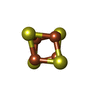 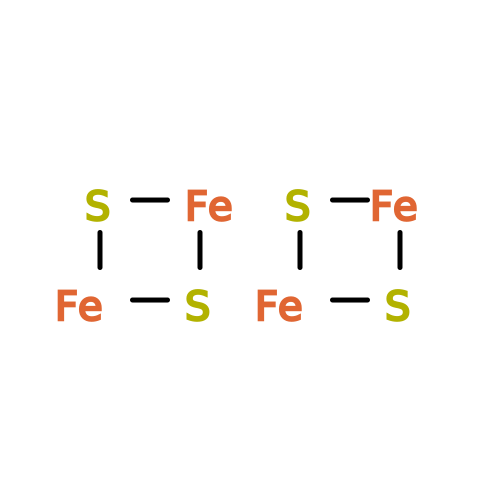 Mass: 351.640 Da / Num. of mol.: 1 / Source method: obtained synthetically / Formula: Fe4S4 Mass: 351.640 Da / Num. of mol.: 1 / Source method: obtained synthetically / Formula: Fe4S4Has ligand of interest | N | Has protein modification | N | |
-Experimental details
-Experiment
| Experiment | Method: ELECTRON MICROSCOPY |
|---|---|
| EM experiment | Aggregation state: PARTICLE / 3D reconstruction method: single particle reconstruction |
- Sample preparation
| Component | Name: Ternary complex of Pol epsilon, PCNA and DNA / Type: COMPLEX / Entity ID: #1-#4 / Source: RECOMBINANT |
|---|---|
| Molecular weight | Experimental value: NO |
| Source (natural) | Organism: Homo sapiens (human) |
| Source (recombinant) | Organism: Trichoplusia ni (cabbage looper) |
| Buffer solution | pH: 7.6 |
| Specimen | Embedding applied: NO / Shadowing applied: NO / Staining applied: NO / Vitrification applied: YES |
| Vitrification | Cryogen name: ETHANE |
- Electron microscopy imaging
| Experimental equipment |  Model: Titan Krios / Image courtesy: FEI Company |
|---|---|
| Microscopy | Model: TFS KRIOS |
| Electron gun | Electron source:  FIELD EMISSION GUN / Accelerating voltage: 300 kV / Illumination mode: FLOOD BEAM FIELD EMISSION GUN / Accelerating voltage: 300 kV / Illumination mode: FLOOD BEAM |
| Electron lens | Mode: BRIGHT FIELD / Nominal defocus max: 3000 nm / Nominal defocus min: 800 nm |
| Image recording | Electron dose: 40.08 e/Å2 / Film or detector model: GATAN K3 BIOQUANTUM (6k x 4k) |
- Processing
| EM software |
| |||||||||
|---|---|---|---|---|---|---|---|---|---|---|
| CTF correction | Type: PHASE FLIPPING AND AMPLITUDE CORRECTION | |||||||||
| 3D reconstruction | Resolution: 3.3 Å / Resolution method: FSC 0.143 CUT-OFF / Num. of particles: 221792 / Symmetry type: POINT | |||||||||
| Refinement | Cross valid method: NONE |
