 Movie
Movie Controller


+ Open data

- Basic information
| Entry | Database: PDB / ID: 9qsy | ||||||||||||||||||||||||
|---|---|---|---|---|---|---|---|---|---|---|---|---|---|---|---|---|---|---|---|---|---|---|---|---|---|
| Title | Cryo-EM structure of aquaporin 3 at pH 5.5 | ||||||||||||||||||||||||
 Components Components | Aquaporin-3 | ||||||||||||||||||||||||
 Keywords Keywords | MEMBRANE PROTEIN / glycerol channel / hydrogen peroxide transport / tetramer | ||||||||||||||||||||||||
| Function / homology |  Function and homology information Function and homology informationpositive regulation of immune system process / glycerol channel activity / Passive transport by Aquaporins / regulation of keratinocyte differentiation / glycerol transmembrane transport / urea transmembrane transporter activity / water channel activity / water transport / response to vitamin D / odontogenesis ...positive regulation of immune system process / glycerol channel activity / Passive transport by Aquaporins / regulation of keratinocyte differentiation / glycerol transmembrane transport / urea transmembrane transporter activity / water channel activity / water transport / response to vitamin D / odontogenesis / Differentiation of Keratinocytes in Interfollicular Epidermis in Mammalian Skin / renal water homeostasis / response to retinoic acid / response to calcium ion / cell-cell junction / Vasopressin regulates renal water homeostasis via Aquaporins / cellular response to hypoxia / basolateral plasma membrane / membrane / identical protein binding / plasma membrane / cytoplasm Similarity search - Function | ||||||||||||||||||||||||
| Biological species |  Homo sapiens (human) Homo sapiens (human) | ||||||||||||||||||||||||
| Method | ELECTRON MICROSCOPY / single particle reconstruction / cryo EM / Resolution: 3.2 Å | ||||||||||||||||||||||||
 Authors Authors | Huang, P. / Venskutonyte, R. / Lindkvist-Petersson, K. | ||||||||||||||||||||||||
| Funding support |  Sweden, 3items Sweden, 3items
| ||||||||||||||||||||||||
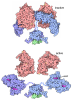
 Citation Citation | Journal: Nat Commun / Year: 2025 Title: Structural insights into AQP3 channel closure upon pH and redox changes reveal an autoregulatory molecular mechanism. Authors: Peng Huang / Raminta Venskutonytė / Carter J Wilson / Sara Bsharat / Rashmi B Prasad / Pontus Gourdon / Isabella Artner / Bert L de Groot / Karin Lindkvist-Petersson /   Abstract: Regulation of intracellular levels of reactive oxygen species (ROS) remains poorly understood. Aquaporin 3 (AQP3) facilitates the membrane transport of hydrogen peroxide (HO), a key ROS signaling ...Regulation of intracellular levels of reactive oxygen species (ROS) remains poorly understood. Aquaporin 3 (AQP3) facilitates the membrane transport of hydrogen peroxide (HO), a key ROS signaling molecule. Here we elucidate the molecular mechanism of AQP3 and show that its regulatory properties are both pH dependent and autoregulated by HO. Using single particle cryo-electron microscopy, we present open and closed conformations of human AQP3. At pH 8.0, the channel adopts an open state, while acidic pH or exposure to HO promotes closure via a large conformational rearrangement of extracellular loop E. These findings reveal a mechanism for autoregulation of HO transport and establish AQP3 as a key modulator of redox homeostasis in human pancreatic β-cells. | ||||||||||||||||||||||||
| History |
|
- Structure visualization
| Structure viewer | Molecule: MolmilJmol/JSmol |
|---|
- Downloads & links
-Download
| PDBx/mmCIF format | 9qsy.cif.gz | 194.1 KB | Display | PDBx/mmCIF format |
|---|---|---|---|---|
| PDB format | pdb9qsy.ent.gz | 153.9 KB | Display | PDB format |
| PDBx/mmJSON format | 9qsy.json.gz | Tree view | PDBx/mmJSON format | |
| Others |  Other downloads Other downloads |
-Validation report
| Arichive directory | https://data.pdbj.org/pub/pdb/validation_reports/qs/9qsyftp://data.pdbj.org/pub/pdb/validation_reports/qs/9qsy | HTTPS FTP |
|---|
-Related structure data
| Related structure data |  53344MC  9qsxC  9qszC M: map data used to model this data C: citing same article ( |
|---|---|
| Similar structure data |


-Links
 PDBj
PDBj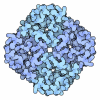
- Assembly
| Deposited unit | 
|
|---|---|
| 1 |
|
-Components
| #1: Protein | Mass: 32396.549 Da / Num. of mol.: 4 Source method: isolated from a genetically manipulated source Source: (gene. exp.) Homo sapiens (human) / Gene: AQP3 / Production host:  Komagataella pastoris (fungus) / References: UniProt: Q92482 Komagataella pastoris (fungus) / References: UniProt: Q92482#2: Water | ChemComp-HOH / |  Mass: 18.015 Da / Num. of mol.: 4 / Source method: isolated from a natural source / Formula: H2O Mass: 18.015 Da / Num. of mol.: 4 / Source method: isolated from a natural source / Formula: H2OHas protein modification | N | |
|---|
-Experimental details
-Experiment
| Experiment | Method: ELECTRON MICROSCOPY |
|---|---|
| EM experiment | Aggregation state: PARTICLE / 3D reconstruction method: single particle reconstruction |
- Sample preparation
| Component | Name: Aquaporin 3 / Type: ORGANELLE OR CELLULAR COMPONENT / Entity ID: #1 / Source: RECOMBINANT |
|---|---|
| Molecular weight | Experimental value: NO |
| Source (natural) | Organism: Homo sapiens (human) |
| Source (recombinant) | Organism: Komagataella pastoris (fungus) |
| Buffer solution | pH: 5.5 Details: 20mM Tris-HCL (pH 8), 100mM Nacl with adjusted pH by MES buffer (pH 5.5) |
| Specimen | Conc.: 7.1 mg/ml / Embedding applied: NO / Shadowing applied: NO / Staining applied: NO / Vitrification applied: YES |
| Vitrification | Instrument: FEI VITROBOT MARK IV / Cryogen name: ETHANE / Humidity: 100 % / Chamber temperature: 277.15 K |
- Electron microscopy imaging
| Experimental equipment |  Model: Titan Krios / Image courtesy: FEI Company |
|---|---|
| Microscopy | Model: TFS KRIOS |
| Electron gun | Electron source:  FIELD EMISSION GUN / Accelerating voltage: 300 kV / Illumination mode: FLOOD BEAM FIELD EMISSION GUN / Accelerating voltage: 300 kV / Illumination mode: FLOOD BEAM |
| Electron lens | Mode: BRIGHT FIELD / Nominal magnification: 105000 X / Nominal defocus max: 2000 nm / Nominal defocus min: 800 nm |
| Image recording | Average exposure time: 1.8 sec. / Electron dose: 52.825 e/Å2 / Film or detector model: GATAN K3 (6k x 4k) / Num. of real images: 11820 |
- Processing
| EM software |
| ||||||||||||||||||||||||
|---|---|---|---|---|---|---|---|---|---|---|---|---|---|---|---|---|---|---|---|---|---|---|---|---|---|
| CTF correction | Type: PHASE FLIPPING AND AMPLITUDE CORRECTION | ||||||||||||||||||||||||
| Symmetry | Point symmetry: C4 (4 fold cyclic) | ||||||||||||||||||||||||
| 3D reconstruction | Resolution: 3.2 Å / Resolution method: FSC 0.143 CUT-OFF / Num. of particles: 311941 / Symmetry type: POINT | ||||||||||||||||||||||||
| Refinement | Highest resolution: 3.2 Å Stereochemistry target values: REAL-SPACE (WEIGHTED MAP SUM AT ATOM CENTERS) | ||||||||||||||||||||||||
| Refine LS restraints |
|
