 Movie
Movie Controller

[English] 日本語
 Yorodumi
- PDB-9qfe: Cryo-EM structure of the actin filament hetero-decorated by Coron... -
+ Open data

- Basic information
| Entry | Database: PDB / ID: 9qfe | |||||||||||||||
|---|---|---|---|---|---|---|---|---|---|---|---|---|---|---|---|---|
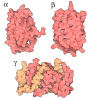
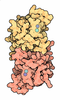
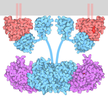
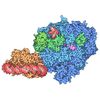
| Title | Cryo-EM structure of the actin filament hetero-decorated by Coronin-1 and Cofilin-1 on separate actin strands | |||||||||||||||
 Components Components |
| |||||||||||||||
 Keywords Keywords | STRUCTURAL PROTEIN / actin / coronin / cofilin / filament / cytoskeleton | |||||||||||||||
| Function / homology |  Function and homology information Function and homology informationactin filament branching / cellular response to ether / cofilin-actin rod / positive regulation of protein localization to cell leading edge / positive regulation of establishment of cell polarity regulating cell shape / negative regulation of unidimensional cell growth / positive regulation of barbed-end actin filament capping / protein localization to cell leading edge / MGMT-mediated DNA damage reversal / negative regulation of lamellipodium assembly ...actin filament branching / cellular response to ether / cofilin-actin rod / positive regulation of protein localization to cell leading edge / positive regulation of establishment of cell polarity regulating cell shape / negative regulation of unidimensional cell growth / positive regulation of barbed-end actin filament capping / protein localization to cell leading edge / MGMT-mediated DNA damage reversal / negative regulation of lamellipodium assembly / negative regulation of postsynaptic density organization / actin filament fragmentation / Arp2/3 complex binding / methylated-DNA-[protein]-cysteine S-methyltransferase / methylated-DNA-[protein]-cysteine S-methyltransferase activity / negative regulation of smooth muscle cell chemotaxis / positive regulation of actin filament depolymerization / negative regulation of actin filament bundle assembly / modification of postsynaptic actin cytoskeleton / regulation of Arp2/3 complex-mediated actin nucleation / positive regulation of embryonic development / positive regulation of norepinephrine uptake / negative regulation of Arp2/3 complex-mediated actin nucleation / endothelial cell chemotaxis / DNA-methyltransferase activity / negative regulation of actin filament depolymerization / positive regulation of cell motility / cellular response to cytochalasin B / Formation of the embryonic stem cell BAF (esBAF) complex / actin filament severing / host-mediated activation of viral process / regulation of transepithelial transport / Formation of the canonical BAF (cBAF) complex / negative regulation of cell adhesion / ruffle organization / positive regulation of synaptic plasticity / morphogenesis of a polarized epithelium / Formation of annular gap junctions / Formation of the dystrophin-glycoprotein complex (DGC) / Formation of the polybromo-BAF (pBAF) complex / structural constituent of postsynaptic actin cytoskeleton / Gap junction degradation / GBP-mediated host defense / Formation of neuronal progenitor and neuronal BAF (npBAF and nBAF) / protein localization to adherens junction / Formation of the non-canonical BAF (ncBAF) complex / Cell-extracellular matrix interactions / establishment of spindle localization / regulation of G0 to G1 transition / regulation of dendritic spine morphogenesis / dense body / negative regulation of cell motility / Tat protein binding / actin filament depolymerization / Folding of actin by CCT/TriC / RHO GTPases Activate ROCKs / cellular response to interleukin-6 / postsynaptic actin cytoskeleton / Regulation of CDH1 Function / positive regulation of lamellipodium morphogenesis / apical protein localization / Adherens junctions interactions / microtubule nucleation / Prefoldin mediated transfer of substrate to CCT/TriC / RHOF GTPase cycle / adherens junction assembly / regulation of double-strand break repair / negative regulation of dendritic spine maintenance / Sensory processing of sound by outer hair cells of the cochlea / tight junction / Sensory processing of sound by inner hair cells of the cochlea / regulation of mitotic metaphase/anaphase transition / cellular response to insulin-like growth factor stimulus / positive regulation of T cell differentiation / maintenance of blood-brain barrier / Interaction between L1 and Ankyrins / cortical actin cytoskeleton / positive regulation of dendritic spine development / apical junction complex / phosphatidylinositol bisphosphate binding / regulation of nucleotide-excision repair / positive regulation of stem cell population maintenance / NuA4 histone acetyltransferase complex / regulation of norepinephrine uptake / positive regulation of proteolysis / transporter regulator activity / cell leading edge / Recycling pathway of L1 / cortical cytoskeleton / positive regulation of double-strand break repair / Regulation of MITF-M-dependent genes involved in pigmentation / lamellipodium membrane / negative regulation of cell differentiation / establishment or maintenance of cell polarity / mitotic cytokinesis / nitric-oxide synthase binding / cellular response to interleukin-1 / Sema3A PAK dependent Axon repulsion / brush border / actin filament bundle assembly Similarity search - Function | |||||||||||||||
| Biological species |  Homo sapiens (human) Homo sapiens (human) | |||||||||||||||
| Method | ELECTRON MICROSCOPY / single particle reconstruction / cryo EM / Resolution: 3.12 Å | |||||||||||||||
 Authors Authors | Oosterheert, W. / Boiero Sanders, M. / Hofnagel, O. / Bieling, P. / Raunser, S. | |||||||||||||||
| Funding support |  Germany, European Union, 4items Germany, European Union, 4items
| |||||||||||||||
 Citation Citation | Journal: Cell / Year: 2025 Title: Choreography of rapid actin filament disassembly by coronin, cofilin, and AIP1. Authors: Wout Oosterheert / Micaela Boiero Sanders / Oliver Hofnagel / Peter Bieling / Stefan Raunser / Abstract: Rapid remodeling of actin filament (F-actin) networks is essential for the movement and morphogenesis of eukaryotic cells. The conserved actin-binding proteins coronin, cofilin, and actin-interacting ...Rapid remodeling of actin filament (F-actin) networks is essential for the movement and morphogenesis of eukaryotic cells. The conserved actin-binding proteins coronin, cofilin, and actin-interacting protein 1 (AIP1) act in synergy to promote rapid F-actin network disassembly, but the underlying mechanisms have remained elusive. Here, using cryo-electron microscopy (cryo-EM), we uncover the concerted molecular actions of coronin, cofilin, and AIP1 that lead to actin filament aging and severing. We find that the cooperative binding of coronin allosterically promotes inorganic phosphate release from F-actin and induces filament undertwisting, thereby priming the filament for cofilin binding. Cofilin then displaces coronin from the filament via a strand-restricted cooperative binding mechanism. The resulting cofilactin serves as a high-affinity platform for AIP1, which induces severing by acting as a clamp that disrupts inter-subunit filament contacts. In this "molecular squeezing" mechanism, AIP1 and not cofilin is responsible for filament severing. Our work redefines the role of key disassembly factors in actin dynamics. | |||||||||||||||
| History |
|
- Structure visualization
| Structure viewer | Molecule: MolmilJmol/JSmol |
|---|
- Downloads & links
-Download
| PDBx/mmCIF format | 9qfe.cif.gz | 1 MB | Display | PDBx/mmCIF format |
|---|---|---|---|---|
| PDB format | pdb9qfe.ent.gz | 692.5 KB | Display | PDB format |
| PDBx/mmJSON format | 9qfe.json.gz | Tree view | PDBx/mmJSON format | |
| Others |  Other downloads Other downloads |
-Validation report
| Arichive directory | https://data.pdbj.org/pub/pdb/validation_reports/qf/9qfeftp://data.pdbj.org/pub/pdb/validation_reports/qf/9qfe | HTTPS FTP |
|---|
-Related structure data
| Related structure data |  53107MC  9qewC  9qeyC  9qf2C  9qfbC  9qfdC  9qfgC  9qfjC  9qfkC  9qfoC  9qfqC  9qfwC C: citing same article ( M: map data used to model this data |
|---|---|
| Similar structure data |


-Links
 PDBj
PDBj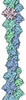
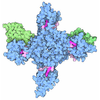

- Assembly
| Deposited unit | 
|
|---|---|
| 1 |
|
-Components
| #1: Protein | Mass: 41632.422 Da / Num. of mol.: 7 / Mutation: C272A Source method: isolated from a genetically manipulated source Source: (gene. exp.) Homo sapiens (human) / Gene: ACTB / Cell line (production host): BTI-Tnao38 / Production host:  Trichoplusia ni (cabbage looper) / References: UniProt: P60709 Trichoplusia ni (cabbage looper) / References: UniProt: P60709#2: Protein | Mass: 18532.531 Da / Num. of mol.: 4 Source method: isolated from a genetically manipulated source Source: (gene. exp.) Homo sapiens (human) / Gene: CFL1, CFL / Production host:   Escherichia coli BL21(DE3) (bacteria) / References: UniProt: P23528 Escherichia coli BL21(DE3) (bacteria) / References: UniProt: P23528#3: Protein | Mass: 74788.086 Da / Num. of mol.: 3 Source method: isolated from a genetically manipulated source Source: (gene. exp.) Homo sapiens (human) / Gene: CORO1B, MGMT / Cell line (production host): BTI-Tnao38 / Production host: Trichoplusia ni (cabbage looper)References: UniProt: Q9BR76, UniProt: P16455, methylated-DNA-[protein]-cysteine S-methyltransferase #4: Chemical | ChemComp-ADP / 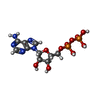 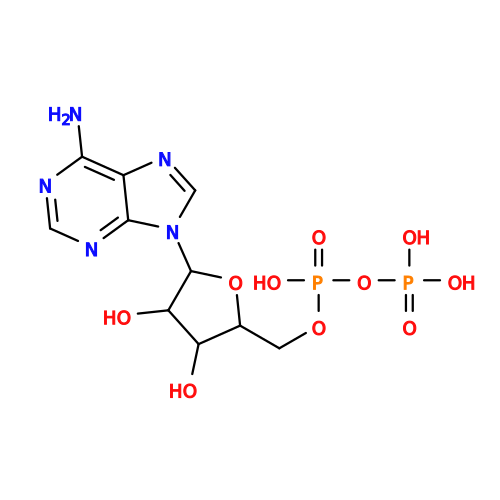 Mass: 427.201 Da / Num. of mol.: 7 / Source method: obtained synthetically / Formula: C10H15N5O10P2 / Feature type: SUBJECT OF INVESTIGATION / Comment: ADP, energy-carrying molecule*YM Mass: 427.201 Da / Num. of mol.: 7 / Source method: obtained synthetically / Formula: C10H15N5O10P2 / Feature type: SUBJECT OF INVESTIGATION / Comment: ADP, energy-carrying molecule*YM#5: Chemical | ChemComp-MG /   Mass: 24.305 Da / Num. of mol.: 7 / Source method: obtained synthetically / Formula: Mg / Feature type: SUBJECT OF INVESTIGATION Mass: 24.305 Da / Num. of mol.: 7 / Source method: obtained synthetically / Formula: Mg / Feature type: SUBJECT OF INVESTIGATIONHas ligand of interest | Y | Has protein modification | Y | |
|---|
-Experimental details
-Experiment
| Experiment | Method: ELECTRON MICROSCOPY |
|---|---|
| EM experiment | Aggregation state: FILAMENT / 3D reconstruction method: single particle reconstruction |
- Sample preparation
| Component |
| |||||||||||||||||||||||||||||||||||
|---|---|---|---|---|---|---|---|---|---|---|---|---|---|---|---|---|---|---|---|---|---|---|---|---|---|---|---|---|---|---|---|---|---|---|---|---|
| Molecular weight |
| |||||||||||||||||||||||||||||||||||
| Source (natural) |
| |||||||||||||||||||||||||||||||||||
| Source (recombinant) |
| |||||||||||||||||||||||||||||||||||
| Buffer solution | pH: 7.1 Details: 1xKMEH (10 mM HEPES pH 7.1, 100 mM KCl, 2 mM MgCl2, 1 mM EGTA, 0.5 mM TCEP, 0.02% Tween20). | |||||||||||||||||||||||||||||||||||
| Buffer component |
| |||||||||||||||||||||||||||||||||||
| Specimen | Embedding applied: NO / Shadowing applied: NO / Staining applied: NO / Vitrification applied: YES | |||||||||||||||||||||||||||||||||||
| Specimen support | Grid material: COPPER / Grid mesh size: 200 divisions/in. / Grid type: Quantifoil R2/1 | |||||||||||||||||||||||||||||||||||
| Vitrification | Instrument: FEI VITROBOT MARK IV / Cryogen name: ETHANE-PROPANE / Humidity: 100 % / Chamber temperature: 286 K |
- Electron microscopy imaging
| Experimental equipment |  Model: Titan Krios / Image courtesy: FEI Company |
|---|---|
| Microscopy | Model: TFS KRIOS |
| Electron gun | Electron source:  FIELD EMISSION GUN / Accelerating voltage: 300 kV / Illumination mode: FLOOD BEAM FIELD EMISSION GUN / Accelerating voltage: 300 kV / Illumination mode: FLOOD BEAM |
| Electron lens | Mode: BRIGHT FIELD / Nominal magnification: 105000 X / Nominal defocus max: 2700 nm / Nominal defocus min: 1200 nm / Cs: 0.01 mm / C2 aperture diameter: 50 µm |
| Specimen holder | Cryogen: NITROGEN / Specimen holder model: FEI TITAN KRIOS AUTOGRID HOLDER |
| Image recording | Electron dose: 65.8 e/Å2 / Film or detector model: GATAN K3 BIOQUANTUM (6k x 4k) / Num. of grids imaged: 1 / Num. of real images: 14055 |
| EM imaging optics | Energyfilter name: GIF Bioquantum / Energyfilter slit width: 15 eV Spherical aberration corrector: The used Titan Krios G2 microscope contains an in-column Cs corrector. |
- Processing
| EM software |
| |||||||||||||||||||||||||||||||||||||||||||||||||||||||
|---|---|---|---|---|---|---|---|---|---|---|---|---|---|---|---|---|---|---|---|---|---|---|---|---|---|---|---|---|---|---|---|---|---|---|---|---|---|---|---|---|---|---|---|---|---|---|---|---|---|---|---|---|---|---|---|---|
| CTF correction | Details: Patch CTF / Type: PHASE FLIPPING AND AMPLITUDE CORRECTION | |||||||||||||||||||||||||||||||||||||||||||||||||||||||
| Particle selection | Num. of particles selected: 10071093 | |||||||||||||||||||||||||||||||||||||||||||||||||||||||
| Symmetry | Point symmetry: C1 (asymmetric) | |||||||||||||||||||||||||||||||||||||||||||||||||||||||
| 3D reconstruction | Resolution: 3.12 Å / Resolution method: FSC 0.143 CUT-OFF / Num. of particles: 40453 / Symmetry type: POINT | |||||||||||||||||||||||||||||||||||||||||||||||||||||||
| Atomic model building | Protocol: FLEXIBLE FIT / Space: REAL / Details: Phenix real space refinement. | |||||||||||||||||||||||||||||||||||||||||||||||||||||||
| Atomic model building | PDB-ID: 9QF2 Accession code: 9QF2 / Source name: PDB / Type: experimental model | |||||||||||||||||||||||||||||||||||||||||||||||||||||||
| Refinement | Cross valid method: NONE Stereochemistry target values: GeoStd + Monomer Library + CDL v1.2 | |||||||||||||||||||||||||||||||||||||||||||||||||||||||
| Displacement parameters | Biso mean: 73.31 Å2 | |||||||||||||||||||||||||||||||||||||||||||||||||||||||
| Refine LS restraints |
|
