 Movie
Movie Controller

[English] 日本語
 Yorodumi
- PDB-9p9m: CA-SP1 immature lattice assembled in vitro with inhibitor lenacap... -
+ Open data

- Basic information
| Entry | Database: PDB / ID: 9p9m | ||||||||||||||||||||||||||||||
|---|---|---|---|---|---|---|---|---|---|---|---|---|---|---|---|---|---|---|---|---|---|---|---|---|---|---|---|---|---|---|---|
| Title | CA-SP1 immature lattice assembled in vitro with inhibitor lenacapavir (dialyzed to 50nM) | ||||||||||||||||||||||||||||||
 Components Components | Gag polyprotein | ||||||||||||||||||||||||||||||
 Keywords Keywords | VIRUS LIKE PARTICLE / HIV-1 / CA-SP1 / Inhibitor / virion assembly | ||||||||||||||||||||||||||||||
| Function / homology |  Function and homology information Function and homology informationviral budding via host ESCRT complex / host multivesicular body / ISG15 antiviral mechanism / viral nucleocapsid / viral translational frameshifting / host cell nucleus / host cell plasma membrane / virion membrane / structural molecule activity / RNA binding / zinc ion binding Similarity search - Function | ||||||||||||||||||||||||||||||
| Biological species |  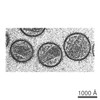 Human immunodeficiency virus type 1 Human immunodeficiency virus type 1 | ||||||||||||||||||||||||||||||
| Method | ELECTRON MICROSCOPY / single particle reconstruction / cryo EM / Resolution: 2.93 Å | ||||||||||||||||||||||||||||||
 Authors Authors | Wu, C. / Meuser, M.E. / Xiong, Y. | ||||||||||||||||||||||||||||||
| Funding support |  United States, 2items United States, 2items
| ||||||||||||||||||||||||||||||
 Citation Citation | Journal: J Am Chem Soc / Year: 2025 Title: Distinct Target Site of Lenacapavir in Immature HIV-1 and Concurrent Binding with the Maturation Inhibitor Bevirimat. Authors: Chunxiang Wu / Megan E Meuser / Juan S Rey / Hamed Meshkin / Rachel Yang / Swapnil C Devarkar / Christian Freniere / Jiong Shi / Christopher Aiken / Juan R Perilla / Yong Xiong / Abstract: HIV-1 inhibitors, such as bevirimat (BVM) and lenacapavir (LEN), significantly reduce the production and maturation of infectious virions. However, their mechanisms remain unclear due to the absence ...HIV-1 inhibitors, such as bevirimat (BVM) and lenacapavir (LEN), significantly reduce the production and maturation of infectious virions. However, their mechanisms remain unclear due to the absence of high-resolution structures for BVM in complex with the immature Gag lattice and LEN's structural data being limited to the mature capsid. Utilizing perforated virus-like particles (VLPs) produced from mammalian cells, we determined in situ cryo-electron microscopy (cryo-EM) structures of HIV-1 with inhibitors. This allowed for the first structural determination of the native immature HIV-1 particle with BVM and LEN bound inside the VLPs at high resolutions. Our findings demonstrate that LEN not only binds the mature capsid but also targets the immature lattice in a distinct manner. The binding of LEN induces a conformational change in the capsid protein (CA) region and alters the architecture of the Gag lattice, which may affect the maturation process. In addition, a more accurate model of BVM engaging the Gag lattice is revealed, one that is independent of LEN binding. These insights expand our understanding of the inhibitory mechanisms of LEN and BVM on HIV-1 and provide valuable clues for the design of future inhibitors. | ||||||||||||||||||||||||||||||
| History |
|
- Structure visualization
| Structure viewer | Molecule: MolmilJmol/JSmol |
|---|
- Downloads & links
-Download
| PDBx/mmCIF format | 9p9m.cif.gz | 1.5 MB | Display | PDBx/mmCIF format |
|---|---|---|---|---|
| PDB format | pdb9p9m.ent.gz | 1.3 MB | Display | PDB format |
| PDBx/mmJSON format | 9p9m.json.gz | Tree view | PDBx/mmJSON format | |
| Others |  Other downloads Other downloads |
-Validation report
| Arichive directory | https://data.pdbj.org/pub/pdb/validation_reports/p9/9p9mftp://data.pdbj.org/pub/pdb/validation_reports/p9/9p9m | HTTPS FTP |
|---|
-Related structure data
| Related structure data |  71418MC 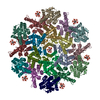 9cwvC 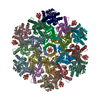 9d6cC 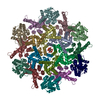 9d6eC 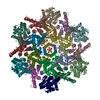 9d88C 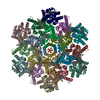 9dwdC  9e39C  9p9lC M: map data used to model this data C: citing same article ( |
|---|---|
| Similar structure data |


-Links
 PDBj
PDBj
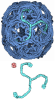
- Assembly
| Deposited unit | 
|
|---|---|
| 1 |
|
-Components
| #1: Protein | Mass: 25339.037 Da / Num. of mol.: 18 Fragment: Capsid (CA) domain and Spacer Peptide 1 (SP1) region Source method: isolated from a genetically manipulated source Details: recombinant CA-SP1 domain immature lattice in vitro assembled Source: (gene. exp.) Human immunodeficiency virus type 1 (NEW YORK-5 ISOLATE)Strain: Clone pNL4-3 / Gene: gag / Production host:   Escherichia coli BL21(DE3) (bacteria) / References: UniProt: P12493 Escherichia coli BL21(DE3) (bacteria) / References: UniProt: P12493#2: Chemical | ChemComp-QNG /  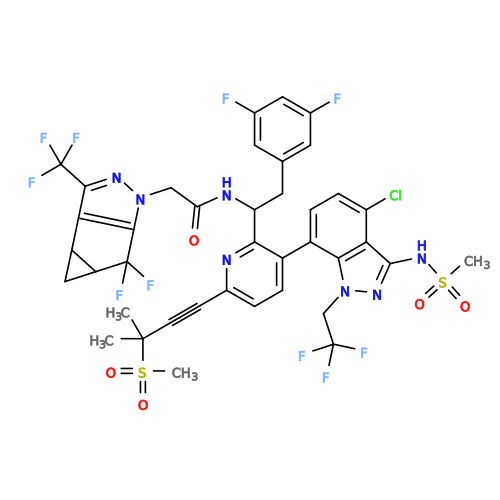 Mass: 968.282 Da / Num. of mol.: 18 / Source method: obtained synthetically / Formula: C39H32ClF10N7O5S2 / Feature type: SUBJECT OF INVESTIGATION / Comment: medication, antiretroviral*YM Mass: 968.282 Da / Num. of mol.: 18 / Source method: obtained synthetically / Formula: C39H32ClF10N7O5S2 / Feature type: SUBJECT OF INVESTIGATION / Comment: medication, antiretroviral*YM#3: Chemical | ChemComp-IHP / |  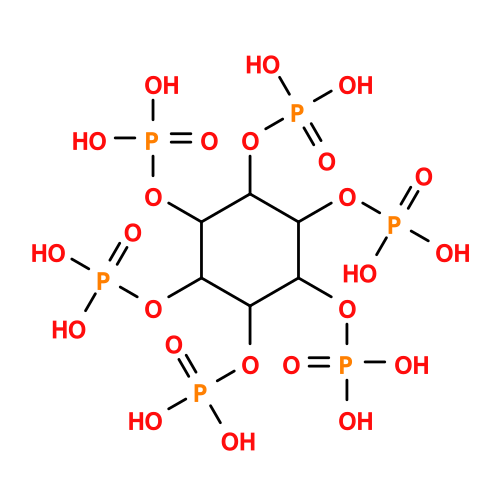 Mass: 660.035 Da / Num. of mol.: 1 / Source method: obtained synthetically / Formula: C6H18O24P6 / Feature type: SUBJECT OF INVESTIGATION Mass: 660.035 Da / Num. of mol.: 1 / Source method: obtained synthetically / Formula: C6H18O24P6 / Feature type: SUBJECT OF INVESTIGATIONHas ligand of interest | Y | Has protein modification | Y | |
|---|
-Experimental details
-Experiment
| Experiment | Method: ELECTRON MICROSCOPY |
|---|---|
| EM experiment | Aggregation state: PARTICLE / 3D reconstruction method: single particle reconstruction |
- Sample preparation
| Component | Name: Human immunodeficiency virus type 1 (NEW YORK-5 ISOLATE) Type: VIRUS / Details: recombinantly expressed in E coli / Entity ID: #1 / Source: RECOMBINANT | ||||||||||||||||||||
|---|---|---|---|---|---|---|---|---|---|---|---|---|---|---|---|---|---|---|---|---|---|
| Source (natural) | Organism: Human immunodeficiency virus type 1 (NEW YORK-5 ISOLATE) Strain: NL4-3 | ||||||||||||||||||||
| Source (recombinant) | Organism: Escherichia coli (E. coli) / Strain: BL21(DE3) | ||||||||||||||||||||
| Details of virus | Empty: YES / Enveloped: NO / Isolate: OTHER / Type: VIRUS-LIKE PARTICLE | ||||||||||||||||||||
| Natural host | Organism: Homo sapiens | ||||||||||||||||||||
| Buffer solution | pH: 7.4 Details: the initial Lenacapavir concentration is 180uM and CA-SP1 is 90uM upon particle assembly; the assembled particle is then dialyzed in same buffer, but have final Lenacapavir concentration drop to 50nM. | ||||||||||||||||||||
| Buffer component |
| ||||||||||||||||||||
| Specimen | Conc.: 2 mg/ml / Embedding applied: NO / Shadowing applied: NO / Staining applied: NO / Vitrification applied: YES Details: recombinantly expressed and purified CA-SP1 from E coli. In vitro assembled with excess of Lenacapavir:CA-SP1 ratio (90uM of CA-SP1), and then dialyzed to final Lenacapavir concentration of 50nM. | ||||||||||||||||||||
| Specimen support | Details: 15mA / Grid material: COPPER / Grid mesh size: 300 divisions/in. / Grid type: Quantifoil R2/1 | ||||||||||||||||||||
| Vitrification | Instrument: FEI VITROBOT MARK IV / Cryogen name: ETHANE / Humidity: 100 % / Chamber temperature: 283 K |
- Electron microscopy imaging
| Microscopy | Model: TFS GLACIOS |
|---|---|
| Electron gun | Electron source:  FIELD EMISSION GUN / Accelerating voltage: 200 kV / Illumination mode: FLOOD BEAM FIELD EMISSION GUN / Accelerating voltage: 200 kV / Illumination mode: FLOOD BEAM |
| Electron lens | Mode: BRIGHT FIELD / Nominal defocus max: 2400 nm / Nominal defocus min: 1400 nm |
| Image recording | Electron dose: 50 e/Å2 / Film or detector model: GATAN K3 (6k x 4k) |
- Processing
| EM software |
| ||||||||||||||||||||||||||||||||||||||||||||||||||||||||||||
|---|---|---|---|---|---|---|---|---|---|---|---|---|---|---|---|---|---|---|---|---|---|---|---|---|---|---|---|---|---|---|---|---|---|---|---|---|---|---|---|---|---|---|---|---|---|---|---|---|---|---|---|---|---|---|---|---|---|---|---|---|---|
| CTF correction | Type: PHASE FLIPPING AND AMPLITUDE CORRECTION | ||||||||||||||||||||||||||||||||||||||||||||||||||||||||||||
| Particle selection | Num. of particles selected: 3929347 | ||||||||||||||||||||||||||||||||||||||||||||||||||||||||||||
| Symmetry | Point symmetry: C6 (6 fold cyclic) | ||||||||||||||||||||||||||||||||||||||||||||||||||||||||||||
| 3D reconstruction | Resolution: 2.93 Å / Resolution method: FSC 0.143 CUT-OFF / Num. of particles: 835109 / Symmetry type: POINT | ||||||||||||||||||||||||||||||||||||||||||||||||||||||||||||
| Atomic model building | Protocol: RIGID BODY FIT | ||||||||||||||||||||||||||||||||||||||||||||||||||||||||||||
| Atomic model building | PDB-ID: 9D6C Accession code: 9D6C / Source name: PDB / Type: experimental model | ||||||||||||||||||||||||||||||||||||||||||||||||||||||||||||
| Refinement | Highest resolution: 2.93 Å Stereochemistry target values: REAL-SPACE (WEIGHTED MAP SUM AT ATOM CENTERS) | ||||||||||||||||||||||||||||||||||||||||||||||||||||||||||||
| Refine LS restraints |
|
