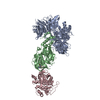
Movie
Movie Controller

[English] 日本語
 Yorodumi
- PDB-9oty: DDB1-CRBN with CK1 alpha, SB-405483, and DEG-47: composite map an... -
+ Open data

- Basic information
| Entry | Database: PDB / ID: 9oty | ||||||||||||||||||
|---|---|---|---|---|---|---|---|---|---|---|---|---|---|---|---|---|---|---|---|
| Title | DDB1-CRBN with CK1 alpha, SB-405483, and DEG-47: composite map and model submission | ||||||||||||||||||
 Components Components |
| ||||||||||||||||||
 Keywords Keywords | LIGASE / E3 ligases / Cullin RING Ligase / CRL4 / Cereblon / CRBN / molecular glues / IMiDs | ||||||||||||||||||
| Function / homology |  Function and homology information Function and homology informationintermediate filament cytoskeleton organization / negative regulation of NLRP3 inflammasome complex assembly / Activation of SMO / negative regulation of monoatomic ion transmembrane transport / cellular response to nutrient / beta-catenin destruction complex / APC truncation mutants have impaired AXIN binding / AXIN missense mutants destabilize the destruction complex / Truncations of AMER1 destabilize the destruction complex / Beta-catenin phosphorylation cascade ...intermediate filament cytoskeleton organization / negative regulation of NLRP3 inflammasome complex assembly / Activation of SMO / negative regulation of monoatomic ion transmembrane transport / cellular response to nutrient / beta-catenin destruction complex / APC truncation mutants have impaired AXIN binding / AXIN missense mutants destabilize the destruction complex / Truncations of AMER1 destabilize the destruction complex / Beta-catenin phosphorylation cascade / Signaling by GSK3beta mutants / CTNNB1 S33 mutants aren't phosphorylated / CTNNB1 S37 mutants aren't phosphorylated / CTNNB1 S45 mutants aren't phosphorylated / CTNNB1 T41 mutants aren't phosphorylated / positive regulation by virus of viral protein levels in host cell / Disassembly of the destruction complex and recruitment of AXIN to the membrane / spindle assembly involved in female meiosis / epigenetic programming in the zygotic pronuclei / UV-damage excision repair / Maturation of nucleoprotein / biological process involved in interaction with symbiont / regulation of mitotic cytokinesis / regulation of mitotic cell cycle phase transition / regulation of miRNA-mediated gene silencing / regulation of natural killer cell activation / WD40-repeat domain binding / positive regulation of Rho protein signal transduction / Golgi organization / regulation of cell cycle phase transition / locomotory exploration behavior / Cul4A-RING E3 ubiquitin ligase complex / Cul4-RING E3 ubiquitin ligase complex / regulation of stem cell population maintenance / Cul4B-RING E3 ubiquitin ligase complex / ubiquitin ligase complex scaffold activity / negative regulation of adipose tissue development / regulation of cellular response to stress / limb development / viral release from host cell / cullin family protein binding / positive regulation of Wnt signaling pathway / negative regulation of protein-containing complex assembly / regulation of DNA-templated DNA replication initiation / positive regulation of viral genome replication / positive regulation of gluconeogenesis / positive regulation of TORC1 signaling / regulation of embryonic development / replication fork processing / proteasomal protein catabolic process / negative regulation of canonical Wnt signaling pathway / Wnt signaling pathway / epigenetic regulation of gene expression / positive regulation of protein-containing complex assembly / nucleotide-excision repair / Recognition of DNA damage by PCNA-containing replication complex / regulation of autophagy / Degradation of GLI2 by the proteasome / GLI3 is processed to GLI3R by the proteasome / regulation of circadian rhythm / Degradation of beta-catenin by the destruction complex / DNA Damage Recognition in GG-NER / cell population proliferation / spindle / Dual Incision in GG-NER / Transcription-Coupled Nucleotide Excision Repair (TC-NER) / Formation of TC-NER Pre-Incision Complex / kinetochore / Formation of Incision Complex in GG-NER / Ubiquitin-Mediated Degradation of Phosphorylated Cdc25A / positive regulation of protein catabolic process / cellular response to UV / Dual incision in TC-NER / Gap-filling DNA repair synthesis and ligation in TC-NER / cilium / positive regulation of proteasomal ubiquitin-dependent protein catabolic process / regulation of cell population proliferation / rhythmic process / site of double-strand break / Neddylation / ciliary basal body / spermatogenesis / ubiquitin-dependent protein catabolic process / Potential therapeutics for SARS / damaged DNA binding / proteasome-mediated ubiquitin-dependent protein catabolic process / regulation of apoptotic process / transmembrane transporter binding / protein kinase activity / protein-macromolecule adaptor activity / protein phosphorylation / chromosome, telomeric region / non-specific serine/threonine protein kinase / cell surface receptor signaling pathway / nuclear speck / protein ubiquitination / viral protein processing / protein serine kinase activity / cell division / DNA repair Similarity search - Function | ||||||||||||||||||
| Biological species |  Homo sapiens (human) Homo sapiens (human) | ||||||||||||||||||
| Method | ELECTRON MICROSCOPY / single particle reconstruction / cryo EM / Resolution: 3 Å | ||||||||||||||||||
 Authors Authors | Rizvi, Z. / Lander, G.C. | ||||||||||||||||||
| Funding support |  United States, 1items United States, 1items
| ||||||||||||||||||
 Citation Citation | Journal: Nature / Year: 2026 Title: Identification of an allosteric site on the E3 ligase adapter cereblon. Authors: Vanessa N Dippon / Zeba Rizvi / Anthony E Choudhry / Chun-Wa Chung / Ibrahim F Alkuraya / Wenqing Xu / Xavier B Tao / Anthony J Jurewicz / Jessica L Schneck / Wenqian Chen / Nicole M Curnutt ...Authors: Vanessa N Dippon / Zeba Rizvi / Anthony E Choudhry / Chun-Wa Chung / Ibrahim F Alkuraya / Wenqing Xu / Xavier B Tao / Anthony J Jurewicz / Jessica L Schneck / Wenqian Chen / Nicole M Curnutt / Farah Kabir / Kwok-Ho Chan / Markus A Queisser / Caterina Musetti / Han Dai / Gabriel C Lander / Andrew B Benowitz / Christina M Woo /  Abstract: Cereblon (CRBN) is the target of thalidomide derivatives that achieve therapeutic efficacy against some haematologic neoplasias by recruiting neosubstrates for degradation. Despite the intense ...Cereblon (CRBN) is the target of thalidomide derivatives that achieve therapeutic efficacy against some haematologic neoplasias by recruiting neosubstrates for degradation. Despite the intense investigation of orthosteric thalidomide derivatives, little is known about alternate binding sites on CRBN. Here we report an evolutionarily conserved cryptic allosteric binding site on CRBN. Small-molecule SB-405483 binds the allosteric site to cooperatively enhance the binding of orthosteric ligands and alter their neosubstrate degradation profiles. A survey of over 100 orthosteric ligands and their degradation targets reveals trends in the classes of compounds and neosubstrates in which degradation outcomes are enhanced or inhibited by SB-405483. Structural investigations provide a mechanistic basis for the effects of the allosteric ligand by shifting the conformational distribution of CRBN to a novel CRBN and increasing the CRBN state. The discovery of a cryptic allosteric binding site on CRBN that alters the functional effects of orthosteric ligands opens new directions with broad implications for improving the selectivity and efficacy of CRBN therapeutics. | ||||||||||||||||||
| History |
|
- Structure visualization
| Structure viewer | Molecule: MolmilJmol/JSmol |
|---|
- Downloads & links
-Download
| PDBx/mmCIF format | 9oty.cif.gz | 300.5 KB | Display | PDBx/mmCIF format |
|---|---|---|---|---|
| PDB format | pdb9oty.ent.gz | Display | PDB format | |
| PDBx/mmJSON format | 9oty.json.gz | Tree view | PDBx/mmJSON format | |
| Others |  Other downloads Other downloads |
-Validation report
| Arichive directory | https://data.pdbj.org/pub/pdb/validation_reports/ot/9otyftp://data.pdbj.org/pub/pdb/validation_reports/ot/9oty | HTTPS FTP |
|---|
-Related structure data
| Related structure data |  70862MC  9oukC  9oulC  9sfmC C: citing same article ( M: map data used to model this data |
|---|---|
| Similar structure data |


-Links
 PDBj
PDBj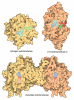

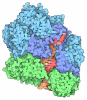
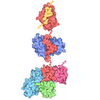
- Assembly
| Deposited unit | 
|
|---|---|
| 1 |
|
-Components
-Protein , 3 types, 3 molecules ABC
| #1: Protein | Mass: 93061.852 Da / Num. of mol.: 1 Source method: isolated from a genetically manipulated source Source: (gene. exp.) Homo sapiens (human) / Gene: DDB1, XAP1 / Plasmid: pFASTBac / Cell line (production host): Sf9Production host:  Spodoptera aff. frugiperda 1 BOLD-2017 (butterflies/moths) Spodoptera aff. frugiperda 1 BOLD-2017 (butterflies/moths)References: UniProt: Q16531 |
|---|---|
| #2: Protein | Mass: 43978.617 Da / Num. of mol.: 1 Source method: isolated from a genetically manipulated source Source: (gene. exp.) Homo sapiens (human) / Gene: CRBN, AD-006 / Plasmid: pFASTBac / Cell line (production host): Sf9Production host: Spodoptera aff. frugiperda 1 BOLD-2017 (butterflies/moths)References: UniProt: Q96SW2 |
| #3: Protein | Mass: 34682.211 Da / Num. of mol.: 1 Source method: isolated from a genetically manipulated source Source: (gene. exp.) Homo sapiens (human) / Gene: CSNK1A1 / Plasmid: pFASTBac / Cell line (production host): Sf9Production host: Spodoptera aff. frugiperda 1 BOLD-2017 (butterflies/moths)References: UniProt: P48729, non-specific serine/threonine protein kinase |
-Non-polymers , 3 types, 3 molecules 
| #4: Chemical | ChemComp-ZN / 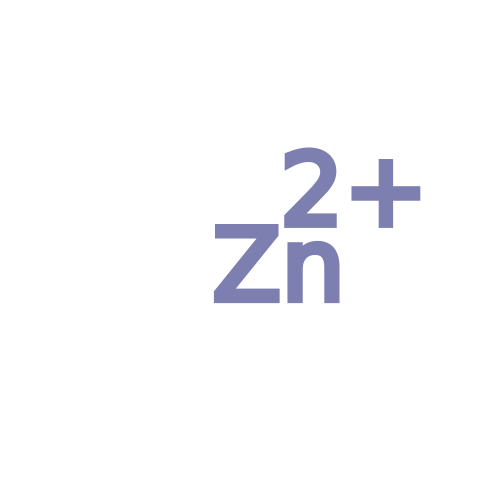 Mass: 65.409 Da / Num. of mol.: 1 / Source method: obtained synthetically / Formula: Zn / Feature type: SUBJECT OF INVESTIGATION Mass: 65.409 Da / Num. of mol.: 1 / Source method: obtained synthetically / Formula: Zn / Feature type: SUBJECT OF INVESTIGATION |
|---|---|
| #5: Chemical | ChemComp-A1CEH / Mass: 363.367 Da / Num. of mol.: 1 / Source method: obtained synthetically / Formula: C20H17N3O4 / Feature type: SUBJECT OF INVESTIGATION |
| #6: Chemical | ChemComp-A1CEG / Mass: 360.366 Da / Num. of mol.: 1 / Source method: obtained synthetically / Formula: C20H16N4O3 / Feature type: SUBJECT OF INVESTIGATION |
-Details
| Has ligand of interest | Y |
|---|---|
| Has protein modification | N |
-Experimental details
-Experiment
| Experiment | Method: ELECTRON MICROSCOPY |
|---|---|
| EM experiment | Aggregation state: PARTICLE / 3D reconstruction method: single particle reconstruction |
- Sample preparation
| Component | Name: DDB1(BPB deleted)-CRBN complex with Casein kinase 1 alpha, SB-405483, and DEG-47 Type: COMPLEX Details: The protein complex was incubated with CK1a, IMiD DEG-47, and allosteric binder SB-405483, and the mixture was incubated at 1:2:13:20 for 30 minutes and then frozen on 1.2/1.3 Au grids Entity ID: #1-#3 / Source: RECOMBINANT | ||||||||||||||||||||
|---|---|---|---|---|---|---|---|---|---|---|---|---|---|---|---|---|---|---|---|---|---|
| Molecular weight | Value: 0.18366303 MDa / Experimental value: YES | ||||||||||||||||||||
| Source (natural) | Organism: Homo sapiens (human) | ||||||||||||||||||||
| Source (recombinant) | Organism: Spodoptera aff. frugiperda 1 BOLD-2017 (butterflies/moths) Strain: Sf9 / Plasmid: pFASTBac | ||||||||||||||||||||
| Buffer solution | pH: 7 / Details: 10mM HEPES, 240mM NaCl, 3mM TCEP | ||||||||||||||||||||
| Buffer component |
| ||||||||||||||||||||
| Specimen | Conc.: 0.5 mg/ml / Embedding applied: NO / Shadowing applied: NO / Staining applied: NO / Vitrification applied: YES Details: The protein complex was incubated with CK1a, IMiD DEG-47, and allosteric binder SB-405483, and the mixture was incubated at 1:2:13:20 for 30 minutes and then frozen on 1.2/1.3 Au grids | ||||||||||||||||||||
| Specimen support | Grid material: GOLD / Grid mesh size: 300 divisions/in. / Grid type: UltrAuFoil R1.2/1.3 | ||||||||||||||||||||
| Vitrification | Instrument: HOMEMADE PLUNGER / Cryogen name: ETHANE / Humidity: 95 % / Chamber temperature: 277.15 K |
- Electron microscopy imaging
| Experimental equipment | 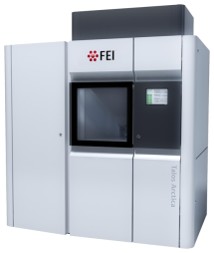 Model: Talos Arctica / Image courtesy: FEI Company |
|---|---|
| Microscopy | Model: FEI TALOS ARCTICA |
| Electron gun | Electron source:  FIELD EMISSION GUN / Accelerating voltage: 200 kV / Illumination mode: FLOOD BEAM FIELD EMISSION GUN / Accelerating voltage: 200 kV / Illumination mode: FLOOD BEAM |
| Electron lens | Mode: BRIGHT FIELD / Nominal magnification: 190000 X / Calibrated magnification: 189189 X / Nominal defocus max: 1200 nm / Nominal defocus min: 800 nm / Cs: 2.7 mm / C2 aperture diameter: 50 µm / Alignment procedure: COMA FREE |
| Specimen holder | Cryogen: NITROGEN / Specimen holder model: FEI TITAN KRIOS AUTOGRID HOLDER / Temperature (max): 77 K / Temperature (min): 70 K |
| Image recording | Average exposure time: 4.08 sec. / Electron dose: 50 e/Å2 / Film or detector model: TFS FALCON 4i (4k x 4k) / Num. of grids imaged: 2 / Num. of real images: 5691 |
| Image scans | Sampling size: 15 µm / Width: 4096 / Height: 4096 |
- Processing
| EM software |
| ||||||||||||||||||||||||||||||||||||||||
|---|---|---|---|---|---|---|---|---|---|---|---|---|---|---|---|---|---|---|---|---|---|---|---|---|---|---|---|---|---|---|---|---|---|---|---|---|---|---|---|---|---|
| CTF correction | Type: PHASE FLIPPING ONLY | ||||||||||||||||||||||||||||||||||||||||
| Particle selection | Num. of particles selected: 3492611 | ||||||||||||||||||||||||||||||||||||||||
| Symmetry | Point symmetry: C1 (asymmetric) | ||||||||||||||||||||||||||||||||||||||||
| 3D reconstruction | Resolution: 3 Å / Resolution method: FSC 0.143 CUT-OFF / Num. of particles: 328293 / Algorithm: FOURIER SPACE / Num. of class averages: 2 / Symmetry type: POINT | ||||||||||||||||||||||||||||||||||||||||
| Atomic model building | B value: 102.6 / Protocol: RIGID BODY FIT / Space: RECIPROCAL | ||||||||||||||||||||||||||||||||||||||||
| Atomic model building | 3D fitting-ID: 1 / Type: experimental model
|