lymphocyte differentiation / negative regulation of monoatomic ion transmembrane transport / positive regulation by virus of viral protein levels in host cell / spindle assembly involved in female meiosis / NOTCH3 Intracellular Domain Regulates Transcription / epigenetic programming in the zygotic pronuclei / UV-damage excision repair / biological process involved in interaction with symbiont / regulation of mitotic cytokinesis / regulation of mitotic cell cycle phase transition ...lymphocyte differentiation / negative regulation of monoatomic ion transmembrane transport / positive regulation by virus of viral protein levels in host cell / spindle assembly involved in female meiosis / NOTCH3 Intracellular Domain Regulates Transcription / epigenetic programming in the zygotic pronuclei / UV-damage excision repair / biological process involved in interaction with symbiont / regulation of mitotic cytokinesis / regulation of mitotic cell cycle phase transition / mesoderm development / regulation of miRNA-mediated gene silencing / regulation of natural killer cell activation / WD40-repeat domain binding / regulation of cell cycle phase transition / locomotory exploration behavior / Cul4A-RING E3 ubiquitin ligase complex / Cul4-RING E3 ubiquitin ligase complex / regulation of stem cell population maintenance / Cul4B-RING E3 ubiquitin ligase complex / ubiquitin ligase complex scaffold activity / negative regulation of adipose tissue development / regulation of cellular response to stress / limb development / viral release from host cell / cullin family protein binding / positive regulation of Wnt signaling pathway / pericentric heterochromatin / negative regulation of protein-containing complex assembly / regulation of DNA-templated DNA replication initiation / positive regulation of viral genome replication / positive regulation of gluconeogenesis / regulation of embryonic development / erythrocyte differentiation / replication fork processing / proteasomal protein catabolic process / epigenetic regulation of gene expression / positive regulation of protein-containing complex assembly / nucleotide-excision repair / Recognition of DNA damage by PCNA-containing replication complex / regulation of autophagy / regulation of circadian rhythm / DNA Damage Recognition in GG-NER / cell population proliferation / Dual Incision in GG-NER / Transcription-Coupled Nucleotide Excision Repair (TC-NER) / Formation of TC-NER Pre-Incision Complex / Formation of Incision Complex in GG-NER / positive regulation of protein catabolic process / cellular response to UV / Dual incision in TC-NER / Gap-filling DNA repair synthesis and ligation in TC-NER / regulation of cell population proliferation / rhythmic process / site of double-strand break / Neddylation / spermatogenesis / ubiquitin-dependent protein catabolic process / chromatin organization / Potential therapeutics for SARS / damaged DNA binding / proteasome-mediated ubiquitin-dependent protein catabolic process / regulation of apoptotic process / transmembrane transporter binding / protein-macromolecule adaptor activity / chromosome, telomeric region / protein ubiquitination / RNA polymerase II cis-regulatory region sequence-specific DNA binding / DNA-binding transcription factor activity / protein domain specific binding / negative regulation of DNA-templated transcription / DNA repair / regulation of transcription by RNA polymerase II / DNA damage response / nucleolus / protein-containing complex binding / perinuclear region of cytoplasm / protein-containing complex / DNA binding / : / DNA-templated transcription / extracellular exosome / nucleoplasm / zinc ion binding / membrane / metal ion binding / identical protein binding / nucleus / cytosol / cytoplasm Similarity search - Function
: / Yippee/Mis18/Cereblon / Yippee zinc-binding/DNA-binding /Mis18, centromere assembly / CULT domain / CULT domain profile. / Lon N-terminal domain profile. / Lon protease, N-terminal domain / Lon protease, N-terminal domain superfamily / ATP-dependent protease La (LON) substrate-binding domain / Found in ATP-dependent protease La (LON) ...: / Yippee/Mis18/Cereblon / Yippee zinc-binding/DNA-binding /Mis18, centromere assembly / CULT domain / CULT domain profile. / Lon N-terminal domain profile. / Lon protease, N-terminal domain / Lon protease, N-terminal domain superfamily / ATP-dependent protease La (LON) substrate-binding domain / Found in ATP-dependent protease La (LON) / : / RSE1/DDB1/CPSF1 second beta-propeller / Cleavage/polyadenylation specificity factor, A subunit, C-terminal / Cleavage/polyadenylation specificity factor, A subunit, N-terminal / : / CPSF A subunit region / RSE1/DDB1/CPSF1 first beta-propeller / PUA-like superfamily / Zinc finger, C2H2 type / zinc finger / Zinc finger C2H2 type domain profile. / Zinc finger C2H2 superfamily / Zinc finger C2H2 type domain signature. / Zinc finger C2H2-type / WD40-repeat-containing domain superfamily / WD40/YVTN repeat-like-containing domain superfamily Similarity search - Domain/homology
National Institutes of Health/National Institute of General Medical Sciences (NIH/NIGMS)
GM143805
United States
Citation
Journal: Nature / Year: 2026 Title: Identification of an allosteric site on the E3 ligase adapter cereblon. Authors: Vanessa N Dippon / Zeba Rizvi / Anthony E Choudhry / Chun-Wa Chung / Ibrahim F Alkuraya / Wenqing Xu / Xavier B Tao / Anthony J Jurewicz / Jessica L Schneck / Wenqian Chen / Nicole M Curnutt ...Authors: Vanessa N Dippon / Zeba Rizvi / Anthony E Choudhry / Chun-Wa Chung / Ibrahim F Alkuraya / Wenqing Xu / Xavier B Tao / Anthony J Jurewicz / Jessica L Schneck / Wenqian Chen / Nicole M Curnutt / Farah Kabir / Kwok-Ho Chan / Markus A Queisser / Caterina Musetti / Han Dai / Gabriel C Lander / Andrew B Benowitz / Christina M Woo / Abstract: Cereblon (CRBN) is the target of thalidomide derivatives that achieve therapeutic efficacy against some haematologic neoplasias by recruiting neosubstrates for degradation. Despite the intense ...Cereblon (CRBN) is the target of thalidomide derivatives that achieve therapeutic efficacy against some haematologic neoplasias by recruiting neosubstrates for degradation. Despite the intense investigation of orthosteric thalidomide derivatives, little is known about alternate binding sites on CRBN. Here we report an evolutionarily conserved cryptic allosteric binding site on CRBN. Small-molecule SB-405483 binds the allosteric site to cooperatively enhance the binding of orthosteric ligands and alter their neosubstrate degradation profiles. A survey of over 100 orthosteric ligands and their degradation targets reveals trends in the classes of compounds and neosubstrates in which degradation outcomes are enhanced or inhibited by SB-405483. Structural investigations provide a mechanistic basis for the effects of the allosteric ligand by shifting the conformational distribution of CRBN to a novel CRBN and increasing the CRBN state. The discovery of a cryptic allosteric binding site on CRBN that alters the functional effects of orthosteric ligands opens new directions with broad implications for improving the selectivity and efficacy of CRBN therapeutics.
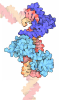
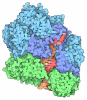
Entire : DDB1(BPB deleted)-CRBN complex with ikaros ZF2-3 and DEG-47 was i...
Entire
Name: DDB1(BPB deleted)-CRBN complex with ikaros ZF2-3 and DEG-47 was incubauted for 30 minutes and then plunge frozen over 1.2/1.3 UltrAufoil
Components
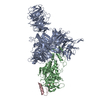
Complex: DDB1(BPB deleted)-CRBN complex with ikaros ZF2-3 and DEG-47 was incubauted for 30 minutes and then plunge frozen over 1.2/1.3 UltrAufoil
Protein or peptide: DNA damage binding protein 1 (DDB1)
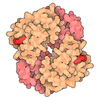
Protein or peptide: Cereblon (CRBN)
Protein or peptide: Ikaros (ZF2-3)
-
Supramolecule #1: DDB1(BPB deleted)-CRBN complex with ikaros ZF2-3 and DEG-47 was i...
Supramolecule
Name: DDB1(BPB deleted)-CRBN complex with ikaros ZF2-3 and DEG-47 was incubauted for 30 minutes and then plunge frozen over 1.2/1.3 UltrAufoil type: complex / ID: 1 / Parent: 0 / Macromolecule list: all
Source (natural)
Organism: Homo sapiens (human)
Molecular weight
Theoretical: 151.27264 KDa
-
Macromolecule #1: DNA damage binding protein 1 (DDB1)
Macromolecule
Name: DNA damage binding protein 1 (DDB1) / type: protein_or_peptide / ID: 1 Details: The BPB domain is truncated (396-705 truncation with addition of a GNGNSG linker between BPA and BPC) from DDB1 and co-expressed with Cereblon (CRBN) in SF9 expression system. Enantiomer: LEVO
The protein complex with ikaros ZF2-3 was incubated with IMiD DEG-47 and was incubated at 1:2:13 for 30 minutes and then frozen on 1.2/1.3 Au grids
-
Electron microscopy
Microscope
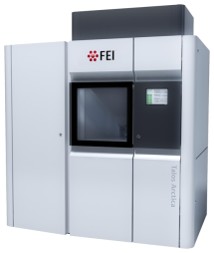
FEI TALOS ARCTICA
Temperature
Min: 70.0 K / Max: 77.0 K
Image recording
Film or detector model: TFS FALCON 4i (4k x 4k) / Digitization - Dimensions - Width: 4096 pixel / Digitization - Dimensions - Height: 4096 pixel / Number grids imaged: 1 / Number real images: 4915 / Average exposure time: 4.08 sec. / Average electron dose: 50.0 e/Å2
Electron beam
Acceleration voltage: 200 kV / Electron source: FIELD EMISSION GUN
Type of model: INSILICO MODEL / In silico model: AB INITIO RECONSTRUCTION
Final reconstruction
Number classes used: 1 / Applied symmetry - Point group: C1 (asymmetric) / Algorithm: FOURIER SPACE / Resolution.type: BY AUTHOR / Resolution: 2.96 Å / Resolution method: FSC 0.143 CUT-OFF / Software - Name: cryoSPARC (ver. 4.6.2) / Number images used: 412326
Initial angle assignment
Type: MAXIMUM LIKELIHOOD / Software - Name: cryoSPARC (ver. 4.6.2) Details: Ab initio reconstruction, heterogeneous refinement, and homogeneous refinement
In the structure databanks used in Yorodumi, some data are registered as the other names, "COVID-19 virus" and "2019-nCoV". Here are the details of the virus and the list of structure data.
Jan 31, 2019. EMDB accession codes are about to change! (news from PDBe EMDB page)
EMDB accession codes are about to change! (news from PDBe EMDB page)
The allocation of 4 digits for EMDB accession codes will soon come to an end. Whilst these codes will remain in use, new EMDB accession codes will include an additional digit and will expand incrementally as the available range of codes is exhausted. The current 4-digit format prefixed with “EMD-” (i.e. EMD-XXXX) will advance to a 5-digit format (i.e. EMD-XXXXX), and so on. It is currently estimated that the 4-digit codes will be depleted around Spring 2019, at which point the 5-digit format will come into force.
The EM Navigator/Yorodumi systems omit the EMD- prefix.
Related info.:Q: What is EMD? / ID/Accession-code notation in Yorodumi/EM Navigator
Yorodumi is a browser for structure data from EMDB, PDB, SASBDB, etc.
This page is also the successor to EM Navigator detail page, and also detail information page/front-end page for Omokage search.
The word "yorodu" (or yorozu) is an old Japanese word meaning "ten thousand". "mi" (miru) is to see.
Related info.:EMDB / PDB / SASBDB / Comparison of 3 databanks / Yorodumi Search / Aug 31, 2016. New EM Navigator & Yorodumi / Yorodumi Papers / Jmol/JSmol / Function and homology information / Changes in new EM Navigator and Yorodumi
 Movie
Movie Controller


 Open data
 Basic information
 Map data
 Sample
 Keywords
 Function and homology information
 Homo sapiens (human)
 Authors
 United States, 1 items
  Citation
 Structure visualization
 Downloads & links
 emd_70866.png
 https://data.pdbj.org/pub/emdb/structures/EMD-70866



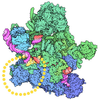
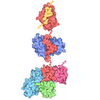
 Z (Sec.)
 Y (Row.)
 X (Col.)


 Sample components
 Spodoptera aff. frugiperda 1 BOLD-2017 (butterflies/moths)
 Escherichia coli BL21(DE3) (bacteria)
 Processing
 Electron microscopy
 FIELD EMISSION GUN