 Movie
Movie Controller

[English] 日本語
 Yorodumi
- PDB-9os2: Cryo-EM structure of the DDB1/CRBN-MRT-5702-G3BP2 ternary complex -
+ Open data

- Basic information
| Entry | Database: PDB / ID: 9os2 | |||||||||||||||||||||
|---|---|---|---|---|---|---|---|---|---|---|---|---|---|---|---|---|---|---|---|---|---|---|
| Title | Cryo-EM structure of the DDB1/CRBN-MRT-5702-G3BP2 ternary complex | |||||||||||||||||||||
 Components Components |
| |||||||||||||||||||||
 Keywords Keywords | LIGASE / molecular glue degrader / neo-substrate / cereblon / E3 ubiquitin ligase | |||||||||||||||||||||
| Function / homology |  Function and homology information Function and homology informationnegative regulation of monoatomic ion transmembrane transport / positive regulation by virus of viral protein levels in host cell / spindle assembly involved in female meiosis / epigenetic programming in the zygotic pronuclei / UV-damage excision repair / mRNA transport / biological process involved in interaction with symbiont / regulation of mitotic cytokinesis / regulation of mitotic cell cycle phase transition / regulation of miRNA-mediated gene silencing ...negative regulation of monoatomic ion transmembrane transport / positive regulation by virus of viral protein levels in host cell / spindle assembly involved in female meiosis / epigenetic programming in the zygotic pronuclei / UV-damage excision repair / mRNA transport / biological process involved in interaction with symbiont / regulation of mitotic cytokinesis / regulation of mitotic cell cycle phase transition / regulation of miRNA-mediated gene silencing / regulation of natural killer cell activation / WD40-repeat domain binding / regulation of cell cycle phase transition / locomotory exploration behavior / Cul4-RING E3 ubiquitin ligase complex / regulation of stem cell population maintenance / Cul4A-RING E3 ubiquitin ligase complex / Cul4B-RING E3 ubiquitin ligase complex / ubiquitin ligase complex scaffold activity / negative regulation of adipose tissue development / regulation of cellular response to stress / limb development / viral release from host cell / cullin family protein binding / positive regulation of Wnt signaling pathway / negative regulation of protein-containing complex assembly / regulation of DNA-templated DNA replication initiation / positive regulation of viral genome replication / positive regulation of gluconeogenesis / rhythmic process / regulation of embryonic development / replication fork processing / stress granule assembly / proteasomal protein catabolic process / epigenetic regulation of gene expression / molecular condensate scaffold activity / positive regulation of protein-containing complex assembly / nucleotide-excision repair / regulation of autophagy / protein homooligomerization / Recognition of DNA damage by PCNA-containing replication complex / regulation of circadian rhythm / DNA Damage Recognition in GG-NER / cell population proliferation / Dual Incision in GG-NER / Transcription-Coupled Nucleotide Excision Repair (TC-NER) / Formation of TC-NER Pre-Incision Complex / Formation of Incision Complex in GG-NER / cytoplasmic stress granule / cellular response to UV / positive regulation of protein catabolic process / Dual incision in TC-NER / Gap-filling DNA repair synthesis and ligation in TC-NER / regulation of cell population proliferation / site of double-strand break / Neddylation / spermatogenesis / ubiquitin-dependent protein catabolic process / Potential therapeutics for SARS / damaged DNA binding / proteasome-mediated ubiquitin-dependent protein catabolic process / regulation of apoptotic process / transmembrane transporter binding / innate immune response / chromosome, telomeric region / protein-macromolecule adaptor activity / protein ubiquitination / DNA repair / mRNA binding / DNA damage response / nucleolus / protein-containing complex binding / perinuclear region of cytoplasm / SARS-CoV-2 activates/modulates innate and adaptive immune responses / : / protein-containing complex / DNA binding / RNA binding / metal ion binding / extracellular exosome / nucleoplasm / membrane / nucleus / cytosol / cytoplasm Similarity search - Function | |||||||||||||||||||||
| Biological species |  Homo sapiens (human) Homo sapiens (human) | |||||||||||||||||||||
| Method | ELECTRON MICROSCOPY / single particle reconstruction / cryo EM / Resolution: 2.5 Å | |||||||||||||||||||||
 Authors Authors | Quan, C. / Petzold, G. / Gainza, P. / Tsai, J. / Bunker, R.D. / Wiedmer, L. / Donckele, E.J. | |||||||||||||||||||||
| Funding support | 1items
| |||||||||||||||||||||
 Citation Citation | Journal: Nat Struct Mol Biol / Year: 2026 Title: Cereblon induces G3BP2 neosubstrate degradation using molecular surface mimicry. Authors: Stefano Annunziato / Chao Quan / Etienne J Donckele / Ilaria Lamberto / Richard D Bunker / Mary Zlotosch / Laura Schwander / Anastasia Murthy / Lars Wiedmer / Camille Staehly / Michelle ...Authors: Stefano Annunziato / Chao Quan / Etienne J Donckele / Ilaria Lamberto / Richard D Bunker / Mary Zlotosch / Laura Schwander / Anastasia Murthy / Lars Wiedmer / Camille Staehly / Michelle Matysik / Samuel Gilberto / Despina Kapsitidou / Daric Wible / Gian Marco De Donatis / Peter Trenh / Rohitha SriRamaratnam / Vaik Strande / Raphael Lieberherr / David Lyon / Danielle Steiner / Joao Silva / Reinaldo Almeida / Elena Dolgikh / Bradley DeMarco / Jennifer Tsai / Amine Sadok / Vladislav Zarayskiy / Magnus Walter / Ralph Tiedt / Kevin J Lumb / Debora Bonenfant / Bernhard Fasching / John C Castle / Sharon A Townson / Pablo Gainza / Georg Petzold /  Abstract: Molecular glue degraders (MGDs) are small-molecule compounds that divert E3 ligases to degrade nonnatural substrates called neosubstrates. Clinically effective MGDs bind cereblon (CRBN), a substrate ...Molecular glue degraders (MGDs) are small-molecule compounds that divert E3 ligases to degrade nonnatural substrates called neosubstrates. Clinically effective MGDs bind cereblon (CRBN), a substrate receptor of the Cullin 4-RING E3 ubiquitin ligase (CRL4), and recruit neosubstrates to an MGD-induced neosurface on the CRBN CULT domain through molecular mimicry of a natural CRBN degron. Here, we identify G3BP2 (Ras-GAP SH3 domain-binding protein 2), a neosubstrate that bypasses canonical interactions with CRBN by engaging an unconventional binding site on the CRBN LON domain. The ternary complex interface does not resemble known interactions with CRBN. Instead, CRBN leverages a preexisting protein-protein interaction (PPI) hotspot on the target protein by mimicking an endogenous binding partner of G3BP2. Our findings suggest that composite neosurfaces that mimic and stabilize the footprint of natural PPIs (in short, 'glueprints') could become a viable strategy for the rational expansion of the MGD target repertoire. | |||||||||||||||||||||
| History |
|
- Structure visualization
| Structure viewer | Molecule: MolmilJmol/JSmol |
|---|
- Downloads & links
-Download
| PDBx/mmCIF format | 9os2.cif.gz | 309.7 KB | Display | PDBx/mmCIF format |
|---|---|---|---|---|
| PDB format | pdb9os2.ent.gz | Display | PDB format | |
| PDBx/mmJSON format | 9os2.json.gz | Tree view | PDBx/mmJSON format | |
| Others |  Other downloads Other downloads |
-Validation report
| Arichive directory | https://data.pdbj.org/pub/pdb/validation_reports/os/9os2ftp://data.pdbj.org/pub/pdb/validation_reports/os/9os2 | HTTPS FTP |
|---|
-Related structure data
| Related structure data |  70791MC M: map data used to model this data C: citing same article ( |
|---|---|
| Similar structure data |
-Links
 PDBj
PDBj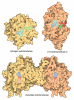

- Assembly
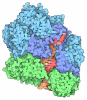
| Deposited unit | 
|
|---|---|
| 1 |
|
-Components
| #1: Protein | Mass: 43554.090 Da / Num. of mol.: 1 Source method: isolated from a genetically manipulated source Source: (gene. exp.) Homo sapiens (human) / Gene: CRBN, AD-006 / Production host:   Spodoptera frugiperda (fall armyworm) / References: UniProt: Q96SW2 Spodoptera frugiperda (fall armyworm) / References: UniProt: Q96SW2 | ||||||||
|---|---|---|---|---|---|---|---|---|---|
| #2: Protein | Mass: 127097.469 Da / Num. of mol.: 1 Source method: isolated from a genetically manipulated source Source: (gene. exp.) Homo sapiens (human) / Gene: DDB1, XAP1 / Production host: Spodoptera frugiperda (fall armyworm) / References: UniProt: Q16531 | ||||||||
| #3: Protein | Mass: 54198.070 Da / Num. of mol.: 2 Source method: isolated from a genetically manipulated source Source: (gene. exp.) Homo sapiens (human) / Gene: G3BP2, KIAA0660 / Production host:   Escherichia coli (E. coli) / References: UniProt: Q9UN86 Escherichia coli (E. coli) / References: UniProt: Q9UN86#4: Chemical | ChemComp-ZN / |   Mass: 65.409 Da / Num. of mol.: 1 / Source method: obtained synthetically / Formula: Zn Mass: 65.409 Da / Num. of mol.: 1 / Source method: obtained synthetically / Formula: Zn#5: Chemical | ChemComp-A1CED / ( | Mass: 621.106 Da / Num. of mol.: 1 / Source method: obtained synthetically / Formula: C30H29ClN6O5S / Feature type: SUBJECT OF INVESTIGATION Has ligand of interest | Y | Has protein modification | Y | |
-Experimental details
-Experiment
| Experiment | Method: ELECTRON MICROSCOPY |
|---|---|
| EM experiment | Aggregation state: PARTICLE / 3D reconstruction method: single particle reconstruction |
- Sample preparation
| Component | Name: DDB1/CRBN-MRT-5702-G3BP2 ternary complex / Type: COMPLEX / Entity ID: #1-#3 / Source: RECOMBINANT |
|---|---|
| Molecular weight | Experimental value: NO |
| Source (natural) | Organism: Homo sapiens (human) |
| Source (recombinant) | Organism: Spodoptera frugiperda (fall armyworm) |
| Buffer solution | pH: 7.4 |
| Specimen | Embedding applied: NO / Shadowing applied: NO / Staining applied: NO / Vitrification applied: YES |
| Specimen support | Grid material: GOLD / Grid mesh size: 300 divisions/in. / Grid type: C-flat-1.2/1.3 |
| Vitrification | Instrument: FEI VITROBOT MARK IV / Cryogen name: ETHANE / Humidity: 100 % / Chamber temperature: 277 K |
- Electron microscopy imaging
| Experimental equipment |  Model: Titan Krios / Image courtesy: FEI Company |
|---|---|
| Microscopy | Model: TFS KRIOS |
| Electron gun | Electron source:  FIELD EMISSION GUN / Accelerating voltage: 300 kV / Illumination mode: FLOOD BEAM FIELD EMISSION GUN / Accelerating voltage: 300 kV / Illumination mode: FLOOD BEAM |
| Electron lens | Mode: BRIGHT FIELD / Nominal magnification: 130000 X / Nominal defocus max: 2000 nm / Nominal defocus min: 300 nm / Cs: 2.7 mm / C2 aperture diameter: 50 µm |
| Specimen holder | Cryogen: NITROGEN / Specimen holder model: FEI TITAN KRIOS AUTOGRID HOLDER |
| Image recording | Electron dose: 50.5056 e/Å2 / Film or detector model: GATAN K3 BIOQUANTUM (6k x 4k) |
- Processing
| EM software | Name: PHENIX / Version: 1.21_5207 / Category: model refinement | ||||||||||||||||||||||||
|---|---|---|---|---|---|---|---|---|---|---|---|---|---|---|---|---|---|---|---|---|---|---|---|---|---|
| CTF correction | Type: NONE | ||||||||||||||||||||||||
| 3D reconstruction | Resolution: 2.5 Å / Resolution method: FSC 0.143 CUT-OFF / Num. of particles: 565661 / Symmetry type: POINT | ||||||||||||||||||||||||
| Refinement | Highest resolution: 2.5 Å Stereochemistry target values: REAL-SPACE (WEIGHTED MAP SUM AT ATOM CENTERS) | ||||||||||||||||||||||||
| Refine LS restraints |
|
