 Movie
Movie Controller
 Structure viewers
 About Yorodumi Papers


+Search query
-Structure paper
| Title | Cereblon induces G3BP2 neosubstrate degradation using molecular surface mimicry. |
|---|---|
| Journal, issue, pages | Nat Struct Mol Biol, Vol. 33, Issue 3, Page 479-487, Year 2026 |
| Publish date | Jan 20, 2026 |
 Authors Authors | Stefano Annunziato / Chao Quan / Etienne J Donckele / Ilaria Lamberto / Richard D Bunker / Mary Zlotosch / Laura Schwander / Anastasia Murthy / Lars Wiedmer / Camille Staehly / Michelle Matysik / Samuel Gilberto / Despina Kapsitidou / Daric Wible / Gian Marco De Donatis / Peter Trenh / Rohitha SriRamaratnam / Vaik Strande / Raphael Lieberherr / David Lyon / Danielle Steiner / Joao Silva / Reinaldo Almeida / Elena Dolgikh / Bradley DeMarco / Jennifer Tsai / Amine Sadok / Vladislav Zarayskiy / Magnus Walter / Ralph Tiedt / Kevin J Lumb / Debora Bonenfant / Bernhard Fasching / John C Castle / Sharon A Townson / Pablo Gainza / Georg Petzold /  |
| PubMed Abstract | Molecular glue degraders (MGDs) are small-molecule compounds that divert E3 ligases to degrade nonnatural substrates called neosubstrates. Clinically effective MGDs bind cereblon (CRBN), a substrate ...Molecular glue degraders (MGDs) are small-molecule compounds that divert E3 ligases to degrade nonnatural substrates called neosubstrates. Clinically effective MGDs bind cereblon (CRBN), a substrate receptor of the Cullin 4-RING E3 ubiquitin ligase (CRL4), and recruit neosubstrates to an MGD-induced neosurface on the CRBN CULT domain through molecular mimicry of a natural CRBN degron. Here, we identify G3BP2 (Ras-GAP SH3 domain-binding protein 2), a neosubstrate that bypasses canonical interactions with CRBN by engaging an unconventional binding site on the CRBN LON domain. The ternary complex interface does not resemble known interactions with CRBN. Instead, CRBN leverages a preexisting protein-protein interaction (PPI) hotspot on the target protein by mimicking an endogenous binding partner of G3BP2. Our findings suggest that composite neosurfaces that mimic and stabilize the footprint of natural PPIs (in short, 'glueprints') could become a viable strategy for the rational expansion of the MGD target repertoire. |
 External links External links | Nat Struct Mol Biol / PubMed:41559416 / PubMed Central |
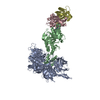
| Methods | EM (single particle) |
| Resolution | 2.5 Å |
| Structure data | EMDB-70791, PDB-9os2: |
| Chemicals |  ChemComp-ZN:  PDB-1ced: |
| Source |
|
 Keywords Keywords | LIGASE / molecular glue degrader / neo-substrate / cereblon / E3 ubiquitin ligase |

 homo sapiens (human)