[English] 日本語
Yorodumi
- PDB-9njt: Structure of native octahedral assembly of D. discoideum Odo2 -

+
Open data


ID or keywords:

Loading...

-
Basic information

Entry
Database: PDB / ID: 9njt
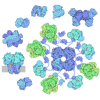
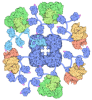
TitleStructure of native octahedral assembly of D. discoideum Odo2
ComponentsDihydrolipoyllysine-residue succinyltransferase component of 2-oxoglutarate dehydrogenase complex, mitochondrial
KeywordsTRANSFERASE / Acyltransferase
Function / homology
Function and homology information


Glycine degradation / OGDH complex synthesizes succinyl-CoA from 2-OG / Protein lipoylation / OADH complex synthesizes glutaryl-CoA from 2-OA / L-lysine catabolic process to acetyl-CoA via L-saccharopine / dihydrolipoyllysine-residue succinyltransferase / dihydrolipoyllysine-residue succinyltransferase activity / oxoglutarate dehydrogenase complex / tricarboxylic acid cycle / mitochondrion
Similarity search - Function
: / Dihydrolipoamide succinyltransferase / 2-oxo acid dehydrogenase, lipoyl-binding site / 2-oxo acid dehydrogenases acyltransferase component lipoyl binding site. / 2-oxoacid dehydrogenase acyltransferase, catalytic domain / 2-oxoacid dehydrogenases acyltransferase (catalytic domain) / Biotin-requiring enzyme / Biotinyl/lipoyl domain profile. / Biotin/lipoyl attachment / Single hybrid motif / Chloramphenicol acetyltransferase-like domain superfamily
Similarity search - Domain/homology
Dihydrolipoyllysine-residue succinyltransferase component of 2-oxoglutarate dehydrogenase complex, mitochondrial
Similarity search - Component
Biological speciesDictyostelium discoideum AX2 (eukaryote)
MethodELECTRON MICROSCOPY / single particle reconstruction / cryo EM / Resolution: 5.72 Å
AuthorsHoogerbrugge, G. / Keatinge-Clay, A.T. / Marcotte, E.M.
Funding support United States, 5items
OrganizationGrant numberCountry
National Institutes of Health/National Institute of General Medical Sciences (NIH/NIGMS)R01 GM106112 United States
National Institutes of Health/National Institute of General Medical Sciences (NIH/NIGMS)R35 GM122480 United States
Department of Defense (DOD, United States)W911NF-12-1-0390 United States
Welch FoundationF-1712 United States
Welch FoundationF-1515 United States
CitationJournal: Mol Cell Proteomics / Year: 2026
Title: Serendipity and the Slime Mold: A Visual Survey of High-Molecular-Weight Protein Assemblies Reveals the Structure of the Polyketide Synthase Pks16.
Authors: Gabriel Hoogerbrugge / Adrian T Keatinge-Clay / Edward M Marcotte /
Abstract: Large macromolecular assemblies are integral to most cellular processes, making their identification and structural characterization an important strategy for advancing our understanding of protein ...Large macromolecular assemblies are integral to most cellular processes, making their identification and structural characterization an important strategy for advancing our understanding of protein functions. In this pilot study, we investigated large multiprotein assemblies from the cytoplasm of the slime mold Dictyostelium discoideum using shotgun electron microscopy, the combined application of mass spectrometry-based proteomics and cryo-EM to heterogenous mixtures of proteins. With its similarities in cell structure and behavior to mammalian cells, D. discoideum has long served as an invaluable model organism, particularly in the study of immune cell chemotaxis, phagocytosis, bacterial infection, and other processes. We subjected D. discoideum soluble protein complexes to two-step fractionation, performing size-exclusion chromatography followed by mixed-bed ion-exchange chromatography. Isolated fractions containing a subset of high molecular weight-scale protein assemblies were subsequently analyzed using mass spectrometry to identify the proteins and cryo-EM to characterize their structures. Mass spectrometry analysis revealed 179 unique proteins in the isolated fractions, then single-particle cryo-EM analysis generated distinct 2D projections of several visually distinctive protein assemblies, from which we successfully identified and reconstructed three major protein complexes: the 20S proteasome, the dihydrolipoyllysine-residue succinyltransferase (Odo2) of the mitochondrial 2-oxoglutarate dehydrogenase complex, and polyketide synthase 16 (Pks16), thought to be the primary fatty acid synthase of D. discoideum. Based on the Pks16 structure, the first of the 40 D. discoideum PKSs to be experimentally determined, models for the full set of D. discoideum PKSs were constructed with help from AlphaFold 3. Comparative analysis enabled structural characterization of their reaction chambers. Shotgun EM thus provides a view of proteins in their native or near-native biological conformations and scaling up this approach offers an effective route to characterize new structures of multiprotein assemblies directly from complex samples.
History
DepositionFeb 27, 2025Deposition site: RCSB / Processing site: RCSB
Revision 1.0Mar 12, 2025Provider: repository / Type: Initial release
Revision 1.0Mar 12, 2025Data content type: EM metadata / Data content type: EM metadata / Provider: repository / Type: Initial release
Revision 1.0Mar 12, 2025Data content type: FSC / Data content type: FSC / Provider: repository / Type: Initial release
Revision 1.0Mar 12, 2025Data content type: Half map / Part number: 1 / Data content type: Half map / Provider: repository / Type: Initial release
Revision 1.0Mar 12, 2025Data content type: Half map / Part number: 2 / Data content type: Half map / Provider: repository / Type: Initial release
Revision 1.0Mar 12, 2025Data content type: Image / Data content type: Image / Provider: repository / Type: Initial release
Revision 1.0Mar 12, 2025Data content type: Mask / Part number: 1 / Data content type: Mask / Provider: repository / Type: Initial release
Revision 1.0Mar 12, 2025Data content type: Primary map / Data content type: Primary map / Provider: repository / Type: Initial release
Revision 1.1Dec 24, 2025Group: Data collection / Database references / Category: citation / citation_author / em_admin
Item: _citation.country / _citation.journal_abbrev ..._citation.country / _citation.journal_abbrev / _citation.journal_id_CSD / _citation.journal_id_ISSN / _citation.page_first / _citation.page_last / _citation.pdbx_database_id_DOI / _citation.pdbx_database_id_PubMed / _citation.title / _citation.year / _citation_author.identifier_ORCID / _em_admin.last_update
Revision 1.1Dec 24, 2025Data content type: EM metadata / Data content type: EM metadata / EM metadata / Group: Database references / Experimental summary / Data content type: EM metadata / EM metadata / EM metadata / Category: citation / citation_author / em_admin
Data content type: EM metadata / EM metadata ...EM metadata / EM metadata / EM metadata / EM metadata / EM metadata / EM metadata / EM metadata / EM metadata / EM metadata / EM metadata / EM metadata / EM metadata
Item: _citation.country / _citation.journal_abbrev ..._citation.country / _citation.journal_abbrev / _citation.journal_id_CSD / _citation.journal_id_ISSN / _citation.page_first / _citation.page_last / _citation.pdbx_database_id_DOI / _citation.pdbx_database_id_PubMed / _citation.title / _citation.year / _citation_author.identifier_ORCID / _em_admin.last_update
Revision 1.2Jan 7, 2026Group: Data collection / Category: em_admin / Item: _em_admin.last_update
Revision 1.2Jan 7, 2026Data content type: EM metadata / Data content type: EM metadata / Group: Experimental summary / Data content type: EM metadata / Category: em_admin / Data content type: EM metadata / Item: _em_admin.last_update
Revision 1.3Jan 28, 2026Group: Data collection / Database references / Category: citation / em_admin
Item: _citation.journal_volume / _citation.title / _em_admin.last_update
Revision 1.3Jan 28, 2026Data content type: EM metadata / Data content type: EM metadata / EM metadata / Group: Database references / Experimental summary / Data content type: EM metadata / EM metadata / Category: citation / em_admin / Data content type: EM metadata / EM metadata / EM metadata
Item: _citation.journal_volume / _citation.title / _em_admin.last_update

-
Structure visualization

Structure viewerMolecule:
MolmilJmol/JSmol

Downloads & links

-
Assembly

Deposited unit
A: Dihydrolipoyllysine-residue succinyltransferase component of 2-oxoglutarate dehydrogenase complex, mitochondrial
B: Dihydrolipoyllysine-residue succinyltransferase component of 2-oxoglutarate dehydrogenase complex, mitochondrial
C: Dihydrolipoyllysine-residue succinyltransferase component of 2-oxoglutarate dehydrogenase complex, mitochondrial
D: Dihydrolipoyllysine-residue succinyltransferase component of 2-oxoglutarate dehydrogenase complex, mitochondrial
E: Dihydrolipoyllysine-residue succinyltransferase component of 2-oxoglutarate dehydrogenase complex, mitochondrial
F: Dihydrolipoyllysine-residue succinyltransferase component of 2-oxoglutarate dehydrogenase complex, mitochondrial
G: Dihydrolipoyllysine-residue succinyltransferase component of 2-oxoglutarate dehydrogenase complex, mitochondrial
H: Dihydrolipoyllysine-residue succinyltransferase component of 2-oxoglutarate dehydrogenase complex, mitochondrial
I: Dihydrolipoyllysine-residue succinyltransferase component of 2-oxoglutarate dehydrogenase complex, mitochondrial
J: Dihydrolipoyllysine-residue succinyltransferase component of 2-oxoglutarate dehydrogenase complex, mitochondrial
K: Dihydrolipoyllysine-residue succinyltransferase component of 2-oxoglutarate dehydrogenase complex, mitochondrial
L: Dihydrolipoyllysine-residue succinyltransferase component of 2-oxoglutarate dehydrogenase complex, mitochondrial
M: Dihydrolipoyllysine-residue succinyltransferase component of 2-oxoglutarate dehydrogenase complex, mitochondrial
N: Dihydrolipoyllysine-residue succinyltransferase component of 2-oxoglutarate dehydrogenase complex, mitochondrial
O: Dihydrolipoyllysine-residue succinyltransferase component of 2-oxoglutarate dehydrogenase complex, mitochondrial
P: Dihydrolipoyllysine-residue succinyltransferase component of 2-oxoglutarate dehydrogenase complex, mitochondrial
Q: Dihydrolipoyllysine-residue succinyltransferase component of 2-oxoglutarate dehydrogenase complex, mitochondrial
R: Dihydrolipoyllysine-residue succinyltransferase component of 2-oxoglutarate dehydrogenase complex, mitochondrial
S: Dihydrolipoyllysine-residue succinyltransferase component of 2-oxoglutarate dehydrogenase complex, mitochondrial
T: Dihydrolipoyllysine-residue succinyltransferase component of 2-oxoglutarate dehydrogenase complex, mitochondrial
U: Dihydrolipoyllysine-residue succinyltransferase component of 2-oxoglutarate dehydrogenase complex, mitochondrial
V: Dihydrolipoyllysine-residue succinyltransferase component of 2-oxoglutarate dehydrogenase complex, mitochondrial
W: Dihydrolipoyllysine-residue succinyltransferase component of 2-oxoglutarate dehydrogenase complex, mitochondrial
X: Dihydrolipoyllysine-residue succinyltransferase component of 2-oxoglutarate dehydrogenase complex, mitochondrial


Theoretical massNumber of molelcules
Total (without water)1,144,54124
Polymers1,144,54124
Non-polymers00
Water00
1


  • Idetical with deposited unit
  • defined by author&software
  • Evidence: electron microscopy, not applicable
TypeNameSymmetry operationNumber
identity operation1_555x,y,z1

-
Components

#1: Protein ...
Dihydrolipoyllysine-residue succinyltransferase component of 2-oxoglutarate dehydrogenase complex, mitochondrial / 2-oxoglutarate dehydrogenase complex component E2 / OGDC-E2 / Dihydrolipoamide succinyltransferase ...2-oxoglutarate dehydrogenase complex component E2 / OGDC-E2 / Dihydrolipoamide succinyltransferase component of 2-oxoglutarate dehydrogenase complex


Mass: 47689.219 Da / Num. of mol.: 24 / Source method: isolated from a natural source / Source: (natural) Dictyostelium discoideum AX2 (eukaryote)
References: UniProt: Q869Y7, dihydrolipoyllysine-residue succinyltransferase
Has protein modificationN

-
Experimental details

-
Experiment

ExperimentMethod: ELECTRON MICROSCOPY
EM experimentAggregation state: PARTICLE / 3D reconstruction method: single particle reconstruction

-
Sample preparation

ComponentName: Octahedral assembly of D. discoideum Odo2 / Type: COMPLEX / Entity ID: all / Source: NATURAL
Source (natural)Organism: Dictyostelium discoideum AX2 (eukaryote)
Buffer solutionpH: 7.4
SpecimenEmbedding applied: NO / Shadowing applied: NO / Staining applied: NO / Vitrification applied: YES
Specimen supportGrid material: COPPER / Grid mesh size: 400 divisions/in. / Grid type: C-flat-1.2/1.3
VitrificationCryogen name: ETHANE

-
Electron microscopy imaging

MicroscopyModel: TFS GLACIOS
Electron gunElectron source: FIELD EMISSION GUN / Accelerating voltage: 200 kV / Illumination mode: FLOOD BEAM
Electron lensMode: BRIGHT FIELD / Nominal defocus max: 2500 nm / Nominal defocus min: 1500 nm
Image recordingElectron dose: 49 e/Å2 / Film or detector model: FEI FALCON IV (4k x 4k)

-
Processing

EM softwareName: PHENIX / Version: 1.21.2_5419 / Category: model refinement
CTF correctionType: PHASE FLIPPING AND AMPLITUDE CORRECTION
3D reconstructionResolution: 5.72 Å / Resolution method: FSC 0.143 CUT-OFF / Num. of particles: 836 / Symmetry type: POINT
RefinementHighest resolution: 5.72 Å
Stereochemistry target values: REAL-SPACE (WEIGHTED MAP SUM AT ATOM CENTERS)
Refine LS restraints
Refine-IDTypeDev idealNumber
ELECTRON MICROSCOPYf_bond_d0.00343872
ELECTRON MICROSCOPYf_angle_d0.59759232
ELECTRON MICROSCOPYf_dihedral_angle_d5.8696000
ELECTRON MICROSCOPYf_chiral_restr0.0446888
ELECTRON MICROSCOPYf_plane_restr0.0047704

+
About Yorodumi

-
News

-
Feb 9, 2022. New format data for meta-information of EMDB entries

New format data for meta-information of EMDB entries

  • Version 3 of the EMDB header file is now the official format.
  • The previous official version 1.9 will be removed from the archive.

Related info.:EMDB header

External links:wwPDB to switch to version 3 of the EMDB data model

-
Aug 12, 2020. Covid-19 info

Covid-19 info

URL: https://pdbj.org/emnavi/covid19.php

New page: Covid-19 featured information page in EM Navigator.

Related info.:Covid-19 info / Mar 5, 2020. Novel coronavirus structure data

+
Mar 5, 2020. Novel coronavirus structure data

Novel coronavirus structure data

Related info.:Yorodumi Speices / Aug 12, 2020. Covid-19 info

External links:COVID-19 featured content - PDBj / Molecule of the Month (242):Coronavirus Proteases

+
Jan 31, 2019. EMDB accession codes are about to change! (news from PDBe EMDB page)

EMDB accession codes are about to change! (news from PDBe EMDB page)

  • The allocation of 4 digits for EMDB accession codes will soon come to an end. Whilst these codes will remain in use, new EMDB accession codes will include an additional digit and will expand incrementally as the available range of codes is exhausted. The current 4-digit format prefixed with “EMD-” (i.e. EMD-XXXX) will advance to a 5-digit format (i.e. EMD-XXXXX), and so on. It is currently estimated that the 4-digit codes will be depleted around Spring 2019, at which point the 5-digit format will come into force.
  • The EM Navigator/Yorodumi systems omit the EMD- prefix.

Related info.:Q: What is EMD? / ID/Accession-code notation in Yorodumi/EM Navigator

External links:EMDB Accession Codes are Changing Soon! / Contact to PDBj

+
Jul 12, 2017. Major update of PDB

Major update of PDB

  • wwPDB released updated PDB data conforming to the new PDBx/mmCIF dictionary.
  • This is a major update changing the version number from 4 to 5, and with Remediation, in which all the entries are updated.
  • In this update, many items about electron microscopy experimental information are reorganized (e.g. em_software).
  • Now, EM Navigator and Yorodumi are based on the updated data.

External links:wwPDB Remediation / Enriched Model Files Conforming to OneDep Data Standards Now Available in the PDB FTP Archive

-
Yorodumi

Thousand views of thousand structures

  • Yorodumi is a browser for structure data from EMDB, PDB, SASBDB, etc.
  • This page is also the successor to EM Navigator detail page, and also detail information page/front-end page for Omokage search.
  • The word "yorodu" (or yorozu) is an old Japanese word meaning "ten thousand". "mi" (miru) is to see.

Related info.:EMDB / PDB / SASBDB / Comparison of 3 databanks / Yorodumi Search / Aug 31, 2016. New EM Navigator & Yorodumi / Yorodumi Papers / Jmol/JSmol / Function and homology information / Changes in new EM Navigator and Yorodumi

Read more