 Movie
Movie Controller

[English] 日本語
 Yorodumi
- PDB-9n92: High-resolution analysis of the human T-cell leukemia virus capsi... -
+ Open data

- Basic information
| Entry | Database: PDB / ID: 9n92 | |||||||||||||||||||||||||||
|---|---|---|---|---|---|---|---|---|---|---|---|---|---|---|---|---|---|---|---|---|---|---|---|---|---|---|---|---|
| Title | High-resolution analysis of the human T-cell leukemia virus capsid protein reveals insights into immature particle morphology | |||||||||||||||||||||||||||
 Components Components | Gag protein | |||||||||||||||||||||||||||
 Keywords Keywords | VIRUS LIKE PARTICLE / Lattice / complex / capsid / gag / HTLV | |||||||||||||||||||||||||||
| Function / homology |  Function and homology information Function and homology informationviral nucleocapsid / nucleic acid binding / viral translational frameshifting / structural molecule activity / zinc ion binding Similarity search - Function | |||||||||||||||||||||||||||
| Biological species |  Human T-cell leukemia virus type I Human T-cell leukemia virus type I | |||||||||||||||||||||||||||
| Method | ELECTRON MICROSCOPY / single particle reconstruction / cryo EM / Resolution: 3.44 Å | |||||||||||||||||||||||||||
 Authors Authors | Arndt, W.G. / Ramezani, A. / Talledge, N. / Yu, G. / Yang, H. / Chen, B. / Zhang, W. / Mansky, L.M. / Perilla, J.R. | |||||||||||||||||||||||||||
| Funding support |  United States, 8items United States, 8items
| |||||||||||||||||||||||||||
 Citation Citation | Journal: Nat Commun / Year: 2025 Title: High-resolution analysis of the human T-cell leukemia virus capsid protein reveals insights into immature particle morphology. Authors: William G Arndt / Alireza Ramezani / Nathaniel Talledge / Guichuan Yu / Huixin Yang / Bo Chen / Juan R Perilla / Wei Zhang / Louis M Mansky / Abstract: Infection with human T-cell leukemia virus type 1 (HTLV-1) can result in adult T-cell leukemia/lymphoma and HTLV-1 associated-myelopathy/tropical spastic paraparesis. The Gag polyprotein - the major ...Infection with human T-cell leukemia virus type 1 (HTLV-1) can result in adult T-cell leukemia/lymphoma and HTLV-1 associated-myelopathy/tropical spastic paraparesis. The Gag polyprotein - the major structural protein - is crucial for driving virus particle assembly, with the capsid (CA) domain as the key determinant for Gag multimerization. Here, we characterize the immature CA lattice from immature virus particles by using cryo-electron microscopy and tomography (cryo-EM/ET). We report resolving the immature CA lattice to 3.4 Å resolution by single particle analysis (SPA). Our reconstruction reveals that the lattice is stabilized through a trimeric NTD inter-hexamer interface and a dimeric CTD inter-hexamer interface. Further analysis by cryo-ET reveals clear heterogeneity, notably the varying lattice curvatures and the varying distances from the CA layer to the membrane. Intriguingly, inositol hexakisphosphate (IP6) is dispensable for HTLV-1 immature particle assembly and proper immature lattice formation. These observations provide deeper insights into the molecular basis of HTLV-1 immature particle morphology as well as aid in revealing therapeutic targets. | |||||||||||||||||||||||||||
| History |
|
- Structure visualization
| Structure viewer | Molecule: MolmilJmol/JSmol |
|---|
- Downloads & links
-Download
| PDBx/mmCIF format | 9n92.cif.gz | 561.8 KB | Display | PDBx/mmCIF format |
|---|---|---|---|---|
| PDB format | pdb9n92.ent.gz | 460 KB | Display | PDB format |
| PDBx/mmJSON format | 9n92.json.gz | Tree view | PDBx/mmJSON format | |
| Others |  Other downloads Other downloads |
-Validation report
| Arichive directory | https://data.pdbj.org/pub/pdb/validation_reports/n9/9n92ftp://data.pdbj.org/pub/pdb/validation_reports/n9/9n92 | HTTPS FTP |
|---|
-Related structure data
| Related structure data |  48796MC  9n0wC M: map data used to model this data C: citing same article ( |
|---|---|
| Similar structure data |

-Links
 PDBj
PDBj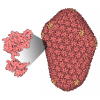
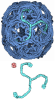
- Assembly
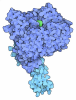
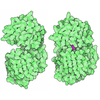
| Deposited unit | 
|
|---|---|
| 1 |
|
-Components
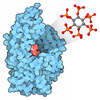
| #1: Protein | Mass: 21689.488 Da / Num. of mol.: 18 Source method: isolated from a genetically manipulated source Source: (gene. exp.) Human T-cell leukemia virus type I / Strain: B1033-2009 / Gene: gag / Cell line (production host): 293T / Production host:  Homo sapiens (human) / References: UniProt: Q82230 Homo sapiens (human) / References: UniProt: Q82230#2: Chemical | ChemComp-IHP / | 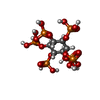 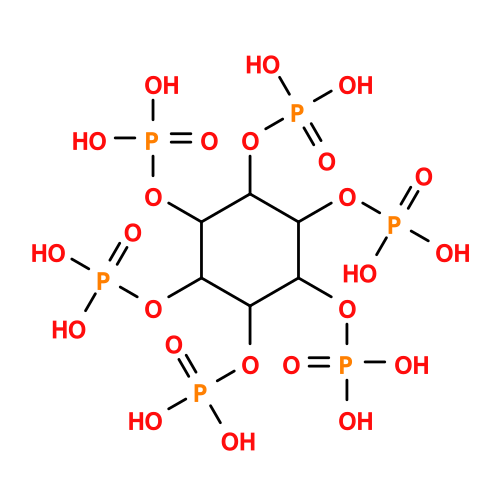 Mass: 660.035 Da / Num. of mol.: 1 / Source method: obtained synthetically / Formula: C6H18O24P6 / Feature type: SUBJECT OF INVESTIGATION Mass: 660.035 Da / Num. of mol.: 1 / Source method: obtained synthetically / Formula: C6H18O24P6 / Feature type: SUBJECT OF INVESTIGATIONHas ligand of interest | Y | Has protein modification | N | |
|---|
-Experimental details
-Experiment
| Experiment | Method: ELECTRON MICROSCOPY |
|---|---|
| EM experiment | Aggregation state: PARTICLE / 3D reconstruction method: single particle reconstruction |
- Sample preparation
| Component | Name: Human T-cell leukemia virus type I / Type: VIRUS Details: HTLV-1 virus-like particles produced by transfecting 293T cells with HTLV-1 Gag and Envelope Entity ID: #1 / Source: RECOMBINANT |
|---|---|
| Molecular weight | Experimental value: NO |
| Source (natural) | Organism: Human T-cell leukemia virus type I / Strain: B1033-2009 |
| Source (recombinant) | Organism: Homo sapiens (human) / Cell: 293T |
| Details of virus | Empty: NO / Enveloped: YES / Isolate: STRAIN / Type: VIRUS-LIKE PARTICLE |
| Natural host | Organism: Homo sapiens |
| Buffer solution | pH: 8 / Details: 100 mM NaCl, 10 mM Tris-HCl, 1 mM EDTA |
| Specimen | Embedding applied: NO / Shadowing applied: NO / Staining applied: NO / Vitrification applied: YES Details: The virus particles were purified from the cell culture supernatant via ultracentrifugation. |
| Specimen support | Grid material: COPPER / Grid mesh size: 200 divisions/in. / Grid type: Quantifoil R2/1 |
| Vitrification | Instrument: LEICA EM GP / Cryogen name: ETHANE / Details: Leica GP2 Grid Plunger |
- Electron microscopy imaging
| Experimental equipment |  Model: Titan Krios / Image courtesy: FEI Company |
|---|---|
| Microscopy | Model: TFS KRIOS |
| Electron gun | Electron source:  FIELD EMISSION GUN / Accelerating voltage: 300 kV / Illumination mode: FLOOD BEAM FIELD EMISSION GUN / Accelerating voltage: 300 kV / Illumination mode: FLOOD BEAM |
| Electron lens | Mode: BRIGHT FIELD / Nominal defocus max: 1500 nm / Nominal defocus min: 750 nm / Cs: 2.7 mm / C2 aperture diameter: 100 µm |
| Specimen holder | Cryogen: NITROGEN / Specimen holder model: FEI TITAN KRIOS AUTOGRID HOLDER |
| Image recording | Electron dose: 50 e/Å2 / Detector mode: SUPER-RESOLUTION / Film or detector model: GATAN K2 SUMMIT (4k x 4k) / Num. of grids imaged: 1 / Num. of real images: 2502 |
| EM imaging optics | Energyfilter slit width: 20 eV |
| Image scans | Movie frames/image: 40 / Used frames/image: 1-40 |
- Processing
| EM software |
| ||||||||||||||||||||||||||||||||||||
|---|---|---|---|---|---|---|---|---|---|---|---|---|---|---|---|---|---|---|---|---|---|---|---|---|---|---|---|---|---|---|---|---|---|---|---|---|---|
| CTF correction | Type: PHASE FLIPPING AND AMPLITUDE CORRECTION | ||||||||||||||||||||||||||||||||||||
| Particle selection | Num. of particles selected: 2138437 | ||||||||||||||||||||||||||||||||||||
| Symmetry | Point symmetry: C6 (6 fold cyclic) | ||||||||||||||||||||||||||||||||||||
| 3D reconstruction | Resolution: 3.44 Å / Resolution method: FSC 0.143 CUT-OFF / Num. of particles: 140020 / Symmetry type: POINT | ||||||||||||||||||||||||||||||||||||
| Atomic model building | Protocol: FLEXIBLE FIT | ||||||||||||||||||||||||||||||||||||
| Atomic model building | Source name: AlphaFold / Type: in silico model |
