National Institutes of Health/National Institute Of Allergy and Infectious Diseases (NIH/NIAID)
R01GM151775
United States
National Institutes of Health/National Institute Of Allergy and Infectious Diseases (NIH/NIAID)
R21DE032878
United States
National Institutes of Health/National Institute Of Allergy and Infectious Diseases (NIH/NIAID)
F31AI184673
United States
National Institutes of Health/National Institute Of Allergy and Infectious Diseases (NIH/NIAID)
T32AI083196
United States
Citation
Journal: Nat Commun / Year: 2025 Title: High-resolution analysis of the human T-cell leukemia virus capsid protein reveals insights into immature particle morphology. Authors: William G Arndt / Alireza Ramezani / Nathaniel Talledge / Guichuan Yu / Huixin Yang / Bo Chen / Juan R Perilla / Wei Zhang / Louis M Mansky / Abstract: Infection with human T-cell leukemia virus type 1 (HTLV-1) can result in adult T-cell leukemia/lymphoma and HTLV-1 associated-myelopathy/tropical spastic paraparesis. The Gag polyprotein - the major ...Infection with human T-cell leukemia virus type 1 (HTLV-1) can result in adult T-cell leukemia/lymphoma and HTLV-1 associated-myelopathy/tropical spastic paraparesis. The Gag polyprotein - the major structural protein - is crucial for driving virus particle assembly, with the capsid (CA) domain as the key determinant for Gag multimerization. Here, we characterize the immature CA lattice from immature virus particles by using cryo-electron microscopy and tomography (cryo-EM/ET). We report resolving the immature CA lattice to 3.4 Å resolution by single particle analysis (SPA). Our reconstruction reveals that the lattice is stabilized through a trimeric NTD inter-hexamer interface and a dimeric CTD inter-hexamer interface. Further analysis by cryo-ET reveals clear heterogeneity, notably the varying lattice curvatures and the varying distances from the CA layer to the membrane. Intriguingly, inositol hexakisphosphate (IP6) is dispensable for HTLV-1 immature particle assembly and proper immature lattice formation. These observations provide deeper insights into the molecular basis of HTLV-1 immature particle morphology as well as aid in revealing therapeutic targets.
Supramolecule #1: Human T-cell leukemia virus type I
Supramolecule
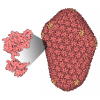
Name: Human T-cell leukemia virus type I / type: virus / ID: 1 / Parent: 0 / Macromolecule list: all Details: HTLV-1 virus-like particles produced by transfecting 293T cells with HTLV-1 Gag and Envelope. NCBI-ID: 11908 / Sci species name: Human T-cell leukemia virus type I / Sci species strain: B1033-2009 / Virus type: VIRUS-LIKE PARTICLE / Virus isolate: STRAIN / Virus enveloped: Yes / Virus empty: No
Host (natural)
Organism: Homo sapiens (human)
-
Macromolecule #1: Gag protein
Macromolecule
Name: Gag protein / type: protein_or_peptide / ID: 1 / Number of copies: 3 / Enantiomer: LEVO
Source (natural)
Organism: Human T-cell leukemia virus type I / Strain: B1033-2009
pH: 8 / Details: 100 mM NaCl, 10 mM Tris-HCL, 1 mM EDTA
Grid
Model: Quantifoil R2/1 / Material: COPPER / Mesh: 200 / Support film - Material: CARBON / Support film - topology: HOLEY / Pretreatment - Type: GLOW DISCHARGE / Pretreatment - Time: 30 sec. / Pretreatment - Atmosphere: AIR
Vitrification
Cryogen name: ETHANE / Instrument: LEICA EM GP / Details: Leica GP2 Grid Plunger.
Details
The virus particles were purified from the cell culture supernatant via optiprep gradient ultracentrifugation.
-
Electron microscopy
Microscope
TFS KRIOS
Specialist optics
Energy filter - Slit width: 20 eV
Image recording
Film or detector model: GATAN K2 SUMMIT (4k x 4k) / Detector mode: SUPER-RESOLUTION / Digitization - Frames/image: 1-40 / Number grids imaged: 1 / Number real images: 2502 / Average electron dose: 50.0 e/Å2
Electron beam
Acceleration voltage: 300 kV / Electron source: FIELD EMISSION GUN
In the structure databanks used in Yorodumi, some data are registered as the other names, "COVID-19 virus" and "2019-nCoV". Here are the details of the virus and the list of structure data.
Jan 31, 2019. EMDB accession codes are about to change! (news from PDBe EMDB page)
EMDB accession codes are about to change! (news from PDBe EMDB page)
The allocation of 4 digits for EMDB accession codes will soon come to an end. Whilst these codes will remain in use, new EMDB accession codes will include an additional digit and will expand incrementally as the available range of codes is exhausted. The current 4-digit format prefixed with “EMD-” (i.e. EMD-XXXX) will advance to a 5-digit format (i.e. EMD-XXXXX), and so on. It is currently estimated that the 4-digit codes will be depleted around Spring 2019, at which point the 5-digit format will come into force.
The EM Navigator/Yorodumi systems omit the EMD- prefix.
Related info.:Q: What is EMD? / ID/Accession-code notation in Yorodumi/EM Navigator
Yorodumi is a browser for structure data from EMDB, PDB, SASBDB, etc.
This page is also the successor to EM Navigator detail page, and also detail information page/front-end page for Omokage search.
The word "yorodu" (or yorozu) is an old Japanese word meaning "ten thousand". "mi" (miru) is to see.
Related info.:EMDB / PDB / SASBDB / Comparison of 3 databanks / Yorodumi Search / Aug 31, 2016. New EM Navigator & Yorodumi / Yorodumi Papers / Jmol/JSmol / Function and homology information / Changes in new EM Navigator and Yorodumi
 Movie
Movie Controller


 Open data
 Basic information
 Map data
 Sample
 Keywords
 Function and homology information
 Human T-cell leukemia virus type I
 Authors
 United States, 4 items
  Citation
 Structure visualization
 Downloads & links
 emd_48796.png
 https://data.pdbj.org/pub/emdb/structures/EMD-48796


 Z (Sec.)
 Y (Row.)
 X (Col.)


 Sample components
 Homo sapiens (human)
 Processing
 Electron microscopy
 FIELD EMISSION GUN

