[English] 日本語
Yorodumi
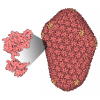
- EMDB-48795: Subtomogram averaging of HTLV-1 Gag capsid from immature particles -

+
Open data


ID or keywords:

Loading...

-
Basic information

Entry
Database: EMDB / ID: EMD-48795
TitleSubtomogram averaging of HTLV-1 Gag capsid from immature particles
Map dataFinal map after RELION postprocessing.
SampleHTLV-1 != Human T-cell leukemia virus type I

HTLV-1

  • Virus: Human T-cell leukemia virus type I
    • Protein or peptide: HTLV-1 Gag Capsid
KeywordsLattice / capsid / VIRAL PROTEIN
Function / homology
Function and homology information


viral nucleocapsid / nucleic acid binding / viral translational frameshifting / structural molecule activity / zinc ion binding
Similarity search - Function
Delta-retroviral matrix protein / Major core protein p19 / : / gag protein p24 N-terminal domain / Retroviral nucleocapsid Gag protein p24, C-terminal domain / Gag protein p24 C-terminal domain / Retrovirus capsid, C-terminal / Retroviral matrix protein / Retrovirus capsid, N-terminal / zinc finger ...Delta-retroviral matrix protein / Major core protein p19 / : / gag protein p24 N-terminal domain / Retroviral nucleocapsid Gag protein p24, C-terminal domain / Gag protein p24 C-terminal domain / Retrovirus capsid, C-terminal / Retroviral matrix protein / Retrovirus capsid, N-terminal / zinc finger / Zinc knuckle / Zinc finger, CCHC-type superfamily / Zinc finger, CCHC-type / Zinc finger CCHC-type profile.
Similarity search - Domain/homology
Biological speciesHuman T-cell leukemia virus type I
Methodsubtomogram averaging / cryo EM / Resolution: 7.82 Å
AuthorsArndt WG / Zhang W / Mansky LM
Funding support United States, 4 items
OrganizationGrant numberCountry
National Institutes of Health/National Institute Of Allergy and Infectious Diseases (NIH/NIAID)R01GM151775 United States
National Institutes of Health/National Institute Of Allergy and Infectious Diseases (NIH/NIAID)R21DE032878 United States
National Institutes of Health/National Institute Of Allergy and Infectious Diseases (NIH/NIAID)F31AI184673 United States
National Institutes of Health/National Institute Of Allergy and Infectious Diseases (NIH/NIAID)T32AI083196 United States
CitationJournal: Nat Commun / Year: 2025
Title: High-resolution analysis of the human T-cell leukemia virus capsid protein reveals insights into immature particle morphology.
Authors: William G Arndt / Alireza Ramezani / Nathaniel Talledge / Guichuan Yu / Huixin Yang / Bo Chen / Juan R Perilla / Wei Zhang / Louis M Mansky /
Abstract: Infection with human T-cell leukemia virus type 1 (HTLV-1) can result in adult T-cell leukemia/lymphoma and HTLV-1 associated-myelopathy/tropical spastic paraparesis. The Gag polyprotein - the major ...Infection with human T-cell leukemia virus type 1 (HTLV-1) can result in adult T-cell leukemia/lymphoma and HTLV-1 associated-myelopathy/tropical spastic paraparesis. The Gag polyprotein - the major structural protein - is crucial for driving virus particle assembly, with the capsid (CA) domain as the key determinant for Gag multimerization. Here, we characterize the immature CA lattice from immature virus particles by using cryo-electron microscopy and tomography (cryo-EM/ET). We report resolving the immature CA lattice to 3.4 Å resolution by single particle analysis (SPA). Our reconstruction reveals that the lattice is stabilized through a trimeric NTD inter-hexamer interface and a dimeric CTD inter-hexamer interface. Further analysis by cryo-ET reveals clear heterogeneity, notably the varying lattice curvatures and the varying distances from the CA layer to the membrane. Intriguingly, inositol hexakisphosphate (IP6) is dispensable for HTLV-1 immature particle assembly and proper immature lattice formation. These observations provide deeper insights into the molecular basis of HTLV-1 immature particle morphology as well as aid in revealing therapeutic targets.
History
DepositionJan 24, 2025-
Header (metadata) releaseDec 24, 2025-
Map releaseDec 24, 2025-
UpdateDec 24, 2025-
Current statusDec 24, 2025Processing site: RCSB / Status: Released

-
Structure visualization

Supplemental images

Downloads & links

-
Map

FileDownload / File: emd_48795.map.gz / Format: CCP4 / Size: 64 MB / Type: IMAGE STORED AS FLOATING POINT NUMBER (4 BYTES)
AnnotationFinal map after RELION postprocessing.
Projections & slices

Image control

Size
Brightness
Contrast
Others
AxesZ (Sec.)Y (Row.)X (Col.)
1.42 Å/pix.
x 256 pix.
= 363.52 Å
1.42 Å/pix.
x 256 pix.
= 363.52 Å
1.42 Å/pix.
x 256 pix.
= 363.52 Å

Surface

Projections

Slices (1/3)

Slices (1/2)

Slices (2/3)

Images are generated by Spider.

Voxel sizeX=Y=Z: 1.42 Å
Density
Contour LevelBy AUTHOR: 0.00441
Minimum - Maximum-0.006116338 - 0.014380733
Average (Standard dev.)0.0003433322 (±0.0011364527)
SymmetrySpace group: 1
Details

EMDB XML:

Map geometry
Axis orderXYZ
Origin000
Dimensions256256256
Spacing256256256
CellA=B=C: 363.52 Å
α=β=γ: 90.0 °

-
Supplemental data

-
Mask #1

Fileemd_48795_msk_1.map
Projections & Slices
AxesZYX

Projections

Slices (1/2)
Density Histograms

-
Additional map: Unsharpened map from final refinement.

Fileemd_48795_additional_1.map
AnnotationUnsharpened map from final refinement.
Projections & Slices
AxesZYX

Projections

Slices (1/2)
Density Histograms

-
Half map: Half map from final refine used for reported FSC calculation.

Fileemd_48795_half_map_1.map
AnnotationHalf map from final refine used for reported FSC calculation.
Projections & Slices
AxesZYX

Projections

Slices (1/2)
Density Histograms

-
Half map: Half map from final refine used for reported FSC calculation.

Fileemd_48795_half_map_2.map
AnnotationHalf map from final refine used for reported FSC calculation.
Projections & Slices
AxesZYX

Projections

Slices (1/2)
Density Histograms

-
Sample components

-
Entire : HTLV-1

EntireName: HTLV-1
Components
  • Virus: Human T-cell leukemia virus type I
    • Protein or peptide: HTLV-1 Gag Capsid

-
Supramolecule #1: Human T-cell leukemia virus type I

SupramoleculeName: Human T-cell leukemia virus type I / type: virus / ID: 1 / Parent: 0 / Macromolecule list: all
Details: Virus particles were purified by co-transfecting in the HTLV-1 Gag and Env genes.
NCBI-ID: 11908 / Sci species name: Human T-cell leukemia virus type I / Sci species strain: B1033-2009 / Virus type: VIRUS-LIKE PARTICLE / Virus isolate: STRAIN / Virus enveloped: Yes / Virus empty: No
Host (natural)Organism: Homo sapiens (human)

-
Macromolecule #1: HTLV-1 Gag Capsid

MacromoleculeName: HTLV-1 Gag Capsid / type: protein_or_peptide / ID: 1 / Enantiomer: LEVO
Source (natural)Organism: Human T-cell leukemia virus type I / Strain: B1033-2009
Recombinant expressionOrganism: Homo sapiens (human)
SequenceString: MGQIFSRSAS PIPRPPRGLA AHHWLNFLQA AYRLEPGPSS YDFHQLKKFL KIALETPVWI CPINYSLLAS LLPKGYPGRV NEILHILIQT QAQIPSRPAP PPPSSPTHDP PDSDPQIPPP YVEPTAPQVL PVMHPHGAPP NHRPWQMKDL QAIKQEVSQA APGSPQFMQT ...String:
MGQIFSRSAS PIPRPPRGLA AHHWLNFLQA AYRLEPGPSS YDFHQLKKFL KIALETPVWI CPINYSLLAS LLPKGYPGRV NEILHILIQT QAQIPSRPAP PPPSSPTHDP PDSDPQIPPP YVEPTAPQVL PVMHPHGAPP NHRPWQMKDL QAIKQEVSQA APGSPQFMQT IRLAVQQFDP TAKDLQDLLQ YLCSSLVASL HHQQLDSLIS EAETRGITGY NPLAGPLRVQ ANNPQQQGLR REYQQLWLAA FAALPGSAKD PSWASILQGL EEPYHAFVER LNIALDNGLP EGTPKDPILR SLAYSNANKE CQKLLQARGH TNSPLGDMLR ACQTWTPKDK TKVLVVQPKK PPPNQPCFRC GKAGHWSRDC TQPRPPPGPC PLCQDPTHWK RDCPRLKPTI PEPEPEEDAL LLDLPADIPH PKNSIGGEV

UniProtKB: Gag protein

-
Experimental details

-
Structure determination

Methodcryo EM
Processingsubtomogram averaging
Aggregation stateparticle

-
Sample preparation

BufferpH: 8 / Details: 100 mM NaCl, 10 mM Tris-Cl, 1 mM EDTA
GridModel: Quantifoil R2/1 / Material: COPPER / Mesh: 200 / Support film - Material: CARBON / Support film - topology: HOLEY / Pretreatment - Type: GLOW DISCHARGE / Pretreatment - Time: 30 sec. / Pretreatment - Atmosphere: AIR
VitrificationCryogen name: ETHANE / Instrument: LEICA EM GP / Details: Leica GP2 Grid Plunger.

-
Electron microscopy

MicroscopeTFS KRIOS
Specialist opticsEnergy filter - Slit width: 20 eV
Image recordingFilm or detector model: GATAN K3 (6k x 4k) / Number real images: 1 / Average electron dose: 3.0 e/Å2
Electron beamAcceleration voltage: 300 kV / Electron source: FIELD EMISSION GUN
Electron opticsC2 aperture diameter: 100.0 µm / Illumination mode: FLOOD BEAM / Imaging mode: BRIGHT FIELD / Cs: 2.7 mm / Nominal defocus max: 4.0 µm / Nominal defocus min: 2.0 µm / Nominal magnification: 64000
Sample stageSpecimen holder model: FEI TITAN KRIOS AUTOGRID HOLDER / Cooling holder cryogen: NITROGEN
Experimental equipment
Model: Titan Krios / Image courtesy: FEI Company

+
Image processing

Final reconstructionApplied symmetry - Point group: C6 (6 fold cyclic) / Resolution.type: BY AUTHOR / Resolution: 7.82 Å / Resolution method: FSC 0.143 CUT-OFF / Software - Name: RELION (ver. 4.0.1_cu11.6) / Number subtomograms used: 12699
ExtractionNumber tomograms: 9 / Number images used: 41841 / Software - Name: Dynamo (ver. 1.1.532)
Details: Surface of each virus particle was modeled as a sphere and coordinates were assigned evenly along the sphere surface.
CTF correctionSoftware - Name: CTFFIND (ver. 4.1.14.c7) / Type: PHASE FLIPPING AND AMPLITUDE CORRECTION
Final angle assignmentType: MAXIMUM LIKELIHOOD / Software - Name: RELION (ver. 4.0.1_cu11.6)
FSC plot (resolution estimation)

+
About Yorodumi

-
News

-
Feb 9, 2022. New format data for meta-information of EMDB entries

New format data for meta-information of EMDB entries

  • Version 3 of the EMDB header file is now the official format.
  • The previous official version 1.9 will be removed from the archive.

Related info.:EMDB header

External links:wwPDB to switch to version 3 of the EMDB data model

-
Aug 12, 2020. Covid-19 info

Covid-19 info

URL: https://pdbj.org/emnavi/covid19.php

New page: Covid-19 featured information page in EM Navigator.

Related info.:Covid-19 info / Mar 5, 2020. Novel coronavirus structure data

+
Mar 5, 2020. Novel coronavirus structure data

Novel coronavirus structure data

Related info.:Yorodumi Speices / Aug 12, 2020. Covid-19 info

External links:COVID-19 featured content - PDBj / Molecule of the Month (242):Coronavirus Proteases

+
Jan 31, 2019. EMDB accession codes are about to change! (news from PDBe EMDB page)

EMDB accession codes are about to change! (news from PDBe EMDB page)

  • The allocation of 4 digits for EMDB accession codes will soon come to an end. Whilst these codes will remain in use, new EMDB accession codes will include an additional digit and will expand incrementally as the available range of codes is exhausted. The current 4-digit format prefixed with “EMD-” (i.e. EMD-XXXX) will advance to a 5-digit format (i.e. EMD-XXXXX), and so on. It is currently estimated that the 4-digit codes will be depleted around Spring 2019, at which point the 5-digit format will come into force.
  • The EM Navigator/Yorodumi systems omit the EMD- prefix.

Related info.:Q: What is EMD? / ID/Accession-code notation in Yorodumi/EM Navigator

External links:EMDB Accession Codes are Changing Soon! / Contact to PDBj

+
Jul 12, 2017. Major update of PDB

Major update of PDB

  • wwPDB released updated PDB data conforming to the new PDBx/mmCIF dictionary.
  • This is a major update changing the version number from 4 to 5, and with Remediation, in which all the entries are updated.
  • In this update, many items about electron microscopy experimental information are reorganized (e.g. em_software).
  • Now, EM Navigator and Yorodumi are based on the updated data.

External links:wwPDB Remediation / Enriched Model Files Conforming to OneDep Data Standards Now Available in the PDB FTP Archive

-
Yorodumi

Thousand views of thousand structures

  • Yorodumi is a browser for structure data from EMDB, PDB, SASBDB, etc.
  • This page is also the successor to EM Navigator detail page, and also detail information page/front-end page for Omokage search.
  • The word "yorodu" (or yorozu) is an old Japanese word meaning "ten thousand". "mi" (miru) is to see.

Related info.:EMDB / PDB / SASBDB / Comparison of 3 databanks / Yorodumi Search / Aug 31, 2016. New EM Navigator & Yorodumi / Yorodumi Papers / Jmol/JSmol / Function and homology information / Changes in new EM Navigator and Yorodumi

Read more